IN Brief:
- Atmos Renewables has reached financial close on the 400MW/1,600MWh Teebar BESS and 470MW Parron Maam Marang wind farm.
- Teebar will connect beside Powerlink’s Teebar Creek substation and is designed for four hours of full-power storage.
- Parron Maam Marang has a long-term PPA with Synergy and could use up to 78 wind turbines across its Wheatbelt site.
Atmos Renewables has reached financial close on two Australian power projects totalling 870MW: the 400MW/1,600MWh Teebar battery in Queensland and the 470MW Parron Maam Marang wind farm in Western Australia.
Both projects are supported through the Australian Government’s Capacity Investment Scheme, but they will operate in separate electricity systems and use different technologies. Financial close puts funding in place for construction after earlier development, grid, offtake and scheme-award milestones.
Teebar combines 400MW of charge and discharge power with 1.6GWh of stored energy, giving the battery four hours of operation at full rated output. It will be built beside Powerlink’s Teebar Creek substation in Queensland’s Fraser Coast region, around 60km west of Maryborough.
The project is planned to connect to the National Electricity Market through a new 275kV bay at the existing substation. Current Australian Industry Participation documentation describes a 33/275kV project substation, 464 battery units, 136 power conversion units and 20 auxiliary transformers.
Wärtsilä Energy Storage has been selected as battery system supplier, while Atmos signed an early contractor involvement agreement with Enerven for the balance-of-plant works.
The power conversion systems provide the bidirectional interface between the DC battery cells and the AC network. During charging they convert grid electricity into controlled DC power, while discharge reverses the process before transformers raise the output through the project network towards the 275kV connection.
Teebar’s four-hour duration allows the 400MW grid connection to move up to 1.6GWh between different periods without increasing its maximum instantaneous output. The battery can therefore absorb energy over an extended period before delivering sustained power later, while retaining the rapid response characteristics associated with power electronic conversion.
Thermal management and control systems will govern how the battery performs over repeated cycles. Cell temperature, state of charge, degradation and converter limits all affect the power and energy available at a particular point in the project’s operating life.
Commercial operation is targeted for the second quarter of 2028. The approximately ten-hectare site will contain the battery blocks, conversion equipment, electrical balance of plant, project substation and operations infrastructure required to connect the system to Powerlink.
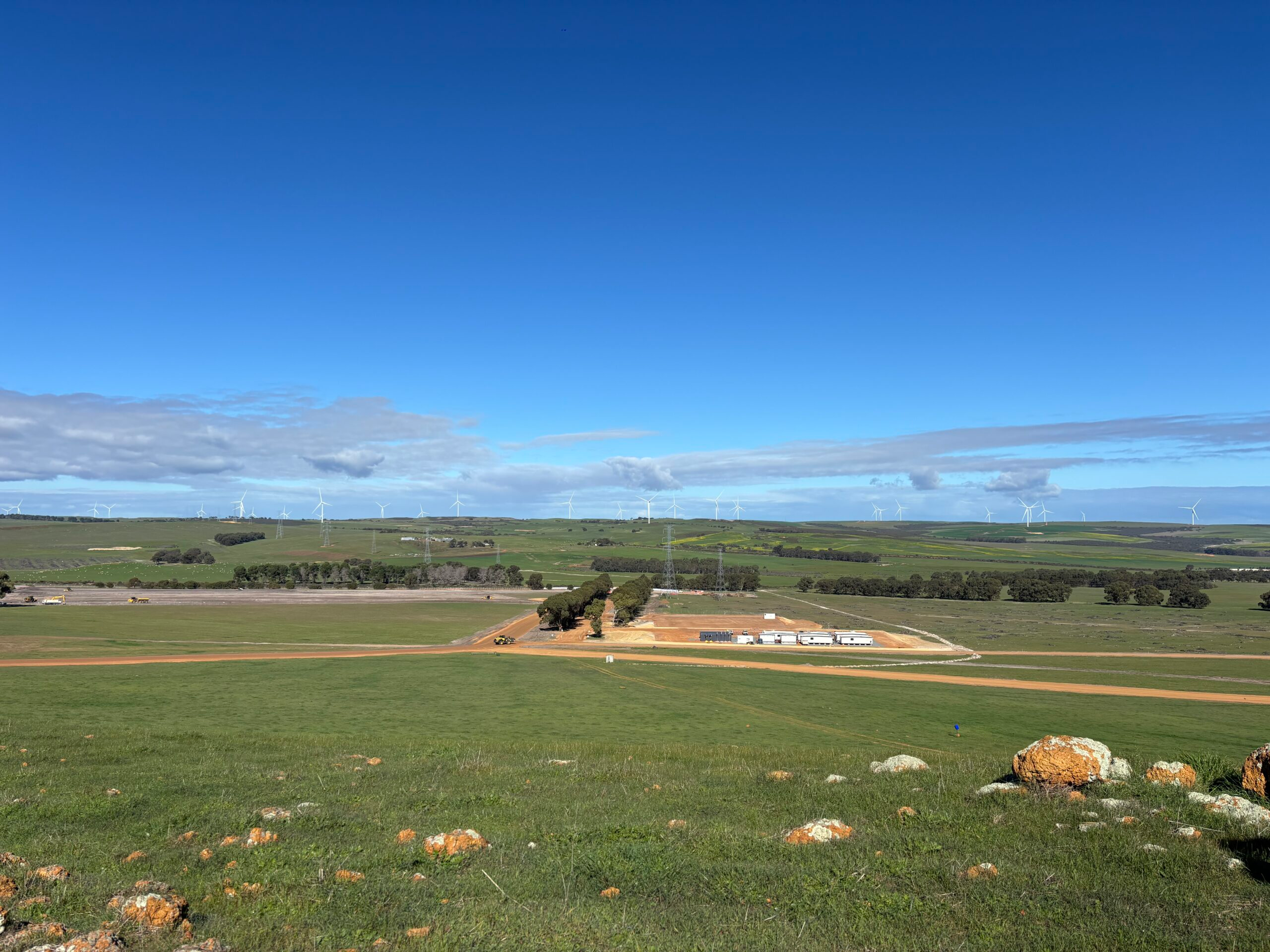
Parron Maam Marang adds generation rather than storage. The planned wind farm lies in Western Australia’s Wheatbelt, around 200km north of Perth, across approximately 8,400 hectares of agricultural land.
The development has a stated capacity of about 470MW and could contain up to 78 turbines. Final turbine selection will determine the relationship between unit rating and machine count before construction.
A long-term power purchase agreement with state-owned retailer Synergy provides the project with an offtake arrangement. Western Australian parliamentary records show that the agreement was executed in March 2026 following an earlier procurement process.
Unlike Teebar, Parron Maam Marang will not operate in the National Electricity Market. Western Australia’s South West Interconnected System is electrically separate from the eastern states, so its generation, transmission and market arrangements are managed within a different grid.
The two projects therefore address different system requirements. Parron Maam Marang adds variable wind generation, while Teebar adds controllable capacity able to absorb and release electricity according to system and market conditions.
Neither project can rely on the Capacity Investment Scheme award alone to reach operation. Grid connection work, equipment procurement, financing, civil construction and commissioning still determine whether the contracted capacity becomes physically available to the system.
Financial close marks the point at which Atmos and owner Igneo Infrastructure Partners have put the capital structure in place for that delivery. They intend to retain ownership through construction and operation rather than sell the projects after development.
Teebar follows the 100MW/400MWh Merredin battery in Western Australia, which reached financial close in June 2025. Across those three Capacity Investment Scheme projects, Atmos has now taken 970MW of wind and storage capacity through financing.
The next construction stages differ sharply between the projects. Teebar must move through battery supply, power conversion installation, 33/275kV substation construction and connection to Teebar Creek, while Parron Maam Marang requires turbine foundations, roads, electrical collection systems, substations and grid connection across a far larger site.
Between them, the projects add 400MW of four-hour battery capability and 470MW of wind generation to Atmos’s Australian pipeline, with financing now in place to move both into their principal construction programmes.