IN Brief:
- ABB E-mobility has launched the OM X-Series for megawatt-scale continuous-duty EV charging.
- The architecture scales from 800kW to 10MW across more than 100 chargepoints.
- The system uses a site-level DC bus, liquid-cooled silicon carbide modules, and direct battery storage integration.
ABB E-mobility has launched the OM X-Series, a distributed EV charging architecture for high-duty fleet, depot, logistics, and corridor applications.
The system scales from 800kW to 10MW across more than 100 chargepoints. It is built for locations where charging infrastructure must operate continuously under sustained load, rather than deliver occasional high-power charging sessions.
The base configuration uses two 800kW cabinets connected through a DC bus, supporting up to 24 charging outputs and direct battery energy storage integration. The architecture separates power conversion into multiple stages, allowing operators to expand site capacity without simply adding standalone chargers in a way that can overload the connection or complicate control.
The OM X-Series uses a site-level DC bus to distribute power across the charging system in real time. Its power conversion system uses liquid-cooled silicon carbide modules, while liquid-cooled power modules and cables support continuous high utilisation. ABB E-mobility puts conversion efficiency at more than 98% under continuous operating conditions.
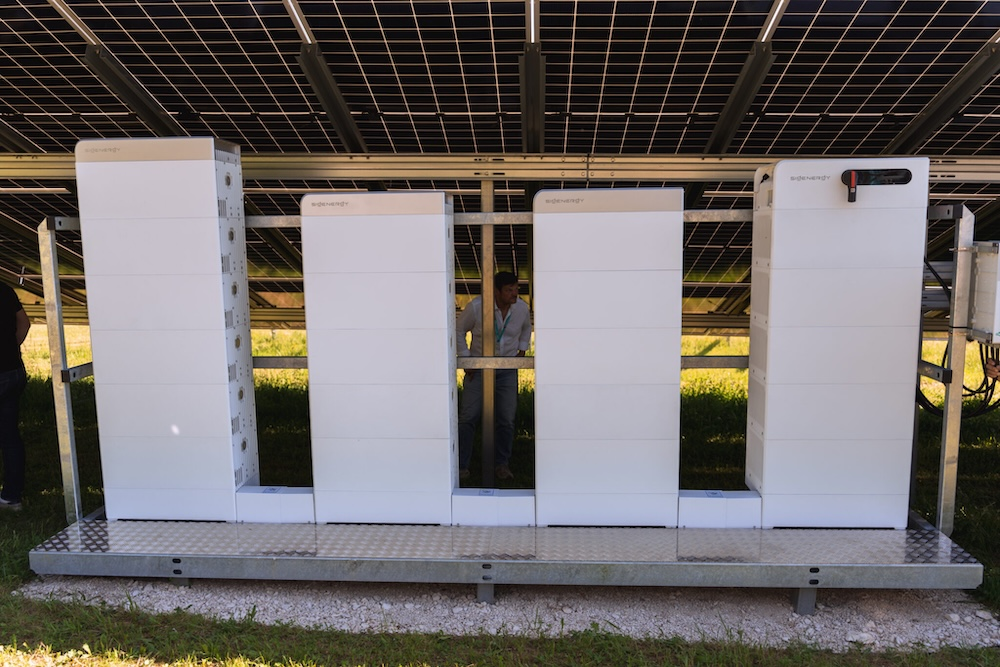
Battery storage can be connected directly to the DC bus. That arrangement can reduce conversion losses compared with AC-coupled storage and allows storage to support peak shaving, demand management, and power distribution across the site. The architecture also gives operators a clearer expansion route as fleet sizes, charging windows, or dwell patterns change.
High-power EV charging is becoming a major electrical infrastructure category in its own right. Depot electrification for buses, vans, and HGVs can require substantial capacity at single sites, often in industrial or urban locations where grid headroom is limited. Public charging corridors face similar constraints when multiple ultra-rapid chargers are expected to operate with high availability and short dwell times.
UK charging infrastructure is already moving into larger site formats. B&Q and RAW Charging are rolling out ultra-rapid EV hubs across retail locations where grid upgrades and high-voltage connections may be required. ABB E-mobility’s architecture addresses the next stage of site design, where charging capacity, storage, load control, and thermal management are engineered as a single electrical system.
Peak rating and continuous duty now sit apart in charging design. A charger can carry a high maximum output, but depot and logistics sites are judged by how reliably they can sustain high utilisation over long operating windows. Thermal stability, conversion losses, maintenance access, cable management, uptime, and power sharing all affect site economics once charging demand becomes continuous.
Megawatt-scale charging also changes the relationship between the site and the grid connection. A 10MW charging installation is a major electrical load requiring coordination with incoming supply, protection settings, transformer capacity, harmonic performance, controls, metering, and connection agreements.
Direct storage integration gives operators more control, while adding further engineering requirements. Batteries need space, fire safety design, thermal management, grid import capacity, and control logic. The site must determine when to charge storage, when to discharge, how to allocate power between vehicles, and how to avoid creating new peaks once storage has been depleted.
The OM X-Series sits within a wider movement from charger procurement toward site power architecture. As fleet electrification scales, the limiting factor is often the quality of the electrical design around the chargers. High-power charging sites are becoming managed power assets, requiring resilience, controllability, maintainability, and lifecycle efficiency alongside charger output.