IN Brief:
- CATL introduced its 9MWh TENER+ utility-scale battery system at All Energy Australia 2026, alongside its TENER Sodium platform.
- TENER+ has a stated 25-year design life, with CATL claiming up to 40% fewer containers and a 12% smaller project footprint.
- Three memorandums of understanding cover power conversion with Hitachi Energy, grid integration with EPEC Group and ESVL, and training with UNSW Sydney.
CATL has launched its 9MWh TENER+ battery energy storage system at All Energy Australia 2026 in Melbourne, alongside three agreements intended to support utility-scale battery delivery and electricity network integration. The company presented the higher-capacity containerised system on 28 October, with partnerships involving Hitachi Energy, EPEC Group and UNSW Sydney covering equipment integration, technical validation and engineering skills.
TENER+ provides a nominal energy storage capacity of 9MWh within a single system configuration. CATL states that its higher energy density can reduce the number of containers required for a project by up to 40%, with a corresponding reduction of 12% in the overall project footprint against the manufacturer’s reference arrangement. The potential savings depend on the final storage capacity and equipment layout selected for each site.
The 9MWh figure measures energy capacity rather than electrical power output. Maximum charging and discharging power depends on the associated power conversion system and the operating limits of the batteries. Those specifications determine how quickly stored electricity can be transferred and the duration for which the installation can deliver a specified electrical output.
A completed battery project also requires transformers, switchgear, protection systems, controls and connections to the electricity network. Increasing energy capacity within individual containers can reduce the number of units required, but the layout of that supporting equipment still affects the total land area. Electrical clearances, access routes, cooling requirements and site safety arrangements must be accommodated within the design.
CATL has specified a 25-year design life for TENER+, supported by liquid cooling and equipment protection intended for humid and coastal environments. Long-term performance will depend on operating temperature, charging and discharge rates, equipment maintenance and the number of cycles completed. The design specification establishes the manufacturer’s intended service life rather than a measured result from an installation that has already operated for that period.
Liquid cooling transfers heat away from battery cells during operation, helping maintain temperatures within the equipment’s specified limits. Charging and discharging produce heat within the cells and electrical connections, while high ambient temperatures increase the demands on the cooling system. The thermal management equipment also consumes auxiliary electricity, which contributes to the difference between energy supplied during charging and energy returned during discharge.
The TENER+ enclosure incorporates an upward exhaust arrangement intended to direct heated air away from neighbouring equipment. CATL describes the configuration as reducing the accumulation of hot air near adjacent power conversion systems during high-temperature operation. The actual thermal performance of a completed site will depend on equipment spacing, airflow, ambient conditions and the configuration of the installed cooling systems.
CATL also specifies an operating noise level below 65dBA at a distance of one metre for the storage system. That figure relates to the stated measurement conditions and does not establish the acoustic performance at the boundary of an entire battery development. Inverters, transformers and other plant equipment can contribute additional noise, requiring assessment of the complete installation where acoustic limits apply.
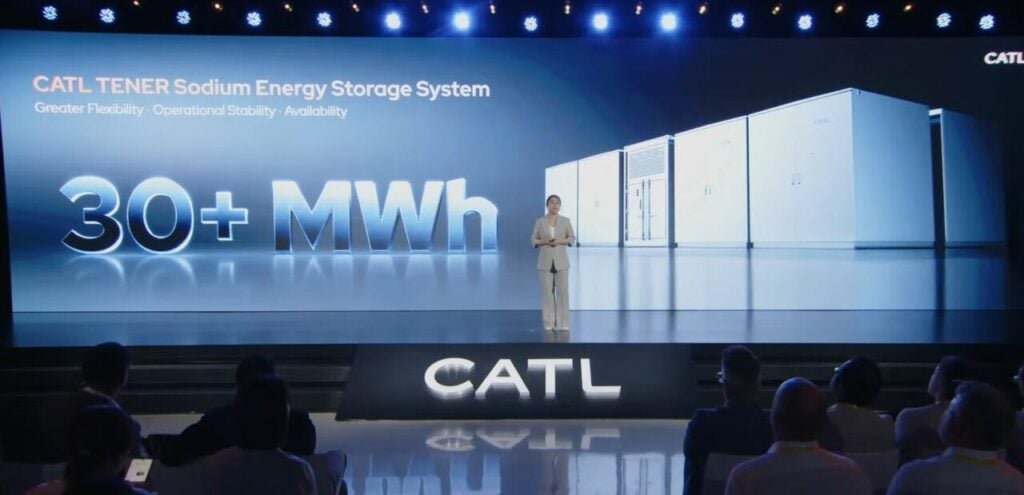
The company demonstrated TENER Sodium alongside the new product. This sodium-ion platform uses a modular cabinet arrangement designed to provide more than 30MWh of storage capacity at system level. CATL describes it as a mass-produced, field-validated system, extending its utility-scale offering beyond conventional lithium-ion equipment.
For TENER Sodium, CATL claims operation at ambient temperatures up to 55°C, more than 10,000 cycles at 45°C and round-trip efficiency of 95%, with a design life exceeding 20 years. These are manufacturer performance specifications rather than independently established results for the Australian projects covered by the new agreements. Actual energy delivery and equipment ageing will depend on the installation and its operating duty.
Using sodium-ion chemistry creates a different material basis for battery production because sodium is more geographically widespread than lithium. The technology also has different energy density and performance characteristics. Selection between battery chemistries depends on the required storage capacity, operating environment, project cost and the electrical services the installation is intended to provide.
CATL’s agreement with Hitachi Energy will examine an integrated offering combining CATL’s direct-current battery equipment with Hitachi Energy’s power conversion systems. The companies intend the arrangement to support projects in Australia and the wider Asia-Pacific region, with a focus on equipment compatibility and reducing integration work during project delivery.
Battery containers store electrical energy as direct current, while utility electricity networks operate with alternating current. The power conversion system manages charging and discharge between those arrangements, controlling active and reactive power at the grid connection. Its control characteristics also affect how the installation responds to changes in network voltage and frequency.
Combining equipment from separate manufacturers requires agreement on electrical ratings, communication protocols, protection functions and the exchange of operating limits. The battery management system must communicate available energy and permissible current to the plant controller, while the converter responds to network instructions within those restrictions. Incompatible settings can constrain output even where individual components meet their own specifications.
The proposed Hitachi Energy collaboration will address those interfaces before equipment is deployed in specific project configurations. Standardised designs can reduce repeated engineering work, although each connection still requires assessment against the relevant network operator’s technical requirements. Those assessments may include power system modelling, protection coordination and demonstration of the required inverter behaviour.
A separate agreement with EPEC Group and the Xiamen Energy Storage Validation Research Institute (ESVL) will combine CATL’s storage technology with local grid integration engineering and full-scale system validation. The parties aim to improve the testing and technical evidence available for Australian storage developments before they move through connection approval and commissioning.
Australia’s transmission and distribution networks impose technical requirements on connecting battery installations, including their response to faults and other electrical disturbances. Demonstrating compliance requires suitable equipment models and testing of the installed control systems. Grid-forming operation, where specified, involves converters contributing to voltage and frequency control rather than relying solely on an existing network waveform.
The ability to provide those functions depends on converter design, control settings and available battery power and energy. A 9MWh capacity rating alone does not establish that a storage system can deliver a particular network support service. The engineering and validation work proposed with Hitachi Energy, EPEC Group and ESVL will help define the equipment configurations needed for individual applications.
CATL has also signed a memorandum of understanding with UNSW Sydney to develop the Centre for Integrated Renewable Energy Training and Innovation in Western Sydney. The proposed centre will focus initially on skills development for battery energy storage technologies, technology demonstrations and collaborative research, bringing educational activity together with industrial storage engineering.
Training will need to cover the interfaces between batteries, power conversion equipment, protection systems and electricity networks. Installation and commissioning personnel must understand the relevant electrical safety requirements, while engineers working on grid integration require capabilities in system modelling, control settings and compliance testing. The university partnership is intended to contribute to those skills as Australian storage deployment expands.
The agreements build on CATL’s existing activities in Australia, including its selection as technology partner for Birdwood Energy’s proposed Baranduda Electrical Energy Reserve near Wodonga in Victoria. That project is rated at 400MW/1,860MWh and is separate from the new TENER+ launch and the three collaboration agreements.
The memorandums establish areas for future technical and educational work but do not constitute completed supply contracts for new installations. CATL’s immediate development is the introduction of the 9MWh TENER+ product and the establishment of partnerships covering the equipment, engineering verification and skills needed to deploy utility-scale storage. Specific integrated designs will require further definition and validation before they can be used in commercial projects.