IN Brief:
- HD Hyundai Heavy Industries has signed the main contract for Taean Wind Power’s 500MW offshore substation.
- The scope covers engineering, procurement, fabrication, installation and commissioning following earlier design and preferred-supplier agreements.
- The fixed-bottom Taean wind farm is planned around 30km offshore and is targeting commercial operation in late 2029.
HD Hyundai Heavy Industries has signed the main contract to engineer, procure, fabricate, install and commission the offshore substation for the 500MW Taean offshore wind project in South Korea.
The EPCIC award follows a preliminary design contract signed in March and preferred-supplier status agreed in July. HD Hyundai now moves from front-end engineering into delivery of the complete substation package.
Taean Wind Power is developing the fixed-bottom wind farm around 30km off Taean County in South Chungcheong Province. The project is backed by Vena Energy, Copenhagen Infrastructure Partners and Korea Western Power, with commercial operation targeted for late 2029.
The offshore substation will collect electricity from the turbine array and transform it for transmission towards shore. Power from individual turbines arrives through the array cable network before passing through the substation’s transformers, switchgear, protection and control systems into the export connection.
Raising voltage reduces the current required to transmit a given amount of power. Because resistive losses increase with the square of current, stepping the collected output up before export allows the project to move hundreds of megawatts over offshore cables more efficiently and with practical conductor sizes.
The detailed equipment schedule has not been published with the contract announcement, so the final export voltage, transformer ratings and switchgear configuration remain undisclosed. The 500MW project capacity nevertheless establishes the scale of power that the platform and its electrical systems must handle.
Offshore substations also combine electrical and marine engineering requirements. Transformers, switchgear and control equipment have to be integrated into a structure capable of transport, lifting, offshore installation and long-term operation in a corrosive environment with constrained maintenance access.
Those interfaces are being addressed within a single EPCIC scope. Engineering determines the electrical and structural configuration before specialist equipment is procured and integrated during fabrication, followed by offshore installation, cable connection, testing and commissioning.
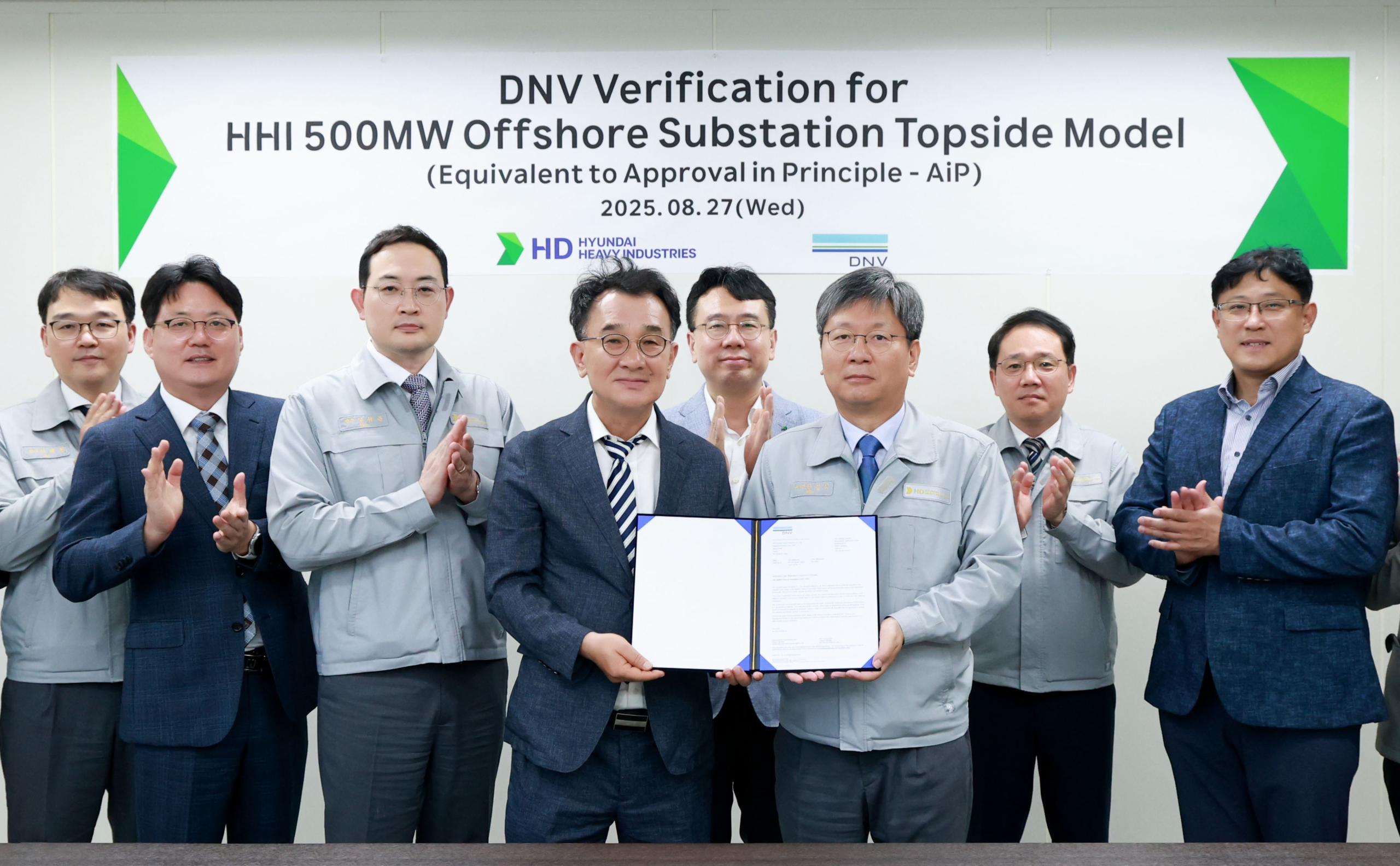
HD Hyundai has already taken the design through independent verification. DNV granted basic design approval to the company’s internally developed 500MW offshore substation model in 2025, followed by detailed design verification in August 2026.
The company says the later review made Taean the first South Korean offshore substation project to receive international verification of its detailed design suitability and safety against the relevant global standards. Completing that review before full fabrication reduces the amount of fundamental design work left unresolved once manufacturing begins.
The electrical package sits within a wider wind farm supply chain that has already begun taking shape. LS Cable & System was selected as preferred supplier for the submarine cable package, while the project has also secured long-term power purchase agreements covering its complete 500MW output.
Korea Western Power has agreed to purchase 300MW and Gangneung Eco Power another 200MW. Those arrangements followed Taean’s selection in South Korea’s 2024 Wind Power Fixed-Price Contract Auction.
Cable and substation programmes have to remain closely aligned because the offshore platform becomes the junction between array generation and the export system. Completed turbines cannot export full output if either the collection cables, substation or onward connection remain unavailable.
Protection coordination is similarly spread across several packages. Faults within an individual turbine, array cable, transformer or export circuit must be isolated without unnecessarily removing healthy parts of the wind farm, requiring compatible settings and communications across equipment supplied by different contractors.
The substation’s auxiliary systems must also remain available while the wind farm is operating. Cooling, control power, fire protection, communications and monitoring support the primary electrical equipment and need to function reliably despite the platform’s offshore location.
Construction of the wider wind farm has been targeted to begin during the second half of 2026. Signing the main substation contract now allows detailed procurement and fabrication to advance alongside foundations, turbines, cables and onshore connection work.
HD Hyundai intends to use Taean as a reference for further offshore wind work with the project partners. Before then, the 500MW substation must progress through manufacture, integration, offshore installation and commissioning in time for the wind farm’s planned late-2029 operation.