IN Brief:
- Schneider Electric has moved protection, control, monitoring, and related functions into a software-configurable medium-voltage architecture.
- Its reference design claims up to three-times faster ordering and manufacturing and up to twice as fast commissioning.
- The architecture is already being piloted with Equinix in a live colocation data centre.
Schneider Electric has introduced software-defined medium-voltage switchgear for data centres, moving protection, control, monitoring, and operational functions away from project-specific hardwired devices and into a standardised software-configurable architecture.
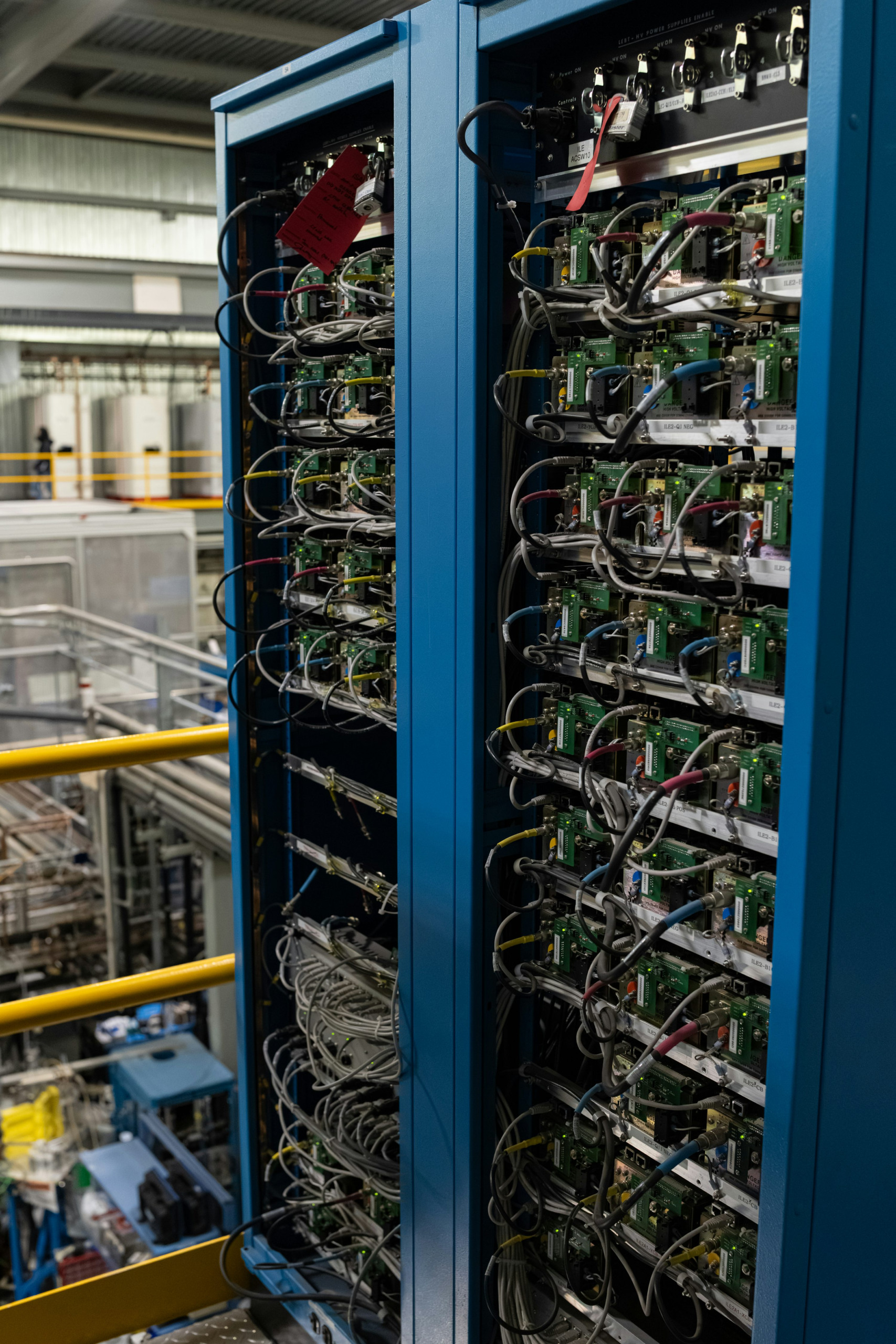
The company says the approach can cut ordering and manufacturing lead time by up to three times and commissioning time by up to two times compared with conventional engineered-to-order medium-voltage switchgear. A 20-panel reference comparison in Schneider Electric’s supporting material also reports 87% less control wiring, 91% fewer terminals, and 85% less copper in that wiring.
Those figures are vendor claims rather than independently measured industry benchmarks, but they show where Schneider expects the design to remove complexity. The architecture replaces several dedicated hardware functions with a standardised merging unit and virtualised functions, allowing protection relays, meters, transducers, gateways, programmable controllers, and control modules to be consolidated.
At system level, the change is intended to move medium-voltage distribution from an engineer-to-order model towards configure-to-order equipment. Physical switchgear can be standardised earlier, while site-specific functionality is applied through software later in the delivery process. For operators building repeated data centre blocks, that could reduce the amount of bespoke design embedded in every switchboard lineup.
The architecture has already moved beyond a laboratory demonstration. Schneider says it is being piloted with Equinix in a live colocation data centre environment. That deployment is significant because medium-voltage equipment in an operating facility has to coexist with real protection requirements, maintenance procedures, fault response, and uptime expectations rather than simply demonstrate software functionality on a test rig.
Data centre developers are particularly sensitive to electrical lead times because computing capacity can be deployed faster than utility connections, substations, switchgear, transformers, and backup systems. High-density AI infrastructure has intensified that mismatch, with operators seeking standardised power blocks that can be repeated across regions while still meeting local electrical codes and network requirements.
Software-defined switchgear addresses only part of that constraint. Busbars, interrupters, insulation systems, cable terminations, earthing arrangements, thermal limits, and short-circuit ratings remain physical characteristics of the installed equipment. Software cannot increase a panel beyond those limits or remove the need for competent installation, protection studies, and commissioning.
The potential advantage lies in changing functions without rebuilding the control layer. Schneider’s product material says new features and configuration changes can be introduced through software, supported by digital commissioning and automated testing. That reduces the number of changes that require additional hardware or rewiring and gives operators a more consistent platform across multiple sites.
That flexibility also makes cybersecurity part of the electrical engineering problem. Moving protection and control logic into software and using Ethernet-based communications increases the importance of authentication, software integrity, access control, configuration management, segmentation, and recovery procedures. A conventional hardwired design can be cumbersome to modify, but its behaviour is also less dependent on networked software.
Standardisation could matter in factories as much as on site. Repeated custom control wiring consumes engineering time and introduces opportunities for assembly and documentation differences between projects. Reducing terminals and secondary wiring simplifies the panel build, but the benefits depend on whether the software architecture remains sufficiently robust and transparent for protection engineers, operators, and maintenance teams.
Schneider is positioning the technology as part of a broader software-defined energy strategy, in which intelligence is separated from fixed hardware so electrical infrastructure can be reconfigured through its operating life. The company is also extending its SF6-free medium-voltage portfolio for high-density data centre applications, reflecting the parallel pressure to reduce greenhouse gas use in switchgear while increasing electrical capacity.
For data centres, the immediate attraction is speed rather than novelty. A switchgear architecture that can be specified with standard hardware, configured later, and commissioned with more automated testing could reduce one element of the programme between design freeze and energisation. It does not solve transformer shortages, utility queues, or site construction, but it can remove some of the custom work inside the medium-voltage package.
The Equinix pilot will therefore be more informative than the headline percentage reductions. Operators will need to see how software updates, protection changes, fault handling, maintenance, and recovery behave over time in a live facility. If those processes remain dependable, software-defined medium-voltage equipment could move from a data centre pilot into a repeatable procurement model rather than remain a specialised technology demonstration.