IN Brief:
- Enel X will provide exclusive Capacity Market access and optimisation for participating Threefold Energy commercial batteries over five years.
- The first phase targets around 3.5MW of behind-the-meter capacity entering service within 12 months.
- Threefold's Optima controls will connect virtually with Enel X's VPP Connect platform without additional hardware at customer sites.
Enel X and Threefold Energy have signed a five-year agreement to optimise commercial battery systems across Great Britain, beginning with an estimated 3.5MW of behind-the-meter capacity that the companies aim to bring into market participation within the first 12 months.
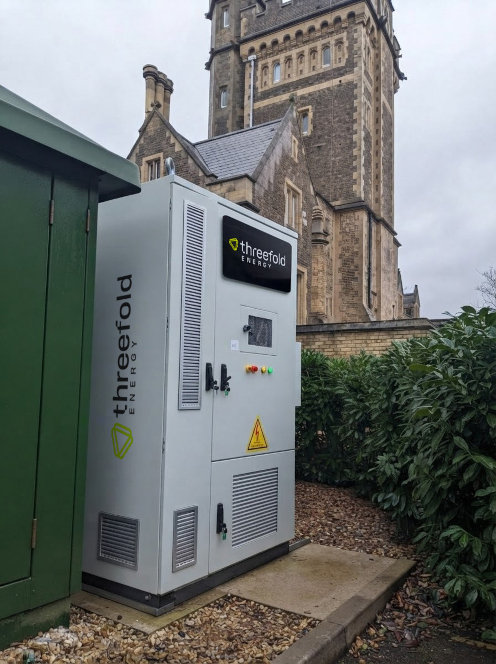
Enel X will act as the exclusive Capacity Market access and optimisation provider for sites covered by the agreement, connecting Threefold’s Optima-managed batteries to its VPP Connect platform. The arrangement is intended to let commercial batteries participate in eligible grid and electricity market services while continuing to perform their primary role at customer sites.
The integration is entirely virtual. Enel X says its platform will connect to Threefold’s existing control architecture without additional hardware at participating sites, reducing the amount of physical retrofit work needed before a battery can be aggregated into the wider virtual power plant.
Threefold’s Optima platform already controls when participating businesses draw, store, and consume electricity, using batteries to shift demand away from expensive periods and manage energy costs. External market access adds another operating layer: a battery can respond to grid service opportunities where doing so remains compatible with the customer’s own operating requirements.
Commercial batteries have different constraints from utility-scale systems built principally to trade electricity. A business may need to preserve enough stored energy to reduce peak demand, manage tariffs, support resilience, or meet another site requirement. Only the remaining flexibility can be committed externally without undermining the purpose for which the battery was installed.
Optimisation therefore becomes a scheduling problem rather than a simple instruction to charge when electricity is cheap and discharge when it is expensive. The control system has to consider the business’s forecast demand, electricity tariffs, market prices, battery state of charge, available power, degradation limits, and obligations created by participation in grid services.
Enel X intends to aggregate those decisions across multiple installations through its virtual power plant. Individual commercial batteries may be small beside grid-scale projects, but a coordinated fleet can present a larger controllable resource to electricity markets. The first phase remains modest at around 3.5MW, although the companies have said participation could expand as Threefold’s installed portfolio grows.
More than 100MW has been cited as a longer term ambition rather than a contractual commitment. The immediate engineering and commercial programme is the first tranche of capacity planned to enter service within 12 months, where telemetry, dispatch, settlement, and customer operating constraints will all have to work reliably across different sites.
Commercial storage can contribute at both customer and system level because charging and discharging alter the net load seen by the distribution network. A battery charging during lower-demand periods and supporting a business at peak times can reduce the site’s maximum import, while coordinated fleets may also respond to wider system conditions where market rules and connection arrangements permit.
Distribution constraints make that capability increasingly relevant. Flexible equipment is being connected below the transmission system in growing volumes, including batteries, electric heating, vehicle charging, solar generation, and industrial loads. The value of those assets depends partly on whether they can be coordinated rather than simply following fixed local schedules.
The agreement also expands the role of software around battery installations. Hardware specifications such as power, energy capacity, efficiency, and cycle life determine what a battery can physically do, but optimisation decides how much of that capability is used at any given time and which commercial or operational objective takes priority.
That control has limits. A battery cannot use the same megawatt-hour to reduce a customer’s peak and simultaneously sell it into another service, while an asset committed to provide capacity has to remain capable of responding when called. Forecast errors, unexpected site loads, maintenance, temperature, and degradation can all reduce available flexibility.
Accurate telemetry is therefore central to the model. Enel X needs timely information on battery state, site demand, operating limits, and availability if it is to dispatch a portfolio without creating conflicts at customer level. Threefold’s local controls must in turn translate those requests into actions that stay within the technical and commercial rules governing each installation.
The absence of additional site hardware could simplify rollout if the software interface performs as intended. Commercial customers often have limited appetite for another layer of meters, gateways, or control cabinets once a battery is already installed, so a virtual integration can reduce installation work and shorten the path from commissioning to market participation.
It also makes communications and cybersecurity part of the operating chain. Market instructions have to reach distributed assets securely and quickly enough for the relevant service, while failures in connectivity or data quality need to be handled without compromising customer operations or creating inaccurate commitments to the system operator.
The five-year term gives both companies time to expand beyond the first group of sites if the model performs as planned. Growth will depend on the pace at which Threefold adds batteries, the proportion suitable for external services, changes in Capacity Market and ancillary service rules, and whether combined customer savings and market revenues justify continued participation.
The first 3.5MW will provide the practical evidence. If Optima and VPP Connect can coordinate customer requirements with grid and market opportunities without adding site hardware or undermining local battery objectives, the same control model can be extended across a much larger commercial fleet.