IN Brief:
- Sungrow and be.storaged aim to deliver a 1.6GWh German battery-storage pipeline over the next two years.
- The framework establishes common processes for planning, technical coordination, implementation, and commissioning.
- Sungrow's PowerTitan platform gives the partners a repeatable equipment architecture for larger multi-site deployments.
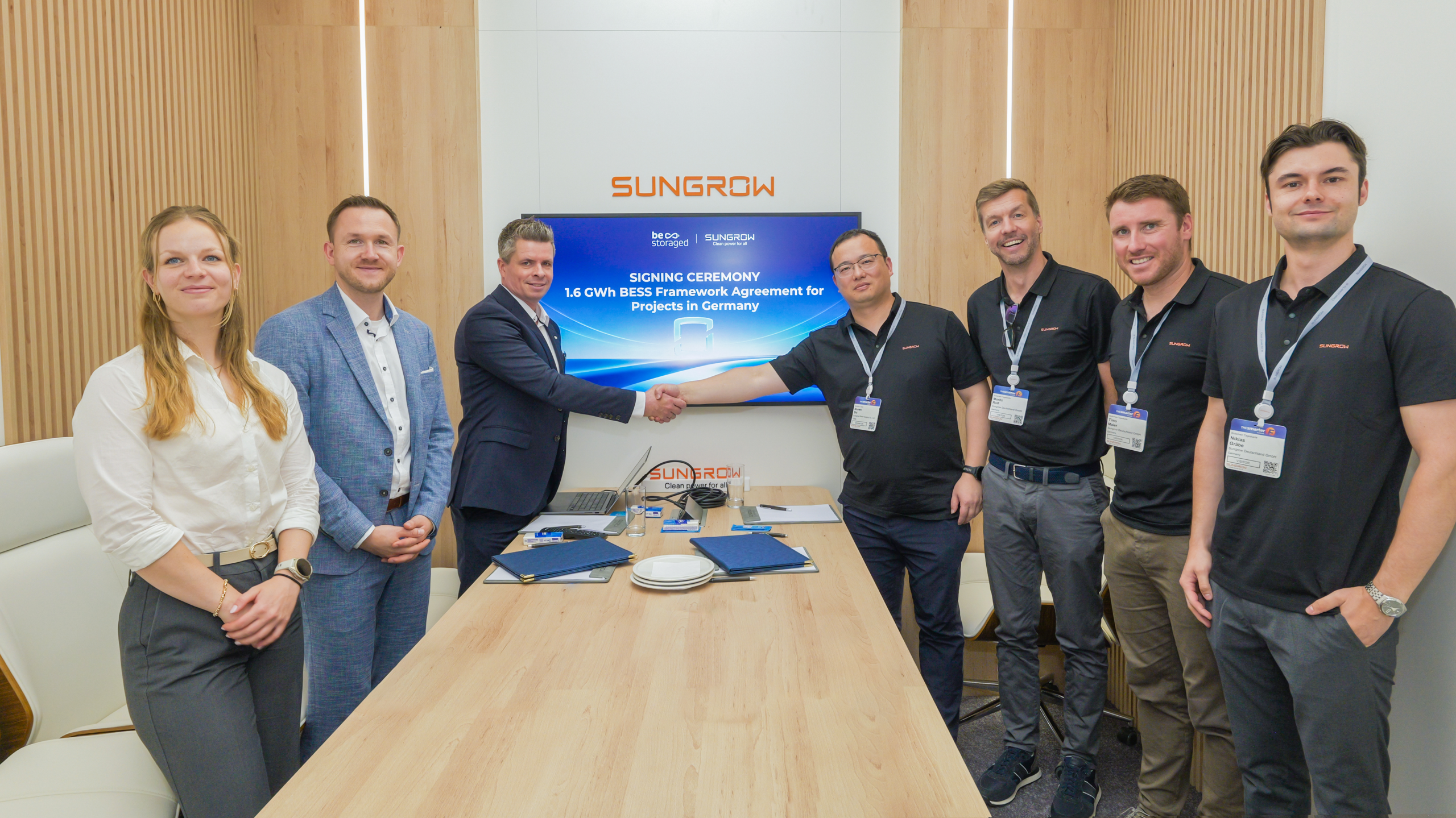
Sungrow Deutschland and be.storaged have signed a framework agreement covering a planned pipeline of 1.6GWh of large-scale battery storage projects in Germany over the next two years.
The agreement formalises an existing relationship between the companies and is intended to establish common processes for planning, development, technical coordination, implementation, and commissioning. be.storaged brings project-development, EPC, operating, and commercial capabilities, while Sungrow supplies battery storage equipment, power electronics, and associated service support.
A portfolio framework changes the way repeat projects can be engineered. Instead of treating every battery site as a completely separate procurement exercise, the two companies can carry forward equipment specifications, control interfaces, documentation, testing procedures, and lessons from earlier installations. Site-specific electrical and civil engineering remains necessary, but less of the common architecture has to be redesigned each time.
That approach becomes increasingly useful as battery portfolios expand from single assets into programmes containing several utility-scale sites. Grid studies, transformer sizing, protection, harmonic performance, earthing, fire strategy, communications, metering, civil works, and route-to-market arrangements still have to be resolved for every location, but an agreed technical baseline can reduce repeated engineering around the battery and inverter package itself.
Sungrow expects its PowerTitan platform to feature in the programme. Integrated battery and power-conversion systems are designed to give developers standardised blocks that can be repeated across larger projects, reducing the number of bespoke interfaces between enclosures, inverters, thermal management, controls, and medium-voltage equipment.
Standardisation does not remove the effect of local network conditions. German battery projects can connect at different voltage levels and may face different requirements around fault contribution, reactive power, harmonics, protection, remote control, and export or import restrictions. A standard battery block therefore has to sit inside a site design capable of meeting the individual network operator’s connection conditions.
The issue is becoming more significant as German storage assets grow in scale. Vattenfall recently approved a 254MW battery at Brunsbüttel with around 1GWh of storage, using a new substation to connect the plant directly to the 380kV transmission network.
Projects at that scale behave less like peripheral electrical equipment and more like substantial network users. Charging can create large new demand, while discharge can inject the same order of power back into the system. Protection, connection capacity, dispatch controls, transformer loading, and market instructions therefore have to account for power moving in both directions.
The 1.6GWh figure in the Sungrow-be.storaged agreement describes a planned pipeline rather than commissioned capacity. Individual schemes still need to progress through land agreements, planning, finance, grid connections, procurement, construction, energisation, and market qualification before the full figure can become operational storage.
Commercial operation will also vary by project. Battery owners can target wholesale price spreads, balancing markets, reserve products, capacity mechanisms, or combinations of several routes. Those strategies determine cycling intensity, required state of charge, availability commitments, and the amount of stored energy that can be exposed to each market at a given time.
Standardised control systems can help across a multi-site portfolio because operators can monitor assets through a common architecture rather than maintaining completely different interfaces at each plant. They can also simplify training, spare parts, service procedures, firmware management, alarm handling, and performance comparison between sites.
Battery warranties place limits around that operating freedom. Cell temperature, charge and discharge rates, depth of discharge, cumulative throughput, and equivalent full cycles all affect degradation. An optimiser seeking maximum short-term market revenue therefore has to remain within the operating envelope agreed with the equipment supplier if long-term capacity guarantees are to remain intact.
A repeatable hardware platform can make those limits easier to manage across several plants, but it also increases the importance of configuration control. Software revisions, parameter changes, replacement components, and commissioning settings have to be tracked carefully so that apparently identical projects do not gradually diverge in ways that complicate maintenance or operating performance.
The framework gives both companies a two-year period in which to test whether those efficiencies translate into faster project delivery. The strongest evidence will come from individual schemes reaching grid connection and commercial operation rather than from the headline pipeline alone.
If a substantial share of the 1.6GWh programme advances, the partnership will become a useful demonstration of how European battery deployment is moving towards repeatable project platforms. Cell capacity remains important, but grid engineering, control standardisation, commissioning, and operating discipline increasingly decide how quickly announced storage becomes usable flexibility.