IN Brief:
- Five 6.8MW Nordex N175/6.X turbines will replace five older machines totalling 3MW at Rauschenberg.
- The turbines will use 199-metre hub-height towers and 175-metre rotors designed for low- and medium-wind sites.
- Installation starts from late 2027, with electricity production expected from summer 2028.
Nordex has secured a 34MW order to repower the Rauschenberg wind farm in Hesse, replacing five older turbines with five N175/6.X machines rated at 6.8MW each.
Nordex Group will supply and install the turbines for EEF Erneuerbare Energien Fabrik on 199-metre hub-height towers, with a 20-year Premium Service agreement included in the contract. Delivery and erection are scheduled from the end of 2027, with electricity production from the repowered site expected from summer 2028.
The existing five turbines provide a combined installed capacity of 3MW. Replacing them with five 6.8MW machines will lift the site to 34MW while leaving the turbine count unchanged, making Rauschenberg a clear example of the capacity gains now available when ageing wind assets are repowered rather than simply extended.
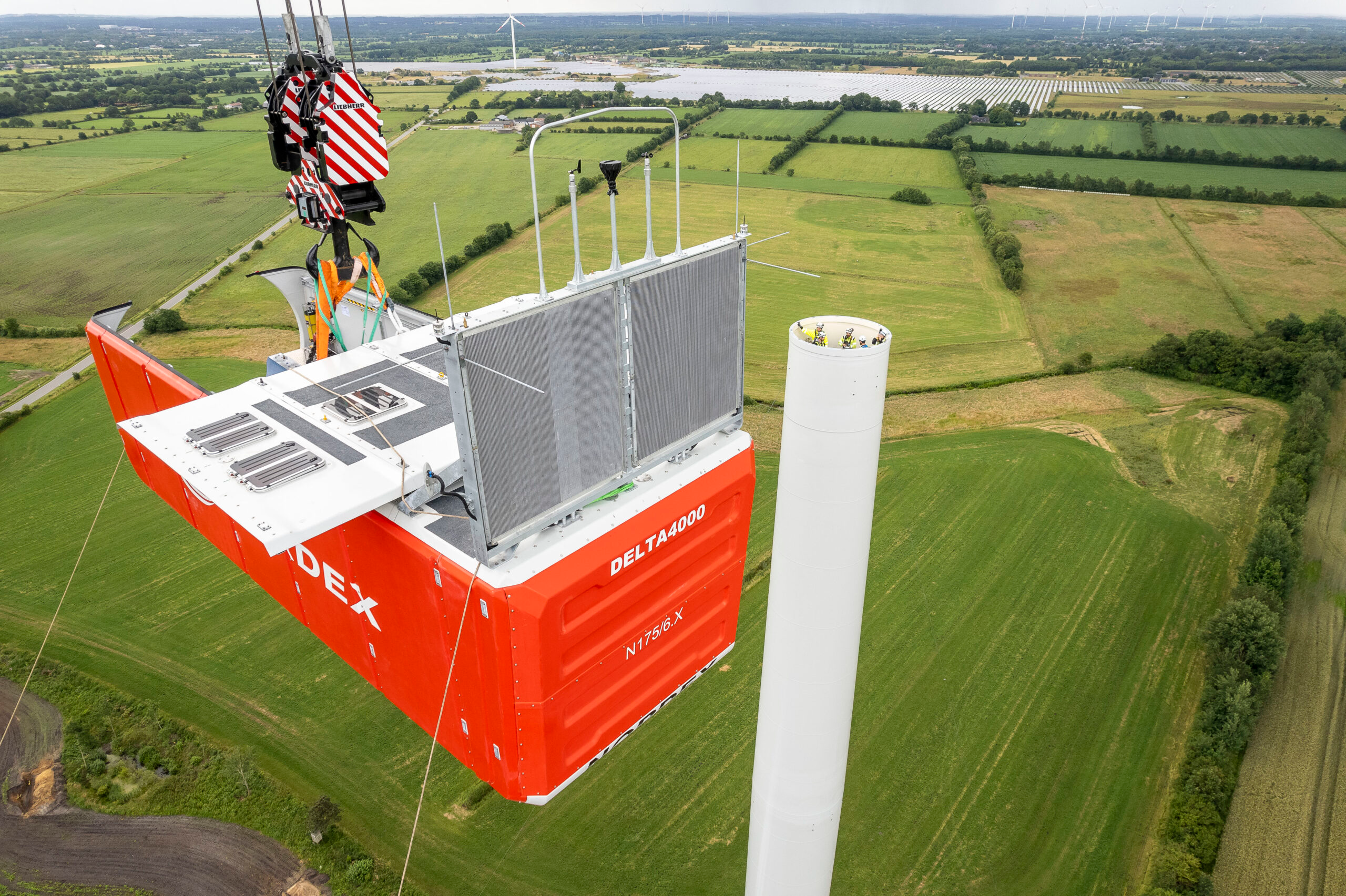
The N175/6.X is designed for low- and medium-wind sites and uses a 175-metre rotor with a swept area of 24,053 square metres. Its single-piece rotor blades are about 86 metres long, and Nordex says the larger rotor allows the turbine to capture significantly more energy at lower wind speeds than earlier models in its Delta4000 range.
At Rauschenberg, that rotor will operate from a 199-metre hub height. The taller configuration places the machine in stronger and more consistent wind flows above the effects of surface roughness, forests, buildings, and terrain, increasing the amount of usable wind available to the turbine during lower-output periods.
Height brings its own engineering consequences. Taller towers require foundations and structures capable of carrying greater static and dynamic loads, while transport, lifting, and erection become more demanding. Crane planning, component logistics, weather windows, and construction access can therefore become as important to the delivery programme as the turbine itself.
The electrical works will also be substantially different from those required by the existing 3MW fleet. Five grid-connected machines remain five generating positions, but increasing total installed capacity by more than eleven times changes transformer ratings, cable duties, switchgear requirements, protection settings, reactive-power capability, and the maximum export that the connection has to accommodate.
Nordex has not detailed the grid reinforcement required for Rauschenberg, so the extent to which existing balance-of-plant equipment can be reused is not yet public. That reuse potential remains one of repowering’s main attractions: established wind sites already have measured resource, operating history, access routes, planning experience, and some grid infrastructure.
The project also illustrates why inland German wind development is increasingly tied to larger rotors and taller towers. Coastal sites typically offer stronger wind conditions, while inland projects have to extract more energy from lower average wind speeds. Rotor area and hub height therefore become central to annual energy yield rather than simply to maximum turbine output.
Nordex says the N175/6.X can deliver between 7% and 14% more yield than its N163/5.X and N163/6.X sister models at typical low- and medium-wind locations, with gains of up to 22% during lower-wind conditions. Those are manufacturer performance comparisons rather than a forecast for Rauschenberg, but they explain the technology choice behind the project.
The 20-year service agreement extends Nordex’s role well beyond delivery. Modern turbines depend on condition monitoring, software, scheduled maintenance, component replacement, and increasingly data-led performance management, so long-term service arrangements have become a material part of the commercial package attached to major turbine orders.
EEF is also positioning the project within a broader investment programme. The developer says it plans to invest more than €1 billion over the coming years in renewable projects combining wind, photovoltaics, storage, and software-based energy management. Rauschenberg is therefore one part of a wider portfolio rather than an isolated equipment purchase.
The order adds to the early commercial deployment of Nordex’s 199-metre N175 configuration. A separate North Rhine-Westphalia project ordered in March uses the same hub height, providing a second reference for a turbine and tower combination aimed specifically at extracting more output from inland sites.
Repowering does not remove the permitting, grid, logistics, and construction constraints facing new wind capacity, but it changes how those constraints are approached. At Rauschenberg, the number of turbine positions stays at five while installed capacity rises from 3MW to 34MW. The engineering case rests on getting considerably more generation from a site that is already part of the power system.
That makes commissioning discipline as important as turbine specification: the repowered site must prove its higher-capacity electrical systems, protection settings, controls, and grid compliance before the additional 31MW of installed capacity becomes commercially useful.