IN Brief:
- National Grid Electricity Transmission is preparing a £7.5 million framework covering SF6 leakage across GIS and gas-insulated busbar assets.
- Contractors will provide repair, reduction, and preventative treatments, with non-intrusive work preferred without outages where reasonably practicable.
- The procurement addresses Britain's installed SF6 equipment while new transmission projects increasingly adopt alternative insulating technologies.
National Grid Electricity Transmission is preparing a £7.5 million framework for sulphur hexafluoride leak repair, reduction, and preventative treatment across gas-insulated switchgear and gas-insulated busbar assets on its transmission network in Great Britain.
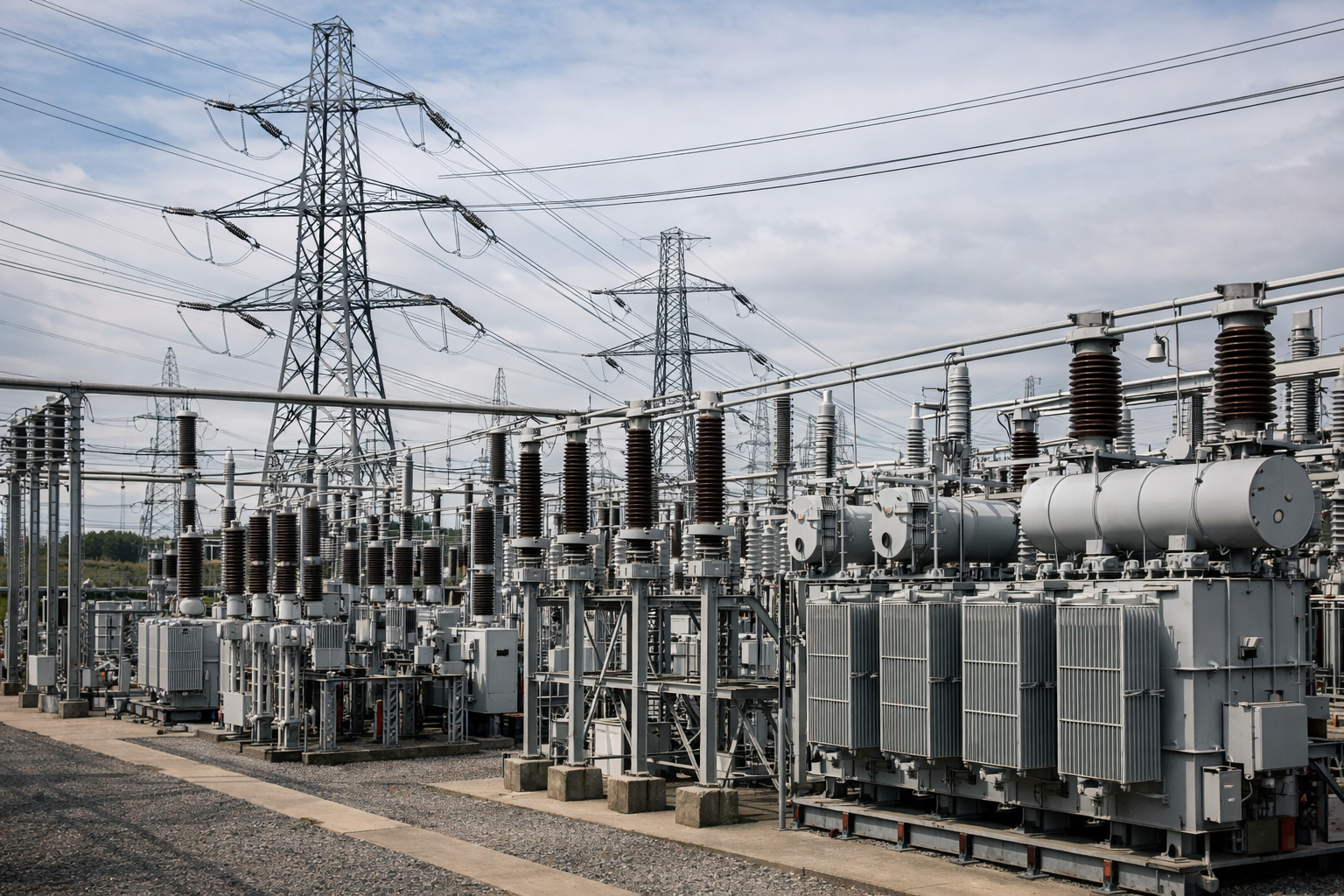
The procurement is intended to create a standard route for dealing with SF6 losses from equipment already in service. Contractors will be expected to design, install, test, inspect, and provide quality assurance for external repair systems, with non-intrusive work undertaken without an outage where reasonably practicable.
That requirement makes the framework more demanding than a conventional maintenance package. Interventions around live high-voltage GIS have to preserve electrical clearances and mechanical integrity while avoiding disturbance to ageing seals, flanges, bushings, enclosure joints, and other interfaces that may already be contributing to leakage.
The scope includes permanent repairs, measures intended to reduce the rate of existing leaks, and preventative treatments designed to stop deterioration developing into a larger loss of gas. Suppliers will also need suitable quality-management arrangements and the ability to fulfil Principal Contractor and Principal Designer duties under the Construction (Design and Management) Regulations 2015.
SF6 has been used extensively in high-voltage switchgear because of its strong dielectric and arc-interruption performance. It allows compact gas-insulated equipment to operate at transmission voltages, which is particularly useful where land is constrained or primary plant has to be enclosed. Its environmental impact, rather than its electrical performance, has become the main reason for reducing reliance on the gas.
The National Atmospheric Emissions Inventory gives SF6 a global warming potential of 22,800 relative to carbon dioxide and says electrical insulation accounted for 88% of UK SF6 emissions in 2024. Emissions arise during equipment manufacture and filling, through leakage in service, and during maintenance, so the condition of installed switchgear remains relevant long after a new substation has been commissioned.
National Grid has set a target to reduce absolute SF6 emissions from its operations by 50% by 2030/31. Its current climate material says the company is shifting from reactive leak repair towards more planned intervention, including asset replacement and retrofitting where suitable alternatives are available.
New projects are already moving away from conventional SF6 equipment. National Grid’s Middleton 400kV substation extension in Lancashire, where Linxon has started engineering and early procurement, is being designed around SF6-free GIS. The existing transmission fleet presents a different problem because equipment can remain electrically serviceable for decades after its insulating medium has become environmentally undesirable.
Replacing every functioning SF6 asset early would impose capital costs, outages, engineering work, and potentially unnecessary asset retirement. Leaving known leaks untreated is equally difficult to justify given the gas’s climate impact. Repair, refurbishment, retrofill, and planned replacement therefore have to run in parallel rather than being treated as competing policies.
The engineering challenge becomes more acute as equipment ages. Gas pressure and density form part of the insulation system, meaning a repair cannot simply stop a leak at any cost; it has to maintain the enclosure’s mechanical condition and avoid creating another weakness. External treatments must also withstand temperature cycling, vibration, weather exposure, electrical loading, and later maintenance activity.
Operational availability adds another constraint. A transmission outage can affect system security, planned maintenance elsewhere on the network, and the ability to connect generation or demand. The framework’s preference for non-intrusive work without outages is therefore commercially useful, but it raises the standard expected from repair methods because they may have to be applied around energised assets.
National Grid’s recent RIIO-T3 environmental plan puts the scale of the installed challenge at more than 930,000kg of SF6 across the transmission system. The same plan says the operator will avoid installing SF6 where a technically, commercially, and programme-viable alternative exists, leaving leak management to deal with the large inventory that cannot be replaced immediately.
The procurement is expected to lead to an award by 10 May 2027, with the framework scheduled to start on 30 May and run initially to 31 May 2030. Its estimated value is £7.5 million excluding VAT, and National Grid is seeking suppliers capable of providing national coverage.
That value is small beside the investment being directed into new transmission infrastructure, but the framework addresses an unavoidable consequence of the existing network. SF6-free switchgear can reduce future additions to the inventory; the equipment already energised across Britain still has to be kept reliable, available, and as leak-tight as practical until replacement programmes catch up.