
IN Brief:
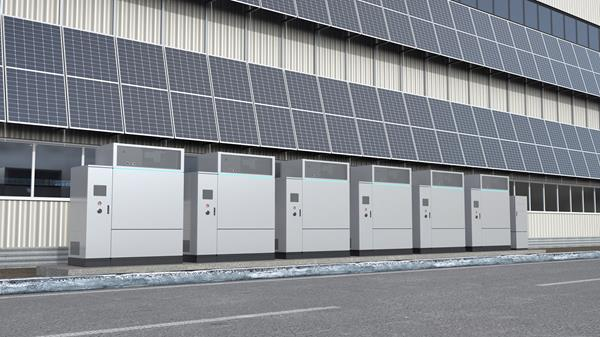
- XCharge has launched GridOne, an all-in-one PV and energy storage system for commercial and industrial sites.
- The system combines 125kW PCS power, a 215kWh LFP battery, optional PV MPPT, and charger integration.
- The product sits within the growing convergence of EV charging, storage, solar self-consumption, and site energy control.
XCharge has launched GridOne at ees Europe in Munich, moving into commercial and industrial energy storage alongside its existing EV charging infrastructure business.
GridOne is an all-in-one photovoltaic and energy storage system for C&I applications. The platform combines a 125kW power conversion system, a 215kWh lithium iron phosphate battery, optional 50kW PV MPPT input, and support for grid-tied and off-grid operation.
The system is designed for peak shaving, solar self-consumption, backup power, EV charging load buffering, and site energy optimisation. Communications and integration options include Ethernet, Modbus TCP/RTU, RS485, CAN, cloud connectivity, and OCPP 1.6J charger integration.
Commercial and industrial electrical systems are becoming more difficult to design around fixed assumptions of load and supply. EV charging, on-site solar, heat pumps, electrified process equipment, and resilience requirements are changing site demand profiles, often in locations where grid capacity is limited or reinforcement is costly. Behind-the-meter storage is increasingly being used to manage those constraints before they become connection blockers.
The inclusion of charger integration places GridOne in a part of the market where energy storage is being specified as enabling infrastructure, rather than as a standalone sustainability measure. A site may want high-power EV charging, but the local connection may not support simultaneous peak charging, building load, and process demand. A battery can buffer charging demand, reduce peak import, and give the energy management system more control over when and how power is drawn from the grid.
Solar self-consumption adds another layer. A commercial site with rooftop or ground-mounted PV may generate more power than it can use during some periods, particularly outside peak operating hours. Storage can capture part of that output, reduce export exposure, and support later demand, although the value depends on tariff structure, load profile, battery cycling strategy, and available connection capacity.
The market is also shifting towards modular packaged systems. Industrial battery installations have often required bespoke design, containerised hardware, separate inverters, external controls, and project-specific integration. All-in-one systems can simplify procurement and installation for smaller C&I sites, but the specification still needs to be matched to site conditions, protection arrangements, fire safety requirements, ventilation, cable routes, and operating duty.
The growth of industrial battery projects, including Sopoco’s 1.1MWh system, shows how storage is being used to manage local electrical constraints and energy costs. XCharge’s GridOne sits at a smaller scale, where site owners are looking for practical storage that can support charging, self-consumption, and resilience without turning every project into a large infrastructure build.
Control software will determine how useful systems of this type become in practice. A battery used for backup needs reserve capacity, while a battery used for peak shaving needs to discharge during high-demand periods. A battery supporting EV charging may need to prioritise charger availability, while one linked to PV self-consumption may need to preserve space for midday generation. Combining those functions in one unit requires control logic that can prioritise competing requirements without undermining site operations.
The launch also shows how charging companies are widening their offer. As EV infrastructure moves into commercial fleets, logistics sites, retail locations, industrial estates, and public hubs, the charger is only one part of the electrical installation. Grid capacity, storage, load management, metering, and energy procurement increasingly shape the project’s economics.
GridOne enters a market where specification sheets will not be enough to separate strong systems from weak ones. Successful installations will be those that reduce connection pressure, support safe deployment, integrate cleanly with existing electrical systems, and give operators reliable control over increasingly complex site loads.

