
IN Brief:
- UKNNL and The University of Manchester have signed a nuclear science and technology MoU.
- The agreement covers decommissioning, advanced materials, fuels, waste management, innovation, and the Northwest Nuclear Arc.
- Manchester researchers and PhD students will gain access to UKNNL facilities, with reciprocal university access for UKNNL staff.
United Kingdom National Nuclear Laboratory and The University of Manchester have signed a Memorandum of Understanding to formalise a broad nuclear science and technology partnership.
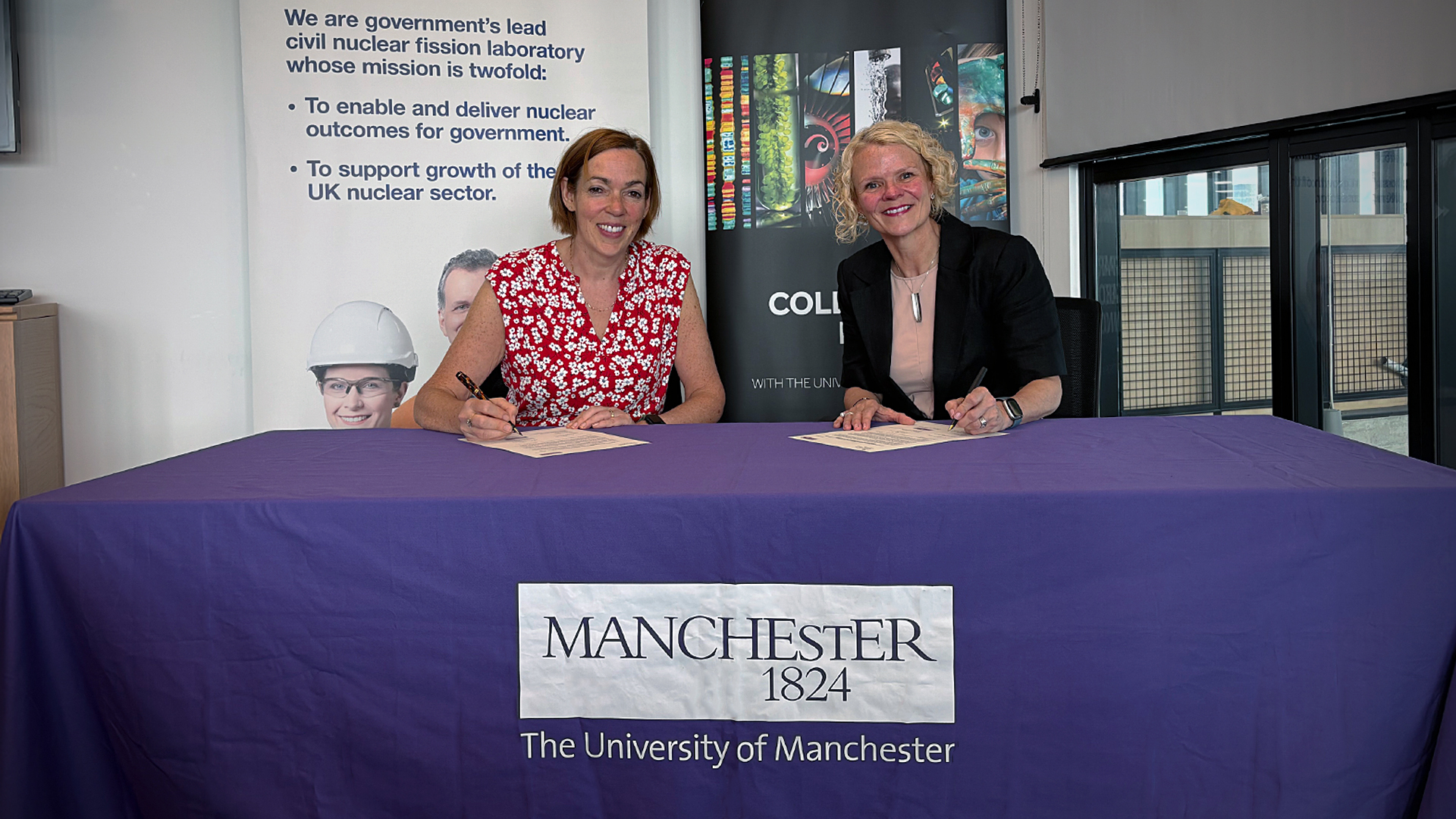
The agreement was signed at The University of Manchester by UKNNL Chief Executive Officer Julianne Antrobus and Professor Sarah Sharples, Vice President and Dean of the Faculty of Science and Engineering. It builds on a long-running relationship between the two organisations and sets out a wider structure for collaboration across research, skills, facilities, and industrial deployment.
The MoU covers six priority areas: decommissioning of engineered facilities; advanced materials performance and degradation for future nuclear systems; improved fuels and fuel manufacturing routes for current and future reactors; waste management, including land quality, effluent treatment, decontamination, and disposal; innovation and translation of research to industrial deployment; and growth of the Northwest Nuclear Arc as a recognised centre of expertise.
The agreement also establishes arrangements for sharing facilities and expertise. Manchester PhD students and researchers will be able to access UKNNL’s Preston, Central Laboratory, Windscale, and Workington facilities, while UKNNL staff will have reciprocal access to University facilities.
The two organisations already have a record of joint work across nuclear fuels and materials research, PhD support in next-generation nuclear technologies, shared personnel arrangements, visiting and honorary academic appointments, and collaborative centres of excellence. These include the Effluents Centre of Excellence and the PHLAME collaborative research group, focused on photonics and laser analysis of materials and environments.
The partnership strengthens the link between national laboratory capability and academic research while the UK nuclear sector faces several priorities at once. Existing nuclear sites require decommissioning, waste treatment, and asset-management capability. New nuclear programmes require fuels, materials, safety analysis, licensing support, and workforce development. Advanced reactor concepts and small modular reactors require both research validation and industrial deployment pathways.
The University of Manchester’s Dalton Nuclear Institute gives the partnership a strong regional and technical anchor. The Northwest Nuclear Arc links research, industrial capability, public institutions, and nuclear-sector employers across a region already central to UK nuclear operations. Formalised access to UKNNL facilities gives researchers a clearer route to work with active materials, specialist infrastructure, and applied nuclear science environments.
European and UK nuclear development is increasingly moving from strategy into procurement, selection, and delivery preparation. Recent SMR activity in Sweden has shown how modular reactor designs are entering national planning, while the UK’s own nuclear ambitions depend on the research base, fuel expertise, materials understanding, and skilled workforce that sit behind project announcements.
Advanced materials remain central to that delivery base. Future nuclear systems will operate under demanding thermal, radiation, corrosion, and mechanical conditions. Materials performance and degradation data influence reactor design, safety cases, maintenance regimes, component qualification, and lifetime extension. Without strong materials research, advanced nuclear deployment risks being limited by uncertainty around long-term performance.
Fuel manufacturing routes are another strategic priority. The UK is seeking to strengthen nuclear fuel capability as new reactor designs, fuel cycles, and security-of-supply concerns reshape the sector. Research into fuels for current and future reactors supports both existing fleet knowledge and advanced technology options, including small modular reactors and potentially more novel systems.
Waste management and decommissioning remain equally important. Nuclear new build often dominates public attention, but the UK’s nuclear sector still carries a substantial legacy estate. Effluent treatment, decontamination, land quality, waste characterisation, and disposal pathways are central to reducing long-term liabilities and preparing sites for future use. Partnerships that link laboratory capability with university research can improve the science base behind those practical programmes.
The innovation and translation element gives the MoU an industrial dimension. Nuclear research can struggle to move from academic output into deployable methods because of licensing, safety, cost, security, and specialist-facility barriers. A formal partnership between UKNNL and Manchester can create clearer routes for research to be tested, validated, and transferred into operational or commercial settings.
The skills dimension may prove the most decisive over time. Nuclear programmes require engineers, materials scientists, chemists, physicists, safety specialists, environmental experts, technicians, and project professionals. The same workforce is needed for decommissioning, new build, defence-related work, fuel cycle development, and waste management. Facility access for PhD students and researchers gives early-career specialists exposure to real nuclear environments rather than purely academic study.
The agreement gives the UK nuclear sector a stronger platform for connecting research, facilities, skills, and industrial application in one of its key regions. As nuclear returns to the centre of energy security and low-carbon generation planning, applied research capacity will carry as much weight as project selection and financing.

