IN Brief:
- PowerUp chargers are being deployed at SP Energy Networks sites in Middlewich, Liverpool, and Cambuslang following a successful pilot.
- Integrated battery storage allows high-power DC charging without requiring the site connection to supply the full charging load instantaneously.
- The deployed units can provide approximately 600 miles of stored driving energy during a power interruption.
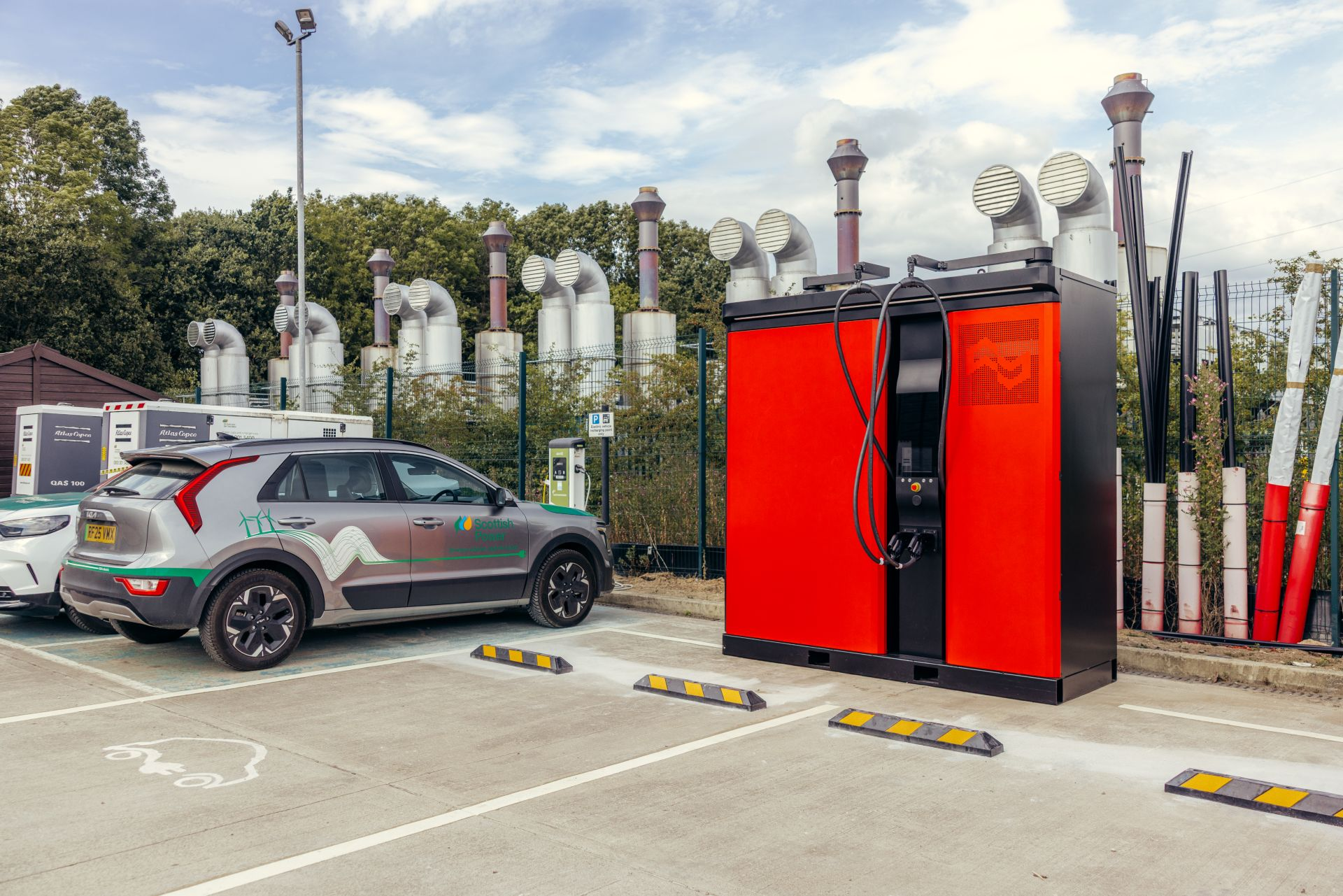
TUAL is rolling out its battery-buffered PowerUp charging technology across three SP Energy Networks operational sites, moving from a pilot installation into the system’s first commercial UK deployment and targeting fleet locations where conventional high-power charging is constrained by electrical capacity, civil works, or changing site requirements.
The rollout covers Middlewich in Cheshire, Liverpool, and Cambuslang near Glasgow. It follows a successful trial at Middlewich and will support high-utilisation operational vehicles that need to return to service quickly rather than remain connected for several hours during a conventional depot-charging cycle.
For SP Energy Networks, that requirement translates into charging sessions designed around approximately 30-minute dwell periods during breaks and vehicle re-stocking visits. PowerUp combines integrated battery energy storage with high-power DC charging, drawing electricity from the site’s available supply before releasing stored energy at a higher instantaneous rate when a vehicle requires it.
The arrangement separates vehicle-side charging power from the continuous capacity of the grid connection. A depot that cannot directly support a large DC charger may still have enough spare capacity over several hours to replenish an onsite battery, which can then supplement the incoming supply during shorter charging sessions.
That does not create additional energy. Every kilowatt-hour delivered to a vehicle must still enter the site, either directly from the grid or through the battery after being stored earlier. What changes is the load profile: a relatively constrained connection can operate for longer at a manageable level before the battery delivers a short burst of higher power to the vehicle.
The approach is particularly relevant where a fleet requires high charging power intermittently rather than continuously. Reinforcing a connection around a relatively short maximum load can require new cabling, transformers, switchgear, protection changes, utility approvals, and civil engineering even where that peak appears for only part of the operating day.
TUAL also positions PowerUp as easier to deploy and relocate than conventional fixed high-power infrastructure. That can matter on leased sites or locations subject to redevelopment, where extensive permanent civil works may be difficult to justify against the remaining tenure of the property.
The flexibility carries a resilience role for SP Energy Networks as well. TUAL says the units being deployed can hold enough energy to provide approximately 600 miles of stored vehicle driving range during a power interruption. The figure describes the aggregate energy available to support the fleet rather than a guaranteed range for any individual vehicle, which will depend on vehicle efficiency and operating conditions.
That capability has a particular relevance for an electricity network operator. Field teams may be mobilised precisely when the wider power system is under stress, meaning charging infrastructure that depends entirely on an uninterrupted local supply could become unavailable at the same time operational vehicles are most heavily required.
Philip Clarke, Founder and CEO at TUAL, said: “PowerUp offers a pathway to making critical fleet electrification a reality now.” His argument is that high-utilisation operators should not necessarily have to postpone fleet electrification until every depot can obtain a conventional high-capacity connection.
The practical economics will still depend on how the chargers are used. Battery storage introduces conversion losses, degradation, controls, and additional capital equipment, while a site with sustained high vehicle throughput can ultimately consume energy faster than a constrained connection can replenish the buffer between charging sessions.
Where vehicle arrivals and dwell periods are reasonably predictable, however, the battery can be sized around the difference between connection capacity and vehicle charging demand. That is a different proposition from using storage principally for electricity-market trading: the asset is being integrated to solve a local power-delivery constraint around an operational fleet.
TUAL describes PowerUp as a high-power CCS charging system for constrained locations, with the battery-integrated architecture intended to support DC charging where grid capacity is limited. The company is targeting applications including utilities, emergency response, logistics, commercial vehicles, ports, and other fleets for which vehicle availability carries operational consequences.
The SP Energy Networks deployment provides a useful test because the vehicles are not simply returning to a depot for an uninterrupted overnight window. Thirty-minute stops for breaks and re-stocking place a different requirement on the electrical system, with charging infrastructure expected to fit around the fleet’s operating pattern rather than determining it.
Battery buffering can therefore occupy a middle ground between low-power depot charging and full connection reinforcement. It offers a route to higher vehicle-side power where a site already has enough underlying energy capacity but cannot economically or quickly increase its instantaneous grid demand.
The limitation remains physical. As fleet size and utilisation increase, the amount of electricity required each day rises with them. Storage can move that demand in time and reduce short peaks, but a sufficiently busy depot will eventually expose the underlying capacity of its connection.
The three-site rollout should provide a clearer indication of where that boundary lies in utility-fleet operation. Middlewich has established the initial pilot case; Liverpool and Cambuslang extend the technology across additional working locations. The more useful measure will be whether high-power charging can be delivered repeatedly inside the required 30-minute dwell periods without exhausting the battery buffer or compromising vehicle availability.