IN Brief:
- TIP Group, Nivalis, BPW, and Sommer have started a German pilot of a propelled semi-trailer without refrigeration.
- The Nivalis Powered Trailer Kit uses an electric axle, battery storage, rooftop solar, regenerative braking, and grid charging.
- The system is targeting savings of up to 7,000 litres of diesel and 18 tonnes of CO₂ per trailer each year.
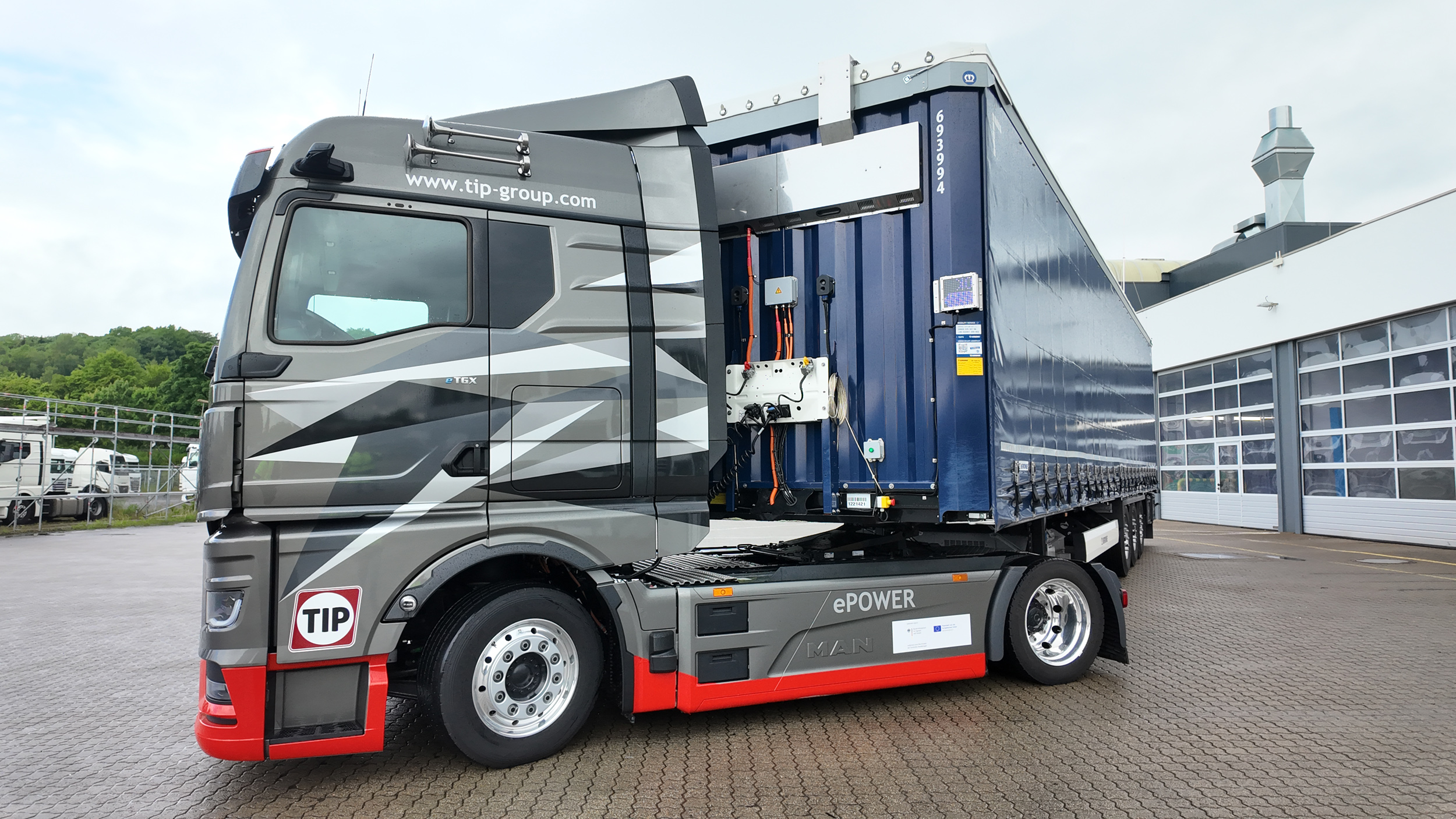
TIP Group, Nivalis Energy Europe, BPW, and German transport operator Sommer have started a pilot trial of a propelled semi-trailer on live freight routes in Germany.
The trial began at the end of May and uses a Nivalis Powered Trailer Kit fitted to a TIP Group trailer. The system turns a standard trailer into a self-assisting unit that contributes to propulsion, reducing the energy demand placed on the tractor unit without changing the driver’s normal operating process.
The pilot is focused on a non-refrigerated semi-trailer, separating it from electrified reefer systems where the main objective is to power refrigeration equipment. The Powered Trailer Kit is designed instead to support movement directly through propulsion assistance and energy recovery.
Integrated into the chassis, the system uses a BPW e-Power axle with Nivalis dual electric motors, gearbox, and clutch. It delivers 50kW peak capability for recuperation and propulsion, with a 60kWh, 400V high-voltage lithium-ion battery pack storing energy gathered through braking, rooftop solar, and grid charging during parking stops.
The rooftop photovoltaic array has a rated output of up to 3.7kWp. An onboard Energy Management Unit hosts the power-electronic components, while an Integrated Power Distribution Unit manages energy flows between the battery, axle, solar array, and charging input. A Human-Machine Interface display, visible from the cab’s side mirror, gives the driver system status and battery charge information.
Operational data flows into Nivalis’ telematics platform, giving fleet managers visibility of energy generation, fuel savings, battery condition, and system health. Predictive maintenance alerts and over-the-air software updates are included to reduce downtime and support integration with existing fleet management systems.
The trailer has received the approvals required for registration and operation across EU and EFTA countries, subject to applicable national rules. Its high-voltage battery packs are certified under UN 38.3, and the electric powertrain complies with UNECE Regulation No. 100. Drivers can operate the trailer under standard European and national driving regulations, with no additional licensing or training required.
By placing electric assistance on the trailer, the pilot offers a route into freight decarbonisation that does not rely entirely on immediate tractor replacement. Heavy-duty battery-electric trucks require high-power depot or corridor charging, while propelled trailers target fuel reduction across existing operating patterns. The two routes are not mutually exclusive; both address different parts of the energy demand in road freight.
Transport electrification is already drawing investment into supporting power infrastructure, including large-scale funding for electrification in France and megawatt charging development in the UK. Efficiency measures at vehicle level can reduce the scale and speed of charging demand, particularly for fleets that operate long routes and high annual mileage.
The projected saving of up to 7,000 litres of diesel and 18 tonnes of CO₂ per trailer each year will depend on duty cycle, load, route profile, driving style, solar yield, and braking opportunities. The German pilot will provide evidence from real operating conditions, including how consistently energy can be recovered and reused across long-haul logistics work.
Propelled trailers also change the role of the trailer in fleet energy management. Rather than functioning as a passive load, the trailer becomes an active electrical asset with battery storage, generation, data, and power electronics. If the pilot confirms stable fuel savings without compromising payload, stability, or daily operations, trailer-level electrification could become a practical step between diesel haulage and fully electric heavy transport.