IN Brief:
- Source has agreed a maintenance partnership with Siemens eMobility and Evolt Charging across the UK and Ireland.
- Siemens eMobility will supply charging hardware, while Evolt will install, commission, and maintain equipment.
- The arrangement supports Source’s target of maintaining more than 99% uptime across its ultra-rapid charging network.
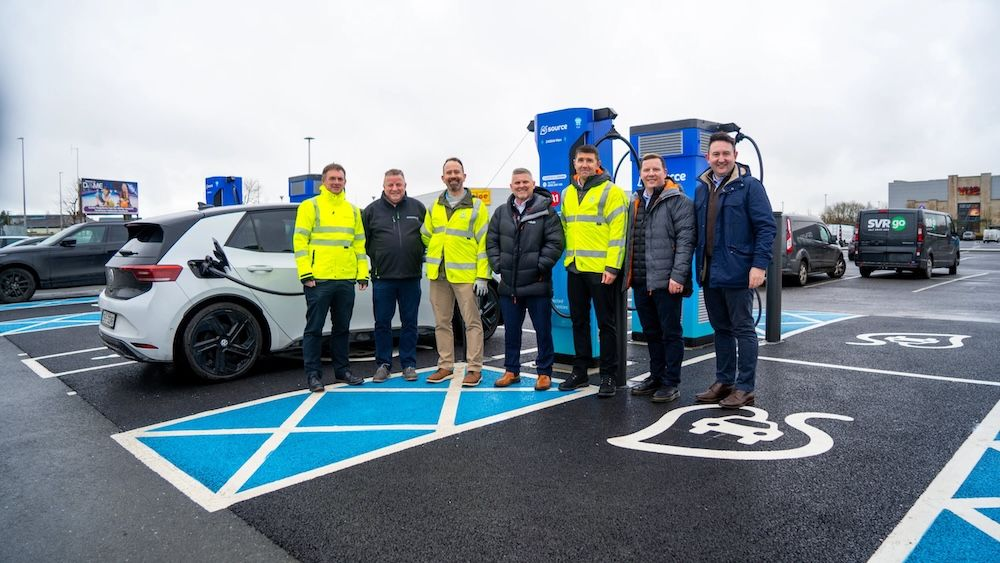
Source has formed a maintenance partnership with Siemens eMobility and Evolt Charging to support the operation of its ultra-rapid EV charging network across the UK and Ireland.
The agreement creates a unified operational and maintenance model for Source sites. Siemens eMobility will supply charging hardware, while Evolt Charging will provide installation, commissioning, and maintenance services. Evolt’s field engineering team is already trained and accredited on Siemens eMobility equipment.
Source launched in 2024 as a joint venture between SSE and TotalEnergies. The company opened its first ultra-rapid charging site in Edinburgh in May 2025 and now operates around 40 ultra-rapid charging hubs across the UK and Ireland. Its longer-term target is to power up towards 300 hubs by 2030.
The partnership is designed to support network reliability as Source scales. The company is targeting more than 99% uptime across its public charging network, placing maintenance response, spares availability, charger diagnostics, and field engineering coordination at the centre of the operating model.
High-power public charging sites place significant electrical demand on local networks and require dependable operation across switchgear, chargers, communications systems, payment systems, cooling, protection, and grid interface equipment. Reliability is now a core infrastructure requirement for ultra-rapid charging rather than an added service feature.
The EV charging market is also moving from a rollout-led phase into a lifecycle operation phase. Early growth focused heavily on charger numbers, site acquisition, and visible network expansion. As utilisation rises, operational performance becomes more exposed. A charger that is installed but unavailable at peak demand weakens the commercial case for the site and reduces confidence in public charging infrastructure.
Ultra-rapid hubs are especially dependent on uptime. Their business model relies on higher throughput, faster vehicle turnaround, and reliable availability for drivers and fleet operators. That creates a different engineering requirement from slower destination charging, with greater emphasis on planned maintenance, rapid fault resolution, remote diagnostics, and consistent service procedures across multiple sites.
The involvement of a hardware supplier and a dedicated field service partner gives Source a clearer operational structure. Siemens eMobility’s role in supplying hardware and Evolt’s role in commissioning and maintaining equipment should reduce fragmentation between product support and site operations, provided diagnostic data, spares, fault reporting, and field response are coordinated effectively.
The partnership also sits alongside the wider challenge of grid-connected charging delivery. Ultra-rapid hubs require suitable connection capacity, robust site electrical design, and continued coordination with distribution network operators where loads are significant. As charging networks expand, site performance will depend on the full electrical system around the charger, not only the charger unit itself.
Source’s growth plan places maintenance discipline into the early stages of network expansion. As the market develops, charge point operators are likely to compete increasingly on availability, power delivery, and service quality rather than headline charger numbers alone.