
IN Brief:
- Airengy and Hagag Europe are planning a compressed-air energy storage project in Romania.
- The scheme would use underground salt caverns and target up to 5GWh of storage capacity.
- The project adds to European interest in long-duration technologies beyond lithium-ion batteries.
Airengy and Hagag Europe are planning a compressed-air energy storage project in Romania that could eventually reach 5GWh of storage capacity.
The project is expected to use Airengy’s AirBattery technology with underground salt caverns. Development is planned in two phases, with the first stage designed to add around 200MWh of storage capacity at an estimated construction cost of €4.5m. The full scheme is planned to reach 25MW of discharge capability and up to 5GWh of storage.
Total investment is expected to be around €55m. Airengy and Hagag Europe will each hold 40% of the project through a special purpose company, while the remaining 20% will be held by a third party. Airengy will take responsibility for planning, design, construction, operation, and deployment of the AirBattery system.
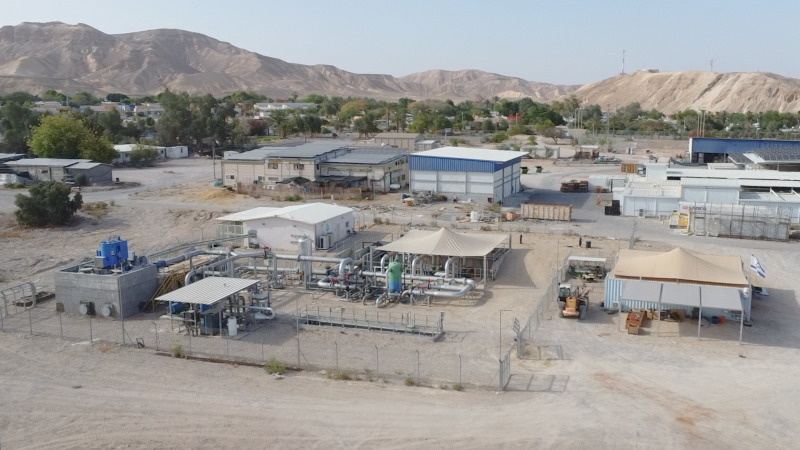
Construction is expected to begin in 2027, with commercial operation targeted for early 2028. The Romanian project follows smaller AirBattery deployments, including a 10kW pilot in central Israel and a 250kW plant in southern Israel.
Compressed-air energy storage uses electricity to compress air during charging. The compressed air is stored underground, then released during discharge to drive a generation process. In the AirBattery system, expanding air applies pressure to water, which is routed through a turbine to generate electricity for export to the grid.
The Romanian site is being shaped around salt-cavern availability, local cost structure, industrial infrastructure, and grid access. Salt caverns have long been used for gas storage in parts of Europe, and their use for electricity storage is gaining attention as power systems search for longer-duration flexibility.
Much of Europe’s recent storage growth has centred on lithium-ion battery systems with durations of one to four hours. Those assets are well suited to fast response, balancing, price arbitrage, and congestion support, but they are less naturally aligned with multi-day storage, seasonal balancing, or very long discharge requirements.
As wind and solar capacity grows, power systems need a wider range of storage durations. Short-duration batteries can smooth intraday volatility and respond quickly to grid events, while longer-duration technologies can support periods where generation and demand are mismatched for more than a few hours.
The Romania proposal sits alongside wider European development of alternative storage technologies, including pumped hydro, compressed air, flow batteries, thermal storage, and hydrogen-linked systems. Each option brings different requirements around geology, efficiency, siting, equipment supply, permitting, response time, grid connection, and project finance.
Germany’s storage market, where large-scale storage revenues are forecast to exceed €17bn, shows how quickly flexibility can become an infrastructure category once renewables, wholesale volatility, and grid services align. Romania’s compressed-air project follows a different technology route, but the underlying requirement is similar: controllable capacity that can absorb surplus electricity and return it when the grid requires support.
The project also highlights how subsurface infrastructure may become more relevant to electricity systems. Salt caverns, former gas storage assets, industrial sites, and grid-adjacent land can provide routes for storage development where above-ground battery siting is constrained or where longer-duration operation is required.
Technology risk remains central. Compressed-air systems require mechanical reliability, cavern suitability, compression equipment, turbines, control systems, grid connection, and a commercial model that rewards longer-duration output. A successful first phase would provide a stronger basis for scaling the Romanian scheme toward the proposed 5GWh target.
Further information on the technology is available through Airengy.

