
IN Brief:
- The RHODÉ consortium has launched a €16m R&D project for floating HVDC offshore connections.
- The work covers transformers, gas-insulated substations, converter stations, and dynamic HVDC cables.
- The project will deliver floating substation designs rated at 320kV and 525kV.
Nexans, Chantiers de l’Atlantique, France Energies Marines, Fondation OPEN-C, GE Vernova, RTE, and SuperGrid Institute have launched RHODÉ, a collaborative R&D project focused on floating HVDC electrical connections for deep-water offshore wind farms.
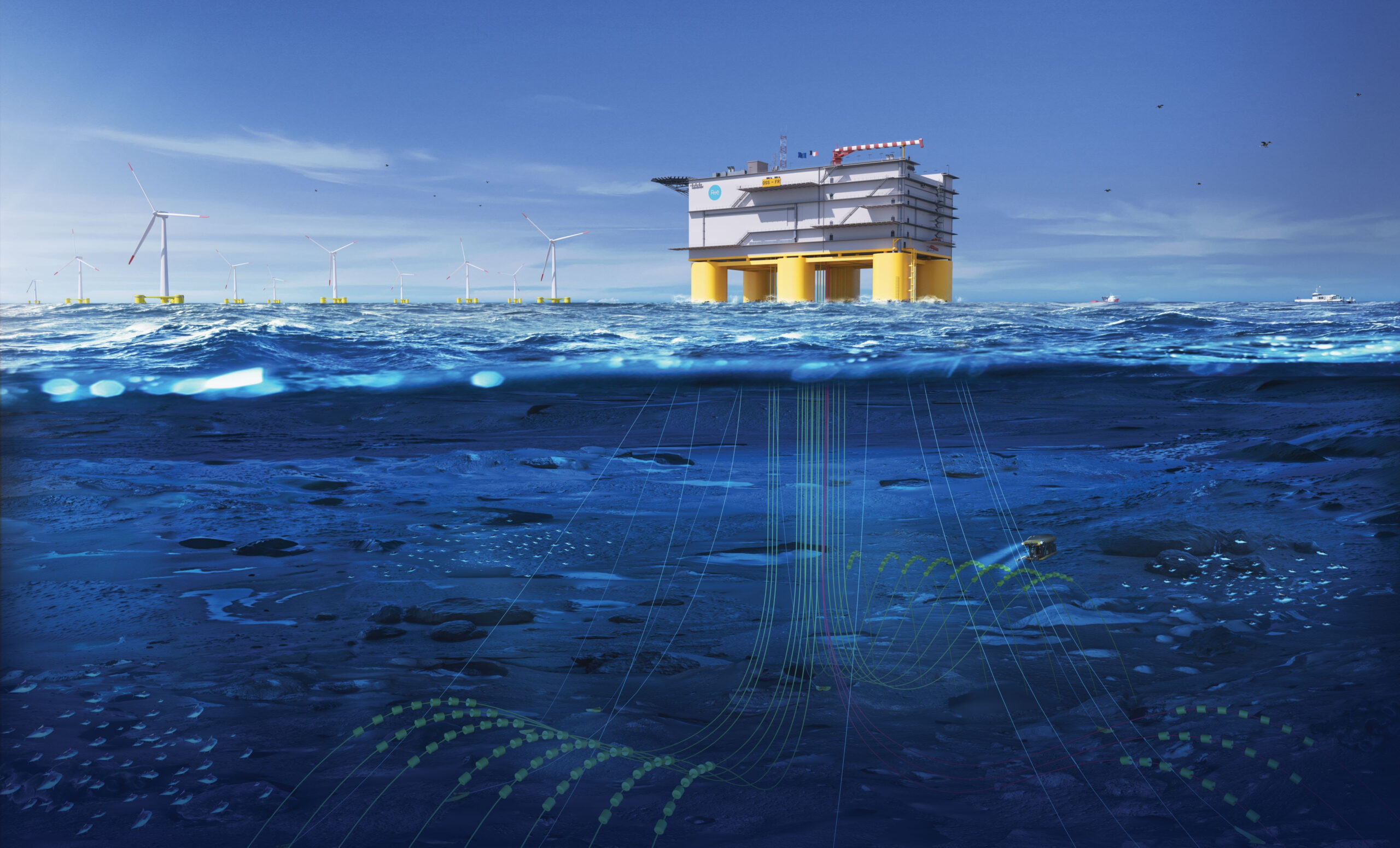
RHODÉ, or Raccordement HVDC Offshore Distant Électrique, will develop and test the technology blocks required for future high-power floating grid connections. The project covers transformers, gas-insulated substations, offshore AC/DC converter stations, and dynamic HVDC cables.
The programme will deliver two floating substation designs, rated at 320kV and 525kV respectively. It has received a €16m grant and is funded by the French State under France 2030, operated by ADEME.
The work is tied to the expected development of offshore wind sites in deeper waters, further from shore. In locations with depths greater than 100 metres and distances of several tens of kilometres from the coastline, fixed-bottom substations can reach technical or economic limits. Floating electrical substations are being developed to connect large-scale offshore wind farms where conventional fixed infrastructure becomes less suitable.
HVDC systems become increasingly important as offshore wind projects move further from shore and increase in scale. Direct current export can reduce electrical losses over long distances and support high-capacity transmission from offshore generation zones to onshore grids. Floating HVDC adds further complexity because high-voltage equipment, converter systems, cables, and controls must operate on floating structures exposed to marine motion and dynamic loads.
The RHODÉ work packages cover use cases, technical specifications, design work, numerical modelling, laboratory test campaigns, environmental impact studies, hydrodynamic basin testing on reduced-scale models, and unit tests at sea. The project will also examine installation, maintenance, and decommissioning concepts.
The consortium brings together expertise across the offshore electrical value chain. Chantiers de l’Atlantique contributes offshore substation design, construction, integration, and commissioning capability. France Energies Marines brings work on moorings, digital twins, operational decision-support tools, and environmental assessment. Fondation OPEN-C provides offshore test-site capability. GE Vernova contributes AC/DC substation, transformer, gas-insulated substation, control, and protection expertise. Nexans brings dynamic and HVDC subsea cable design, testing, qualification, manufacturing, and installation capability. RTE contributes transmission network operation and development expertise, while SuperGrid Institute provides work on SF6-free insulation, dielectric simulation, and high-voltage testing.
RHODÉ is positioned between existing research and the first industrial-scale 320kV or 525kV floating HVDC connections, which are envisaged from 2040 onwards. Floating wind turbines are advancing, but large deep-water arrays also need offshore electrical infrastructure able to collect, convert, export, and protect high volumes of power.
The supply chain demands are already visible in related offshore grid work. Boskalis has ordered a 24,000-tonne cable-lay vessel, strengthening offshore cable installation capacity, while PSE has awarded 400kV transmission line contracts for Polish offshore wind grid integration. Turbine deployment increasingly depends on cables, substations, specialist vessels, converter equipment, and onshore reinforcement being available on compatible timescales.
Floating HVDC has to solve electrical, mechanical, environmental, and operational problems together. Dynamic cables must tolerate motion and fatigue. Converter equipment must be protected and maintainable offshore. Insulation systems must operate safely in compact marine environments. Protection and control systems must coordinate offshore conversion with onshore transmission requirements.
The RHODÉ project addresses one of the missing links in deep-water offshore wind. Floating turbines can expand the geography of renewable generation, but their output still has to be transmitted efficiently and reliably. Without high-power floating electrical connections, deep-water wind remains constrained by the infrastructure used to bring electricity ashore.

