IN Brief:
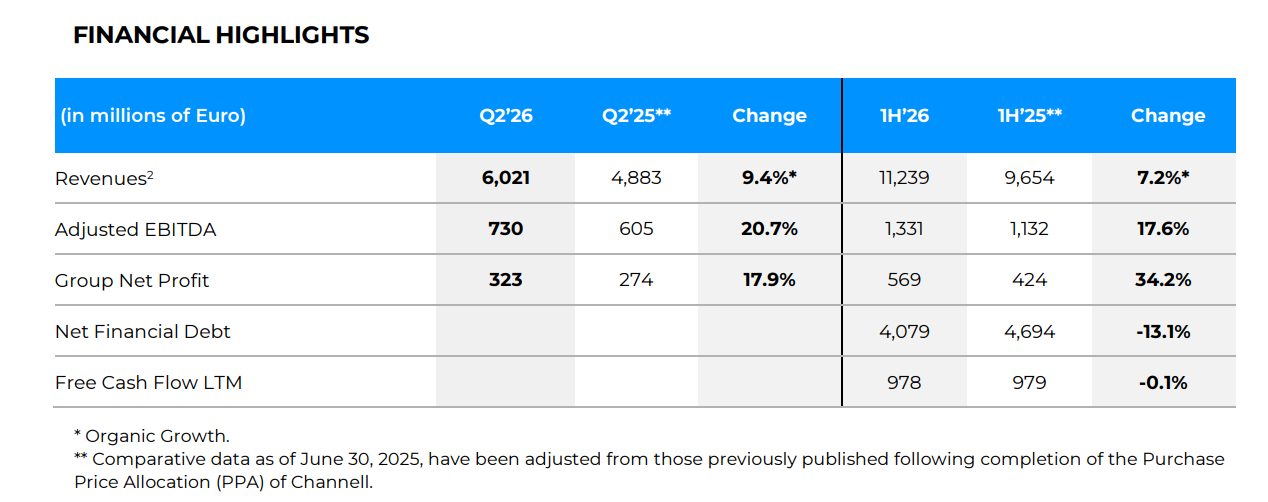
- Prysmian recorded second quarter revenue of €6.02 billion and adjusted EBITDA of €730 million.
- Transmission and Power Grid activities achieved organic growth of 14.3% and 13% respectively.
- Full year adjusted EBITDA guidance has increased to between €2.8 billion and €2.9 billion.
Prysmian has raised its full year financial guidance after recording organic growth across transmission, power grid, industrial, and digital infrastructure activities during the second quarter of 2026.
Quarterly revenue reached €6.02 billion, compared with €4.88 billion during the corresponding period of 2025, while organic growth stood at 9.4%. Adjusted EBITDA increased by 20.7% to €730 million, and the group’s adjusted margin rose from 14.5% to 15.4%.
Following what it described as its strongest quarterly performance to date, Prysmian increased its forecast for full year adjusted EBITDA to between €2.8 billion and €2.9 billion. The previous range had been €2.625 billion to €2.775 billion.
Expected free cash flow has also been raised, moving from €1.3 billion to €1.4 billion previously to a revised range of between €1.65 billion and €1.75 billion.
Transmission recorded organic growth of 14.3%, adjusted EBITDA of €179 million, and a margin of 21.2%. During the second quarter of 2025, the division had produced adjusted EBITDA of €125 million and a margin of 17.1%.
Power Grid achieved organic growth of 13%, with adjusted EBITDA remaining broadly stable at €135 million. Its margin reached 13.8% and improved sequentially from the first quarter.
Industrial & Construction produced organic growth of 9.1%, supported partly by North American data centre demand. Adjusted EBITDA reached €228 million, while the margin stood at 13.6%.
Digital Solutions recorded the fastest organic growth at 18%. Adjusted EBITDA almost doubled to €122 million, and the margin increased to 23.8%, supported by optical cable activities and the contribution from Channell.
Across the first half, revenue reached €11.24 billion and represented organic growth of 7.2%. Adjusted EBITDA rose to €1.33 billion, while net profit increased to €584 million from €435 million during the equivalent period of 2025.
Net financial debt stood at €4.08 billion at the end of June, down from €4.69 billion a year earlier. First half capital expenditure totalled €703 million as the group continued investing in manufacturing, capacity, and integration programmes.
Cable demand spreads across several infrastructure markets
The results show expansion across several cable markets at the same time rather than dependence on a single generation technology or geography. Offshore transmission, interconnectors, distribution reinforcement, renewable connections, data centres, industrial electrification, and telecommunications all draw on overlapping manufacturing resources.
High voltage cable programmes require specialised conductor production, insulation extrusion, armouring, accessories, factory testing, transport, jointing, and commissioning. Submarine projects add cable laying vessels, route clearance, landfalls, burial equipment, weather windows, and offshore repair capability.
Distribution projects use different products and installation methods but still compete for many of the same metals, polymers, factories, test facilities, and engineering skills. Grid operators are seeking higher production volumes while also expecting shorter delivery periods and greater certainty over project schedules.
Transmission profitability reflects both demand and the technical barriers to entry. Qualification cycles are lengthy, individual projects are large, and delivery failures can carry substantial financial consequences, requiring factory loading to be coordinated closely with marine works, converter stations, substations, and network outages.
Power grid growth has a broader operational base because distribution networks require cables, joints, terminations, connectors, monitoring systems, and accessories across thousands of reinforcement and connection projects. Framework agreements can provide stable volumes, although product mix and delivery timing still affect margins.
The stronger performance follows similar evidence elsewhere in the sector, with Nexans also increasing its guidance as electrification activity expanded across grid, connection, and transmission markets.
Parallel growth among major manufacturers points to sustained infrastructure demand, while also increasing the importance of capital investment. Existing factories cannot absorb indefinite volume growth without additional production lines, testing equipment, storage space, trained operators, and dependable supplies of conductor and insulation materials.
Data centre development adds another concentrated source of demand. Campus connections may require high capacity utility supplies, substations, medium voltage distribution, standby generation, uninterruptible power systems, and extensive optical connectivity, drawing simultaneously on Prysmian’s energy and digital portfolios.
The group reported that New Product and Solution Vitality reached 32% during the first half, meeting its 2028 target two years early. Sustainability linked revenue accounted for 45.9% of first half activity.
Product development is increasingly shaped by system performance as well as conductor capacity. Utilities and asset owners are seeking lower loss designs, improved fire performance, digital monitoring, longer operating lives, and installation methods that reduce disruption or make better use of restricted routes.
Execution remains the main constraint. A cable can leave the factory on schedule and still face delay if civil works, substations, vessels, or jointing teams are unavailable, while a delayed cable delivery can leave completed network infrastructure unable to energise.
Prysmian enters the second half with higher expected earnings and growth across its principal infrastructure divisions. Maintaining that performance will depend on converting demand into sequenced production, controlling project risk, integrating acquisitions, and expanding capacity without weakening quality or delivery discipline.