
IN Brief:
- NatPower and Tesla have agreed a multi-year battery storage programme covering more than 25GWh of projects in Europe.
- The agreement combines Tesla Megapack systems, EPC delivery, and trading software for assets in Italy and the UK.
- The programme reinforces the growing link between grid-scale storage, route-to-market strategy, and dispatchable flexibility.
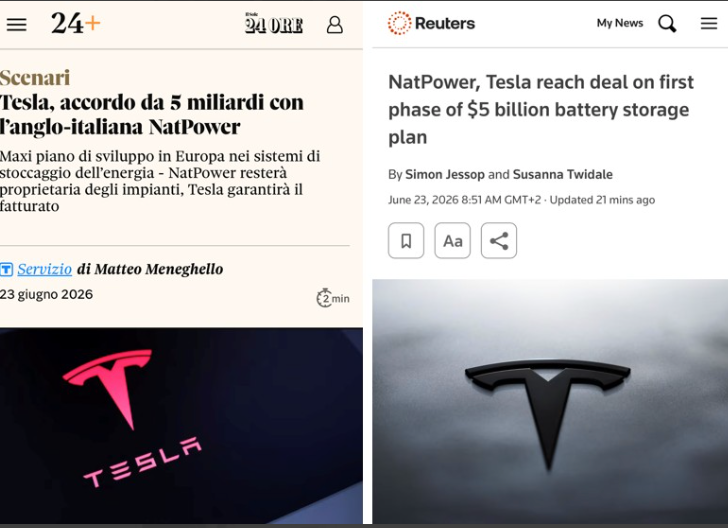
NatPower and Tesla have signed a multi-year agreement for more than 25GWh of battery energy storage systems across Europe, with the first projects focused on Italy and the UK.
The agreement covers Tesla Megapack systems, EPC services, and trading optimisation through Autobidder software. NatPower will own and operate the storage assets, while Tesla’s role will span equipment supply, project execution, and market-facing revenue optimisation.
At this scale, the programme moves beyond a conventional equipment supply arrangement and into the territory of long-term energy infrastructure delivery. Large storage portfolios increasingly require battery systems, balance-of-plant works, grid interface design, dispatch strategy, and market access to be aligned before construction begins, rather than being stitched together after projects have secured grid connections.
Italy and the UK are two of Europe’s more active storage markets, although their grid pressures differ. Italy is managing fast solar growth, regional network constraints, and the need for greater balancing capacity across the power system. The UK has a more mature renewables fleet, tighter transmission corridors, and growing distribution-level flexibility procurement as electrification changes local demand patterns.
Battery storage is becoming an operational layer in the power system rather than a supplementary technology. Higher renewable penetration creates periods of surplus generation, curtailment, and low wholesale pricing, while evening demand peaks and low wind conditions can leave the system looking for dispatchable capacity. Storage assets that can move between wholesale trading, balancing services, ancillary services, and network flexibility products are becoming more valuable as those operating conditions become more frequent.
The commercial model is also maturing. A battery project is no longer defined only by its megawatt rating, cell chemistry, or grid connection offer. The revenue stack depends on dispatch software, degradation management, warranty terms, market access, financing structure, and operational availability. A combined supply, EPC, and optimisation agreement reduces the number of interfaces between developer, technology supplier, contractor, and trading platform.
The same shift is visible across other European storage projects. In Germany, a BESS flexibility agreement between Flower and ENGIE placed optimisation and market access at the centre of the commercial model, rather than treating batteries as passive grid-connected assets. The NatPower and Tesla programme takes that principle to a larger portfolio level, where trading performance and operational discipline become as important as installed capacity.
For Italy, storage deployment is closely linked to the physical geography of generation and demand. Solar resources are strongest in regions where network export capacity can be limited, while demand centres and industrial loads are often located elsewhere. A battery fleet able to absorb surplus generation and discharge during constrained or higher-value periods can reduce curtailment, improve system balancing, and support more efficient use of existing grid infrastructure.
In the UK, grid-scale batteries are increasingly being shaped by connection delays, transmission bottlenecks, local flexibility markets, and the need to manage renewable variability without relying on fossil-fuelled peaking capacity. Large storage portfolios will need to prove that they can provide dependable system value, not simply take advantage of short-term price volatility.
The agreement gives NatPower a structured route to equipment supply and project execution at a point when European storage developers are competing for battery systems, grid capacity, and investment confidence. It also places Tesla’s Megapack platform more deeply into two markets where storage is becoming central to energy security, renewable integration, and grid flexibility.
Portfolio scale will not remove the harder delivery constraints. Grid queue management, planning, construction capacity, safety standards, and market reform will still determine how quickly projects move from development to operation. If those barriers are managed, the NatPower and Tesla programme could become a significant reference point for how European storage moves from individual projects into coordinated, dispatchable infrastructure.

