IN Brief:
- National Grid’s Little Horsted substation is now energised and operational in East Sussex.
- The project adds around 0.5GW of transmission capacity, supported by two 178-tonne supergrid transformers.
- The substation forms part of wider South East network investment as regional electricity demand rises.
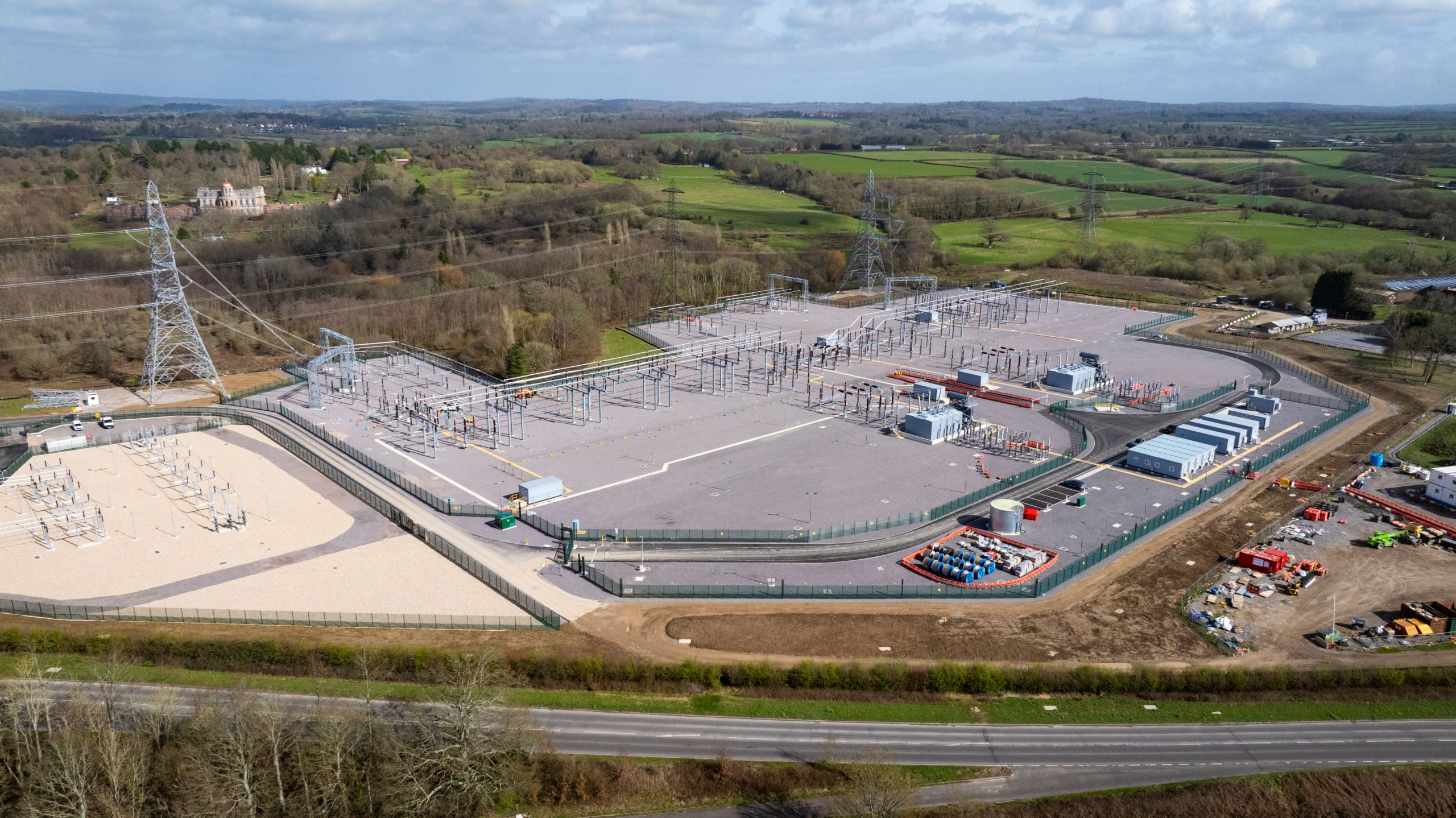
National Grid has brought the Little Horsted substation into operation in East Sussex, adding around 0.5GW of capacity to the electricity transmission network in the South East.
The new substation is located on the transmission route between Bolney and Ninfield and will support increased electricity demand across the region. National Grid has said the added capacity is equivalent to the electricity needs of around 480,000 homes, while the engineering function of the project is to strengthen the transmission-to-distribution interface for future load growth and customer connections.
The scheme will help UK Power Networks complete its adjacent distribution substation, which will provide additional capacity for local customers. Most of that separate DNO project is due to be completed by spring 2027, creating a coordinated reinforcement between transmission and distribution infrastructure.
Little Horsted was built over a two-year construction period and required major enabling works before the electrical assets were installed. Around 65,000 cubic metres of earth were removed to level the site, with material reused locally for surfacing and landscaping works. In October 2024, two 178-tonne supergrid transformers were transported from Shoreham Port in Brighton to the site over a 27-mile route.
The project also included upgrades to one of the overhead line circuits feeding in and out of the substation. National Grid expects to return later to upgrade the second circuit, allowing reinforcement to continue while operational continuity is maintained across the transmission route.
Little Horsted sits within a wider investment programme for the South East. National Grid has planned £2.7bn of network investment in the region between 2026 and 2031 to maintain, upgrade, and futureproof the system.
The South East faces a changing electricity profile as new housing, commercial growth, transport electrification, and heat electrification place heavier demands on distribution networks. Transmission substations such as Little Horsted provide the upstream capacity needed for DNOs to reinforce local circuits and accommodate new connections.
The project also illustrates the physical scale behind transmission reinforcement. Substation energisation is often described through headline capacity figures, but delivery depends on transformer logistics, overhead line works, land preparation, environmental mitigation, protection systems, testing, and staged commissioning.
Coordination between National Grid and UK Power Networks is central to the project’s long-term value. Distribution networks can only release additional capacity to customers where upstream supply and system conditions allow it. Reinforcement at the transmission boundary is therefore becoming more tightly linked to local network readiness.
With Little Horsted operational, the South East gains a further transmission node able to support distribution reinforcement and future customer demand. The next phase of value will come as downstream works move through completion and new capacity becomes available to homes, businesses, and infrastructure projects across the area.