
IN Brief:
- Integrals Power will supply more than 150kg of LMFP cathode active material to OLiMPUS.
- The €9m Horizon Europe project runs from 2026 to 2030 and is coordinated by SINTEF.
- OLiMPUS targets mass production of European LMFP cells by 2032 for road and maritime applications.
Integrals Power has been selected to supply its manganese-rich lithium manganese iron phosphate cathode active material to OLiMPUS, a €9m Horizon Europe project to develop and industrialise LMFP battery cells in Europe.
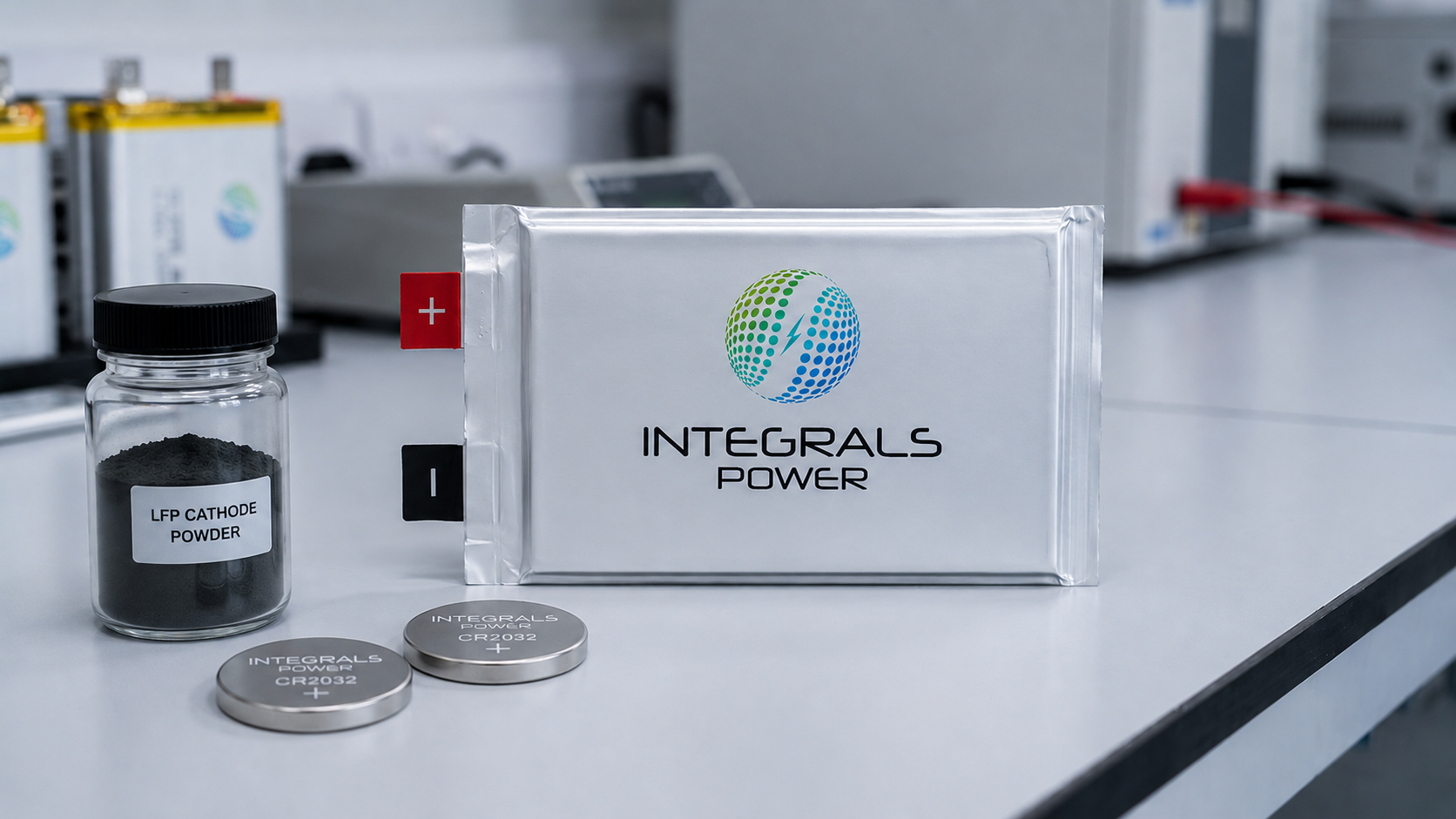
The Milton Keynes-based battery technology company will manufacture and supply more than 150kg of its patented LMFP cathode active material to the project. It will also support manufacturing scale-up, industrialisation, cell prototyping, and performance validation.
OLiMPUS is coordinated by Norwegian research organisation SINTEF and brings together 16 partners across the battery value chain. Participants include Volvo Trucks, Magna Steyr, Verkor, Vianode, Corvus Energy, CEA, Uppsala University, Politecnico di Torino, DLR, NTNU, Solvionic, and other research and industrial organisations.
The project runs from 2026 to 2030 and aims to develop low-cost, safe, sustainable LMFP||graphite battery cells that can be manufactured using European materials, process equipment, and technology. Industrial partners are targeting mass production of OLiMPUS materials, cells, packs, and EV systems in Europe by 2032.
The project will manufacture 132 EV-grade pouch and prismatic cells in capacities from 10Ah to 80Ah. Target energy density is up to 220Wh/kg. The cells are expected to reach EUCAR safety level 2–3 and UN38.3 transport certification, supporting safer cell-to-pack architectures with higher pack-level energy density and lower manufacturing and certification costs.
The manufacturing route includes aqueous and quasi-dry electrode processing and low-CO₂ synthetic graphite. The project replaces toxic and highly flammable NMP solvent-based slurries with water-based processing, while a semi-dry electrode coating process is intended to reduce drying-stage energy consumption compared with conventional wet slurries.
OLiMPUS also includes advanced characterisation, operando sensing, hybrid physics-based and AI models, degradation modelling, lifetime prediction, digital twins, lifecycle impact assessment, and recycling-by-design work. Recycling targets are set at 80–90% by mass to support compliance with the EU Batteries Regulation.
Compared with NMC811||graphite systems, OLiMPUS expects to reduce lifecycle CO₂-equivalent emissions by about 1.8 million tonnes by 2050. Preliminary techno-economic assessment estimates costs of €56–65/kWh at cell level and €67–75/kWh at pack level.
Integrals Power’s LMFP material has an 80% manganese content, enabling up to 20% higher energy density than conventional LFP while retaining key advantages around cost, safety, and cycle life. The chemistry avoids nickel and cobalt, positioning it as an alternative to NMC chemistries still widely used in European and North American EV production.
The project sits across battery supply-chain resilience, transport electrification, and grid-scale storage. Europe has faced repeated setbacks in battery manufacturing capacity, with planned projects cancelled, delayed, or downsized as cost pressure, Chinese competition, raw-material risk, and uncertain demand have affected investment. OLiMPUS takes a chemistry route that reduces dependence on critical minerals while targeting manufacturability through European supply chains.
European storage deployment is already being shaped by questions of bankability, safety, supply security, and lifecycle cost. Policy work to accelerate storage across the EU has highlighted the need for faster deployment and stronger market structures, while OLiMPUS addresses an upstream part of the same challenge by focusing on cathode chemistry, process design, and cell industrialisation.
LMFP is gaining interest because it offers a middle ground between LFP and nickel-rich chemistries. LFP is known for lower cost and strong safety performance, but it has lower energy density. Nickel-rich chemistries offer higher energy density, but they depend on more expensive and geopolitically sensitive materials. LMFP aims to raise energy density while keeping the structural advantages of phosphate-based chemistry.
For maritime applications, safety and cycle life are especially important. Battery systems on vessels must meet demanding certification, thermal management, redundancy, and operating requirements. The involvement of Corvus Energy and Volvo Trucks gives the project exposure to heavy-duty duty cycles, where batteries must support high utilisation, durability, and predictable lifecycle cost.
The manufacturing process is as important as the chemistry. A battery material that performs well at laboratory scale can still fail to become commercially useful if it cannot be produced consistently, coated efficiently, assembled into cells, and validated under industrial conditions. Integrals Power’s role in supplying material and supporting scale-up places it within that transition from materials development to industrial cell production.
OLiMPUS does not resolve Europe’s battery manufacturing challenge on its own, but it targets a practical route through part of it: chemistry selection, process simplification, lower critical-mineral exposure, digital validation, and end-user involvement from the start. If the project reaches its 2032 mass-production target, LMFP could become a stronger European option for heavy transport, maritime, and stationary energy storage applications.

