IN Brief:
- A German pilot is testing DC-coupled battery storage for commercial solar applications.
- The Widderstall project uses a 252kWh battery and Sigenergy hybrid inverters behind a constrained grid connection.
- DC coupling could reduce inverter hardware, improve solar oversizing, and ease connection constraints.
Sigenergy, EnBW, and the Center for Solar Energy and Hydrogen Research Baden-Württemberg are testing a DC-coupled commercial battery storage system in Widderstall, Germany.
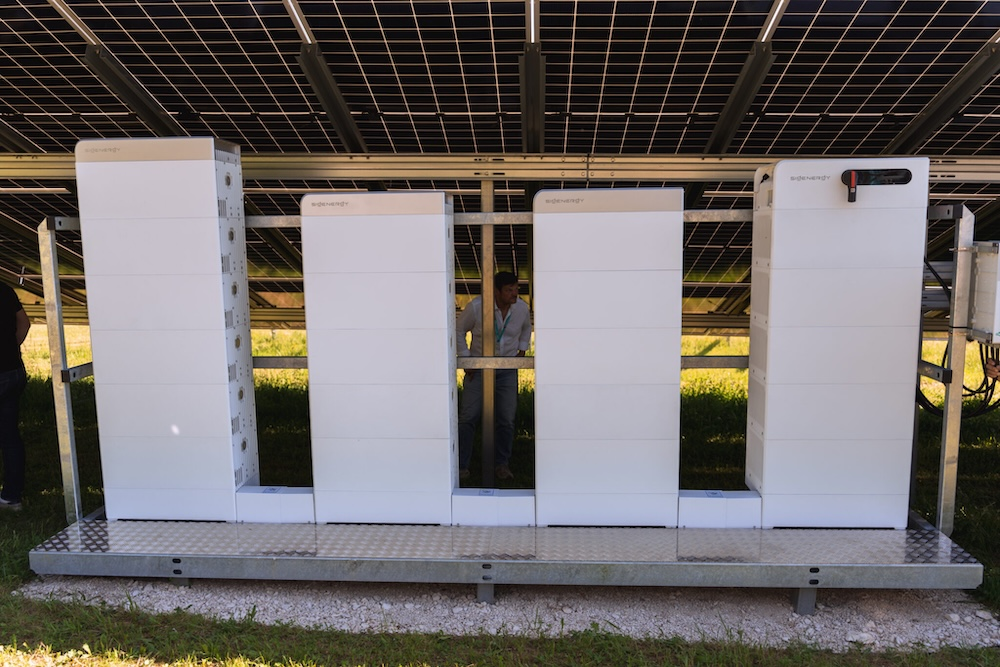
The research project is examining whether DC-coupled architecture can reduce material use, simplify design, improve system efficiency, and make better use of constrained grid connections. The installation includes a 252kWh battery and Sigenergy Sigen Hybrid 60 M1-HYA hybrid inverters, allowing direct DC coupling between solar PV and battery storage.
Commercial solar installations increasingly face a mismatch between available roof or land area and available network capacity. A site may be able to support a larger PV array physically, while the grid connection agreement limits how much power can be exported. Storage can absorb surplus generation, but the way that storage is connected changes both cost and performance.
In a conventional AC-coupled arrangement, a 100kW PV system connected behind a 50kW grid connection may require both 100kW of solar inverter capacity and additional battery inverter capacity, with export limits applied to prevent the site exceeding its agreed connection limit. The equipment duplication can add cost, space requirements, and conversion losses.
A DC-coupled design can use a single hybrid inverter to manage both solar conversion and battery charging. In the example under test, 50kW could be converted and exported to the grid while the remaining PV output is stored directly on the DC side. That configuration can reduce the number of power-electronics components required and allow more PV capacity to be installed behind the same connection.
The appeal is strongest where grid connections are expensive, delayed, or capped. Solar developers and commercial site operators increasingly face situations where roof space, land, or demand profile would support larger PV systems, but network capacity limits export. Battery storage can improve the commercial case by increasing self-consumption and allowing more generation to be used without breaching connection terms.
DC coupling is not new, but it is becoming more relevant as commercial sites combine solar, storage, EV charging, and active energy management. Behind-the-meter projects must now optimise self-consumption, export, peak demand, tariffs, market signals, and connection constraints. The architecture of the system determines how much flexibility is available and how many conversion losses occur between generation, storage, load, and export.
The Widderstall project also intersects with Germany’s proposed MiSpeL regulatory framework, which is intended to define how stored electricity is tracked and allocated between renewable and grid sources. Batteries may be charged from on-site solar, from the grid, or from both, and those accounting rules influence subsidy eligibility, renewable attribution, tax treatment, and trading models.
Under the current draft, DC-coupled systems are not eligible for the most flexible accounting option and can only use a simplified allocation model. The project partners are seeking to demonstrate that DC-side metering can accurately separate renewable electricity from grid electricity, potentially informing future regulatory revisions.
Commercial and industrial storage is becoming a larger part of the market as German storage revenues are forecast to exceed €17bn. DC-coupled systems could become a practical route for sites where electrical design is shaped by limited connection capacity and high on-site renewable potential.
The engineering question extends beyond component count. DC-coupled systems must satisfy protection, metering, safety, fire-risk, isolation, grid-code, and maintenance requirements. Installers and designers also need clear commissioning procedures because faults, controls, and measurement points differ from AC-coupled layouts.
The potential reward is a more efficient use of existing infrastructure. Grid reinforcement remains essential in many locations, but commercial projects can move faster where storage and controls allow more generation to be installed without breaching connection limits. Power electronics are becoming a decisive part of grid utilisation, not a secondary equipment category.
Further technical information is available through Sigenergy.