IN Brief:
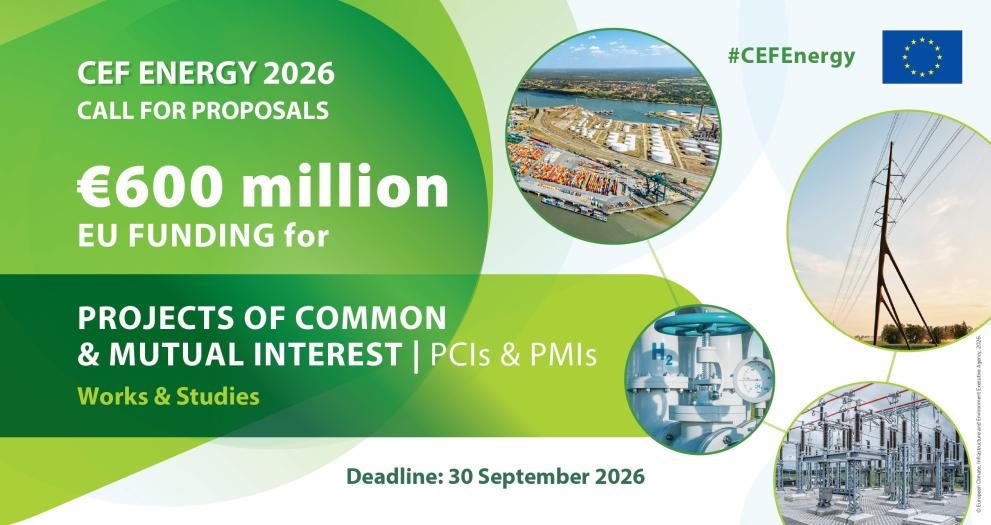
- The European Commission has opened a €600m CEF Energy call for cross-border energy infrastructure projects.
- The funding is available for studies and works linked to electricity, smart grids, hydrogen, CO₂ networks, electrolysers, and related infrastructure.
- Applications close on 30 September 2026, with an online information day scheduled for 18 May 2026.
The European Commission has opened a €600m Connecting Europe Facility Energy call for cross-border energy infrastructure projects, targeting schemes included in the second Union list of Projects of Common Interest and Projects of Mutual Interest.
The funding is available to co-finance studies and works across electricity, smart electricity grids, smart gas grids, CO₂ networks, hydrogen infrastructure, electrolysers, and projects covered under Article 24 gas derogation arrangements. Applications close on 30 September 2026, with an online information day scheduled for 18 May to explain the call, policy context, application process, and evaluation route.
The eligible project list reflects the revised TEN-E framework, which supports cross-border infrastructure aligned with Europe’s energy security, decarbonisation, and market integration goals. Projects selected as PCIs or PMIs can benefit from accelerated permitting, improved regulatory treatment, and access to EU funding instruments designed to reduce delivery risk for infrastructure with cross-border system value.
The updated PCI-PMI transparency platform includes 235 projects in the second list. These comprise 113 electricity, offshore, and smart electricity grid projects, 100 hydrogen and electrolyser projects, three smart gas grid projects, 17 CO₂ network projects, and two natural gas interconnections. The composition of the list shows how European energy infrastructure planning has moved beyond conventional generation and point-to-point interconnectors.
Electricity networks remain at the centre of the programme. Renewable generation, electrified heat and transport, and higher cross-border power flows are placing greater demands on transmission planning, grid automation, and network reinforcement. Smart electricity grid projects sit within that pressure point, particularly where digital control, flexibility, and real-time system operation can defer or reduce conventional reinforcement.
The hydrogen and CO₂ elements also show how power infrastructure is becoming more closely connected to industrial decarbonisation. Electrolysers require access to clean electricity and network capacity, while CO₂ transport projects depend on integrated planning between industrial clusters, ports, storage sites, and energy corridors. Power networks are increasingly supporting adjacent energy systems rather than operating as standalone assets.
Grid connection queues, permitting timelines, supply chain constraints, higher financing costs, and rising demand for power system flexibility continue to shape project economics. EU funding can improve the financeability of early-stage studies and support works where cross-border benefits are difficult to recover through national tariff structures alone.
The call places a clear burden on project promoters to demonstrate system value as well as asset scale. Cross-border infrastructure is expected to contribute to resilience, market coupling, renewable integration, and long-term decarbonisation. Projects with clear technical definition, credible delivery pathways, and measurable benefits across more than one member state or neighbouring energy system are best placed within that framework.
Applications for the CEF Energy call can be submitted through the relevant EU funding route until 30 September 2026. Further details on the call and eligibility requirements are available from the European Climate, Infrastructure and Environment Executive Agency.