
IN Brief:
- The Electricity Storage Network has published Battery Energy Storage Systems Explained for communities, elected representatives, and stakeholders.
- The guide covers common planning concerns including fire safety, emergency response, environmental effects, land use, noise, traffic, biodiversity, cybersecurity, and EMFs.
- The publication arrives as GB battery deployment expands and planning scrutiny of grid-scale storage becomes more technically detailed.
The Electricity Storage Network has published Battery Energy Storage Systems Explained, a guide designed to support informed discussion around grid-scale battery storage projects.
Developed through Regen and ESN, the guide is aimed at communities, elected representatives, and stakeholders involved in battery energy storage system planning and engagement. It addresses the issues most frequently raised around BESS developments, including fire safety, emergency response planning, environmental effects, biodiversity, land use, visual impact, noise, traffic, electromagnetic fields, cybersecurity, and operational resilience.
The publication comes as battery storage moves from early grid-service deployment into a larger and more visible infrastructure class. In 2025, 108GW of new battery storage capacity was deployed worldwide, representing a 40% increase on the previous year. In Great Britain, around 2GW of BESS entered commercial operation during the same period, representing an estimated £1.2bn of investment.
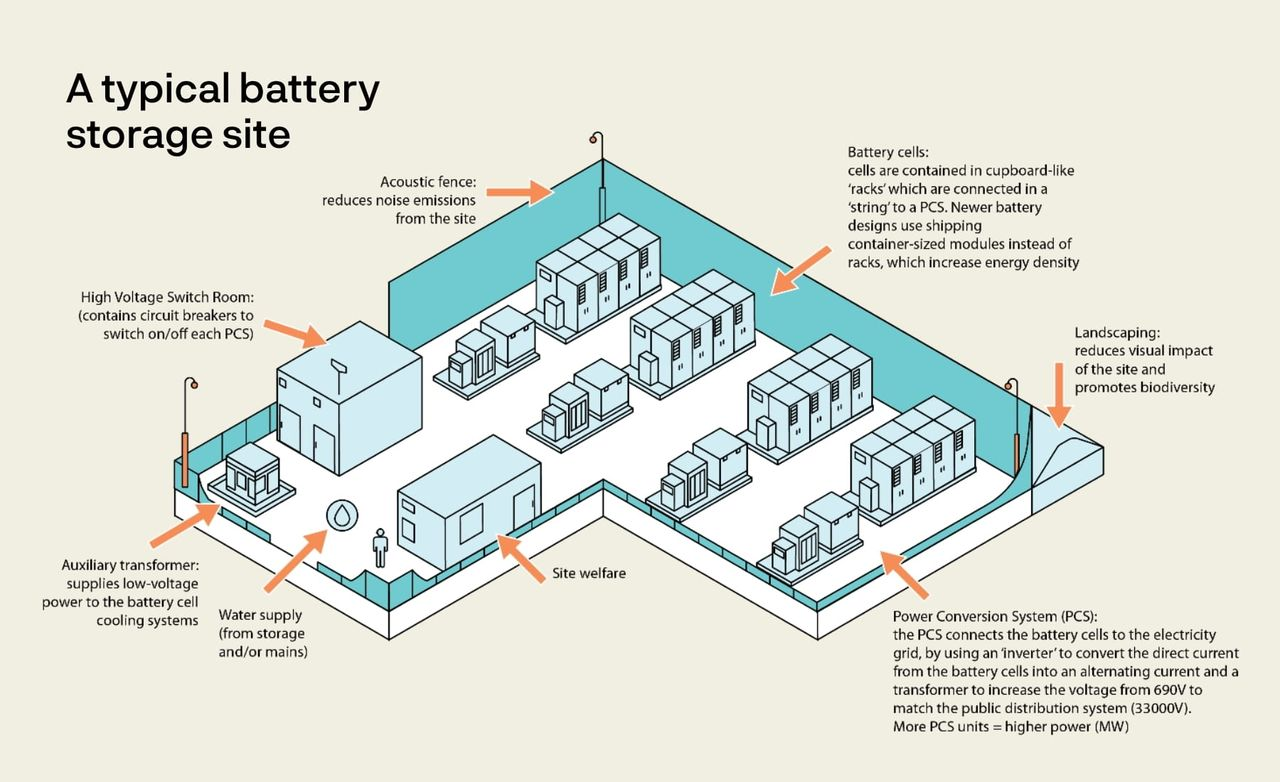
As project numbers, site sizes, and grid-facing requirements increase, battery storage now occupies a more prominent position in local planning systems. New schemes can include containerised battery units, inverters, transformers, switchgear, substations, high-voltage connection equipment, drainage design, acoustic mitigation, perimeter security, fire-water management, control systems, and communications infrastructure.
The ESN guide sets out how the sector is addressing those issues through evolving standards, regulatory oversight, technical design, and established good practice. Fire safety receives detailed attention, with the guide explaining the use of monitoring, detection, suppression, spacing, isolation, and emergency response planning in modern battery projects.
Land use is also treated as a technical planning issue. Battery storage projects generally require far smaller land areas than large solar or wind developments, although local objections often focus on agricultural land quality, landscape change, visual effects, construction access, and long-term site restoration. The guide sets out the role of site selection, landscaping, biodiversity net gain, and avoidance of ecologically sensitive areas where possible.
Noise and transport are handled as practical design and delivery considerations rather than secondary concerns. Battery sites include cooling equipment, power conversion systems, transformers, and other electrical equipment that can require acoustic assessment and mitigation. Construction can also involve abnormal-load deliveries for transformers and other heavy components, making traffic management part of the delivery process.
Cybersecurity now sits inside the technical assurance picture because batteries are remotely monitored, aggregated, and dispatched across multiple markets. Storage systems can sit at the intersection of grid operations, market platforms, and asset management software. Encryption, authentication, network segmentation, and the ability to isolate equipment if a threat is detected are therefore becoming part of BESS design and operation.
Planning scrutiny is becoming more detailed as consented battery capacity expands. Island Green Power’s consent for the Broadclyst BESS project showed how proximity to transmission infrastructure, flexibility value, site design, and local network constraints are now shaping the route from development pipeline to operational asset.
Other storage activity points in the same direction. Gresham House’s £141m financing package for three UK BESS projects and Fidra Energy’s Enderby acquisition show how battery projects are moving into larger capital structures and longer-duration development decisions. Planning quality and public confidence become more demanding as project scale increases.
The technical case for storage is tied to a power system with higher renewable penetration, changing demand, and persistent network constraints. Batteries can absorb power when generation is high or demand is low, discharge during tighter periods, support frequency and balancing services, and provide flexibility around local network conditions. They cannot remove the need for reinforcement, but they can improve how existing infrastructure is used.
Public confidence depends on more than a general explanation of what batteries do. Communities are being asked to accept unfamiliar electrical infrastructure, often near substations, rural land, or existing renewable projects. Project teams therefore need to explain how each site is designed, protected, monitored, maintained, connected, and eventually decommissioned.
Battery Energy Storage Systems Explained can be downloaded through Regen’s guide page.
As more storage projects enter planning, stronger technical guidance should help reduce confusion and focus scrutiny on evidence. Developers will still need site-specific design, transparent engagement, and robust emergency planning to move projects from consent into safe long-term operation.

