IN Brief:
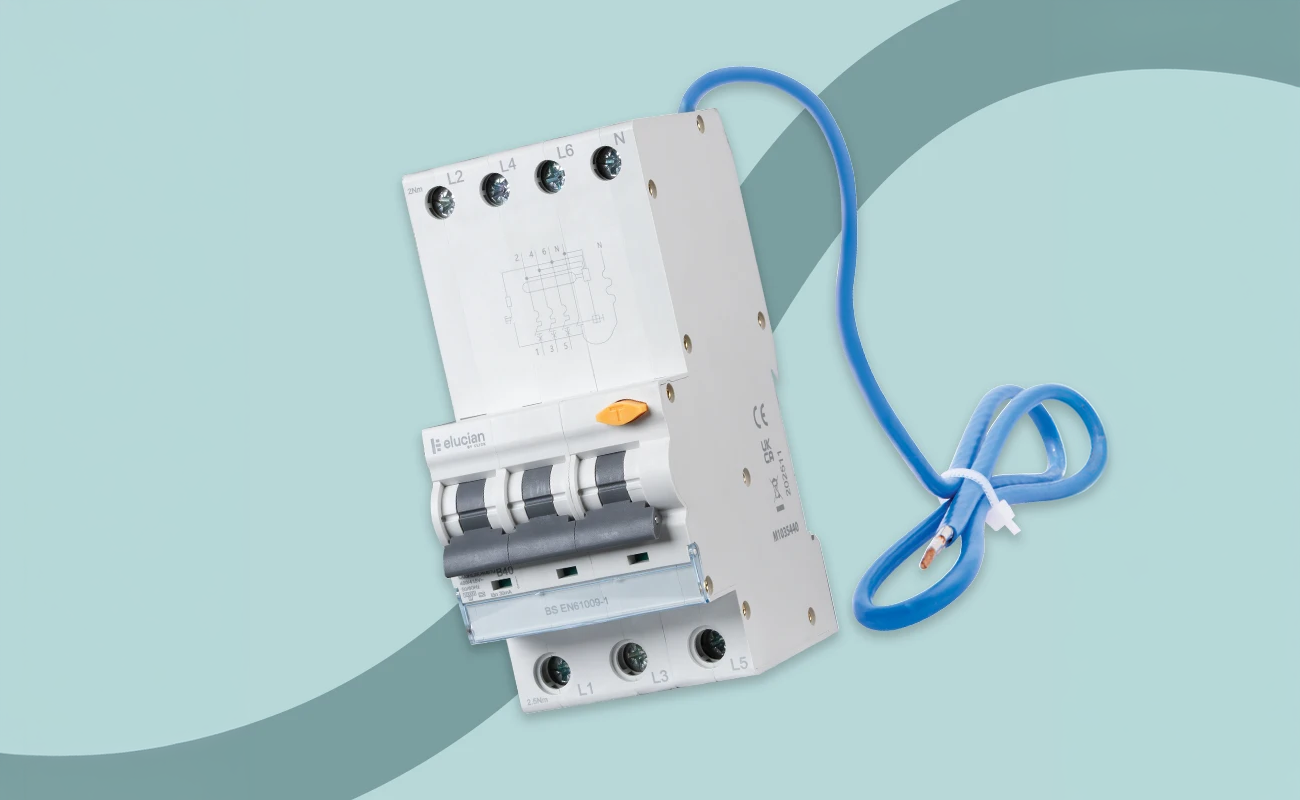
- Elucian has introduced a 10kA three-pole plus switched-neutral bi-directional RCBO range.
- The range is available in B and C curve options from 6A to 63A, with 30mA Type A protection.
- The devices target three-phase installations including renewables, EV charging, HVAC, industrial, and commercial applications.
Elucian has introduced a 10kA three-pole plus switched-neutral bi-directional RCBO range for three-phase electrical installations.
The range is available in B and C curve options from 6A to 63A, with each device supplied with a one-metre fly lead. The units provide 30mA Type A residual current protection and are designed for renewable energy systems, EV charging, HVAC, industrial, and commercial applications.
The launch extends Elucian’s circuit protection offer beyond single-phase consumer units and into more demanding three-phase distribution environments. The range is positioned as a space-saving option for installations where combined overcurrent and residual current protection is required, including sites with multiple three-phase sockets or loads connected through a single protective device.
Bi-directional protective devices are becoming more prominent as electrical installations move away from simple one-way power flow. Solar PV, battery energy storage, EV charging, heat pumps, and other distributed energy assets can create more complex current paths than conventional load-only circuits. Protective devices must be specified with those operating modes in mind, particularly where generation, storage, or charging equipment may export, import, or interact with local distribution boards in different ways.
The 10kA breaking capacity is relevant for commercial and industrial settings where prospective fault currents can exceed the requirements normally associated with smaller domestic installations. Three-phase boards in workshops, commercial premises, industrial units, plant rooms, and energy infrastructure sites often require higher fault ratings, clearer selectivity, and robust device coordination.
The product also reflects the increasing overlap between traditional electrical contracting and low-carbon technology deployment. EV chargers, solar inverters, battery systems, and electrically driven HVAC equipment all require careful attention to circuit protection, residual current behaviour, harmonics, load diversity, and future maintainability. The protective device is part of the engineering boundary between new electrical loads and existing distribution infrastructure.
Type A residual current protection is now common across many modern electrical applications because equipment containing electronic components can produce residual currents with DC components. The correct RCD or RCBO type is essential to maintain protection performance and avoid blinding or nuisance operation. That becomes particularly important in installations involving EV charging, inverters, variable-speed drives, and power electronic loads.
The range arrives as the UK market continues to see growth in three-phase commercial electrification. Warehouses, retail parks, fleet facilities, industrial sites, offices, sports facilities, and mixed-use developments are adding new electrical capacity for charging, heating, cooling, and on-site generation. Distribution board design is having to account for higher loads, more diverse power flows, and greater need for segregation and maintainability.
Component manufacturers are adapting to those installation conditions with protective devices designed for repeated use across commercial and industrial electrification projects. The pace of electrification depends not only on high-profile infrastructure schemes, but also on the availability of compliant, well-specified protection equipment that can be installed repeatedly across ordinary sites.