IN Brief:
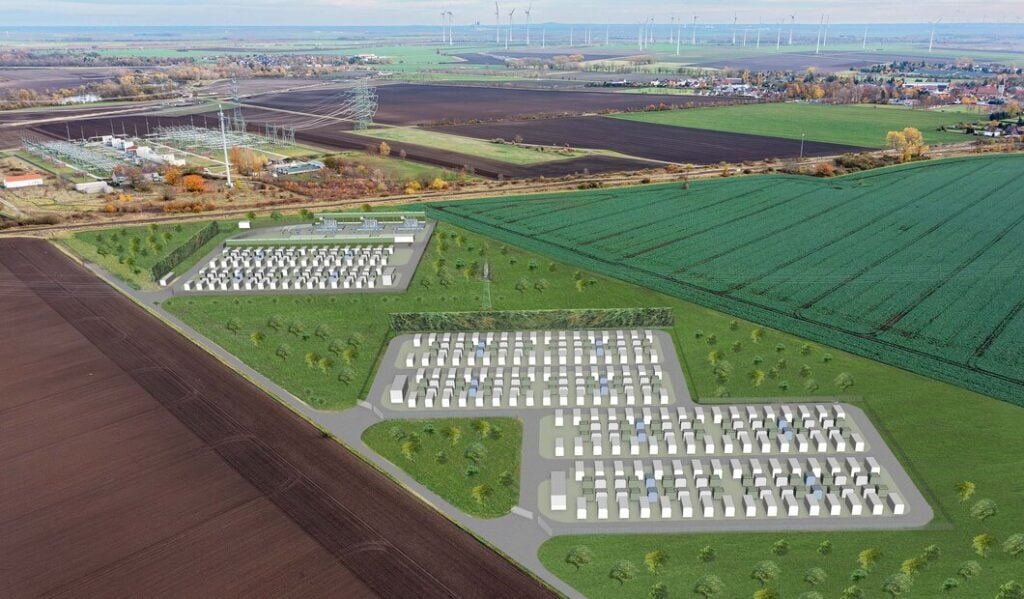
- Eco Stor has agreed a long-term tolling arrangement for its 300MW/700MWh Förderstedt battery energy storage system in Germany.
- Next Kraftwerke will trade the first 100MW phase across wholesale and balancing markets from November 2026.
- The deal places one of Germany’s largest battery projects inside a more contracted operating model as grid-scale storage accelerates.
Eco Stor has agreed a long-term tolling arrangement with Next Kraftwerke for the 300MW/700MWh Förderstedt battery energy storage system in Germany, giving the project a contracted trading route as it moves toward operation.
The agreement covers the first 100MW phase of the project, which Next Kraftwerke is expected to begin trading from November 2026. The full Förderstedt scheme is being developed in three 100MW phases, with the complete system scheduled to be online in 2027. Eco Stor lists the project as a 716MWh gross DC battery scheme under construction, forming part of a wider German storage portfolio designed around large-scale flexibility.
Next Kraftwerke will optimise the first phase across day-ahead, intraday, and balancing markets. That structure gives Eco Stor a route to revenue that is not wholly dependent on unmanaged merchant exposure, while placing operational optimisation with a company already active in virtual power plant aggregation and flexible asset trading.
Germany’s storage market is being shaped by greater renewable output, growing balancing requirements, and a more sophisticated approach to battery revenue management. Large two-hour systems can arbitrage price spreads, absorb excess wind and solar generation, and support short-term system services, but their financeability increasingly rests on how those revenue streams are contracted, stacked, and managed across the asset life.
Alongside private contracting, policy is also changing the operating case for batteries. Germany’s decision to preserve grid-fee exemptions for storage strengthened the economics of assets that charge and discharge in response to system conditions, particularly where network tariffs could otherwise dilute flexibility revenues.
Förderstedt sits in that same commercial landscape. Battery projects are moving beyond capacity announcements and into the practical question of how flexible capacity is dispatched against volatile system conditions. In high-renewables markets, the value of a battery is shaped by its rated output, duration, connection point, market access, degradation strategy, and the quality of its control stack.
Tolling agreements can reduce development risk by separating asset ownership from trading execution. Developers gain a contracted layer around revenue, while traders and aggregators take responsibility for extracting value from market signals. That model is already common in more mature storage markets and is becoming more prominent in Europe as battery pipelines expand faster than long-term revenue certainty.
Germany is also becoming a practical test case for how storage scales when grid congestion, renewable curtailment, and wholesale volatility overlap. Projects such as Förderstedt are no longer peripheral assets connected at the edge of the system. They are being configured as active infrastructure for renewable balancing, intra-day flexibility, and system operation during rapid changes in supply and demand.
Operational performance will now become the harder measure. As large German batteries move from development to dispatch, availability, round-trip efficiency, degradation management, response accuracy, and market switching will all influence returns. Förderstedt gives Eco Stor and Next Kraftwerke a major platform on which to prove that model at scale.
Further information on Eco Stor’s storage portfolio is available from Eco Stor.