IN Brief:
- CMP Products will show a short-circuit cable cleat modelling tool developed with Continuum Blue at SPS 2026.
- The simulation considers electromagnetic forces and the structural response of cleats to inform selection, spacing and installation decisions.
- SG Transmission will also demonstrate electromagnetic, thermal and structural brake modelling for motors, drives and automated equipment.
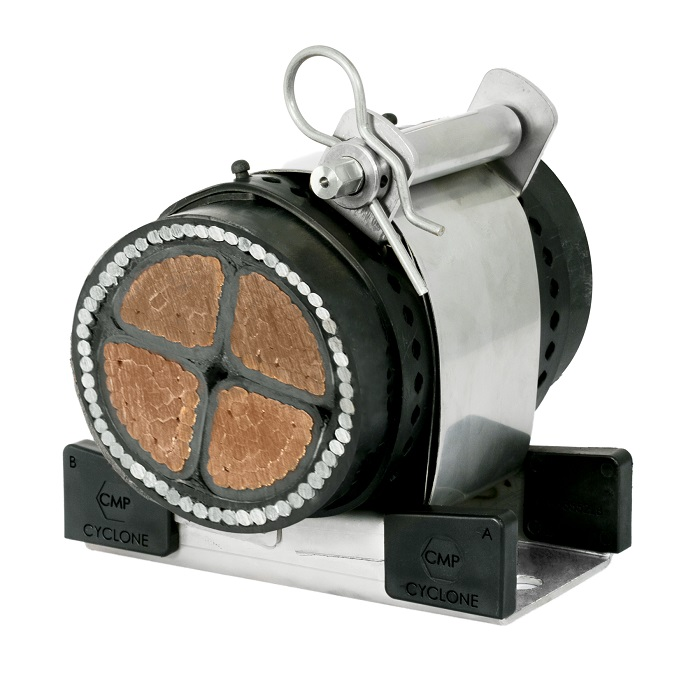
CMP Products will demonstrate a cable cleat simulation tool at SPS 2026 in Nuremberg, allowing engineers to examine the electromagnetic forces produced during a short circuit and the structural response of the cable restraints. Developed with Continuum Blue, the modelling is intended to inform cleat selection, spacing and installation design rather than merely identify a product from its dimensions.
The demonstrations are scheduled for 24–26 November, alongside a separate presentation by sister company SG Transmission on industrial brake simulation. Both businesses belong to British Engines, but their engineering applications differ: CMP is investigating cable restraint under electrical fault conditions, whereas SG Transmission is evaluating the coupled electromagnetic, thermal and mechanical behaviour of braking components.
A short circuit can produce high transient current in adjacent conductors, generating electromagnetic forces that act between the cables. Their magnitude and direction depend on the fault current waveform, cable formation and conductor spacing. Cleats restrain those forces at intervals along the cable route; inadequate restraint can permit movement that damages cable insulation, supports or nearby equipment. The new simulation examines how those forces act on the restraint structure. Because a fault can reach a high current peak in a short interval, the relevant design question is whether the installed cleat arrangement can hold its intended cable geometry throughout the specified event, without relying on steady-state mechanical loading assumptions.
CMP says its model can represent the forces generated during faults and the structural response of the cleats. Analysing both effects together may expose areas of high local stress or deformation in a proposed arrangement and inform decisions on support intervals. The November announcement provides no independently verified accuracy result, numerical comparison with a physical test, software release date or performance improvement figure.
Correctly specifying a cable restraint also requires the expected prospective peak fault current, the arrangement and dimensions of the cables, and the support structure to which the cleat is fixed. Conductors installed in trefoil formation may experience a different pattern of interaction from those laid flat. Model outputs therefore depend on representative installation inputs and cannot by themselves establish the suitability of every field configuration.
CMP launched a separate online cleat-selector tool in April 2026. It takes details such as cable diameter, cleat formation and required peak short-circuit rating and returns a suggested product and specification information. The forthcoming SPS demonstration extends the discussion to force and structural behaviour; the manufacturer has not described it as a replacement for the existing selection tool.
IEC 61914 provides the recognised testing and performance framework for cable cleats, including their behaviour under short-circuit conditions. Numerical simulation can help evaluate prospective configurations before manufacture or testing, but a calculation is not automatically equivalent to a validated short-circuit withstand test. CMP’s announcement does not claim that its new tool grants compliance certification or removes applicable test requirements.
Continuum Blue founder Dr Mark Yeoman will present the modelling during the exhibition. His work draws on multiphysics analysis, where the outputs of one physical model inform another — in this case, an electromagnetic fault event and the resulting mechanical loads. The companies have not identified a specific customer installation or published test data that would establish a quantified reduction in installation costs or failures.
SG Transmission will demonstrate related simulation methods for electromagnetic permanent-magnet and spring-applied brakes. Its models combine electromagnetic, thermal and structural behaviour, including contact, wear and fatigue. These calculations are intended to support brake selection and lifetime assessment in motors, drives, robotics and automated guided vehicles. No particular duty cycle, expected service life or independently measured benefit is disclosed in the event material. These predictions would also need input data for the materials, interfaces and operating environment of the equipment being assessed, rather than a generic estimate of brake wear.
The SPS presentations will also cover ingress protection and electromagnetic compatibility in industrial cable management. CMP plans to show cable glands, cleats and lugs, including its TruSeal range, while SG Transmission will present its brake products. Those displays are distinct from the simulation research and should not be treated as announcements of new certified product ranges unless separately documented.
CMP’s technical sessions are scheduled for 24 November at 16:00 and 25 November at 12:00, while SG Transmission is listed for 24 November at 12:00 and 25 November at 16:00. Both will be in Hall 3C, Stand 358. The company identifies Continuum Blue as its development partner, but has not provided a general commercial availability date or licence terms for the simulation software.