IN Brief:
- The Halden factory has begun industrial-scale manufacture of Nexans’ qualified 525 kV HVDC XLPE subsea cable.
- LanWin2 is designed to transfer up to 2 GW from German North Sea wind generation, with commissioning targeted for 2031.
- BalWin3 is a separate connection whose Wadden Sea and nearshore cable installation activities are planned for 2027.
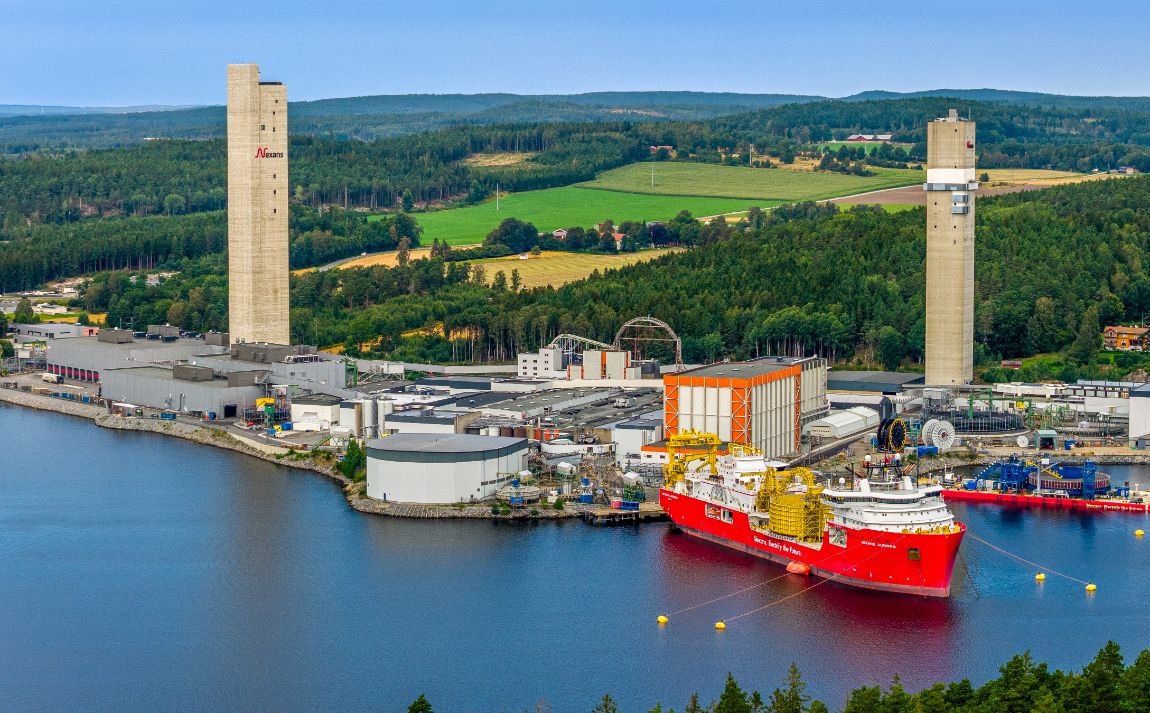
Nexans has started manufacturing 525 kV high-voltage direct current (HVDC) subsea cable for TenneT’s LanWin2 offshore grid connection at its Halden facility in Norway. This is the first industrial-scale production of Nexans’ qualified 525 kV crosslinked polyethylene (XLPE) insulated subsea cable design. Production begins the delivery phase for the cable package; it does not mean that any cable has been installed offshore or that the connection is ready to carry electricity.
LanWin2 is being developed to transfer up to 2 GW from offshore wind generation in the German North Sea into Germany’s onshore transmission grid. TenneT and Nexans currently expect the connection to be commissioned in 2031. That date belongs to LanWin2 as a complete transmission system, rather than the cable factory programme alone, and remains a future target subject to installation and integration of the associated converter and network works.
The start of full-scale manufacture follows qualification of the company’s cable technology. XLPE forms a solid insulating layer around the conductor, and maintaining consistent thickness, concentricity and cleanliness is important to electrical performance at high direct current voltage. A type-qualified design can proceed to manufacture, but each production length still requires its own manufacturing controls and acceptance tests. Qualification at a manufacturing site is therefore distinct from testing and commissioning a cable after installation on its marine route.
A long offshore export route differs from an ordinary alternating-current grid connection. Undersea alternating-current cables accumulate reactive charging current over distance, which can constrain how much useful power can be transferred and can require compensation equipment. High-voltage direct current systems instead use offshore and onshore converters to move large amounts of power over extended cable routes, with electrical losses and converter requirements assessed at the system level.
The offshore converter gathers alternating-current output from wind farms and converts it to direct current for transmission. At the landward end, an onshore converter returns the power to alternating current compatible with the transmission network. That architecture makes the cable a major component of a wider connection: converters, protection systems, control equipment, land cables, sea crossings and substations must all be completed and tested before the grid link can enter commercial operation.
The initial factory work must be followed by handling, transport, installation and electrical acceptance. Finished cables require testing before loading and then deployment by specialist vessels according to the permitted seabed route and protection design. Shore approaches, crossings, joints and terminations introduce additional interfaces. When the marine and onshore cables are in place, the HVDC link will still require converter, protection, control and end-to-end testing before energisation. Nexans’ 16 October announcement does not report completed cable laying or commissioning for LanWin2.
Nexans and TenneT established their long-term frame agreement in 2023 to reserve supply capacity and provide planning certainty for multiple connections. A framework agreement can support investment in manufacturing and installation resources, but it does not remove the delivery risks associated with specialised vessels, coastal crossings, route permissions or the different schedules of converter platforms and onshore works.
Nexans’ Norwegian announcement describes the full LanWin2 combined sea and land cable route as approximately 270 km towards Heide, Schleswig-Holstein, under an existing contract announced in January 2025. That is the planned route length, not a volume of cable already manufactured, loaded or laid. The contract and the 2023 TenneT frame agreement are earlier commercial milestones; the October 2026 development is the commencement of industrial cable production.
Another project under the same TenneT framework, BalWin3, uses the 525 kV technology but follows its own installation sequence. Nexans says cable installation activity in the Wadden Sea and nearshore areas is planned for BalWin3 in 2027. That is not a LanWin2 installation date and gives no basis for assuming LanWin2 will be energised in 2027. LanWin2 retains its distinct target of commissioning in 2031.
Specialised cable production capacity is central to the timing of offshore networks because cable runs have to be made, tested, stored and loaded in a sequence compatible with installation vessels and marine access windows. The physical characteristics of high-voltage subsea cables, including their diameter, bend limits and weight, require purpose-designed handling equipment. Changes to installation sequencing can affect other work packages even when factory manufacturing remains on schedule.
Other Nexans investments in European high-voltage manufacturing, including its Charleroi facility expansion, add wider industrial context but do not advance the construction status of LanWin2. At Halden, the verified change is that production of qualified 525 kV subsea cable has begun at industrial scale. Subsequent factory acceptance, offshore and land installation, converter integration and commissioning remain necessary before the planned 2 GW grid connection can operate.