IN Brief:
- Endesa will replace 40 turbines totalling 24MW at Coriscada with four modern 7MW machines.
- Annual production is forecast to rise from 47GWh to 83.9GWh despite the site retaining its 24MW export limit.
- Testing is planned for late 2027 and full operation for March 2028, with €6.79 million of IDAE support.
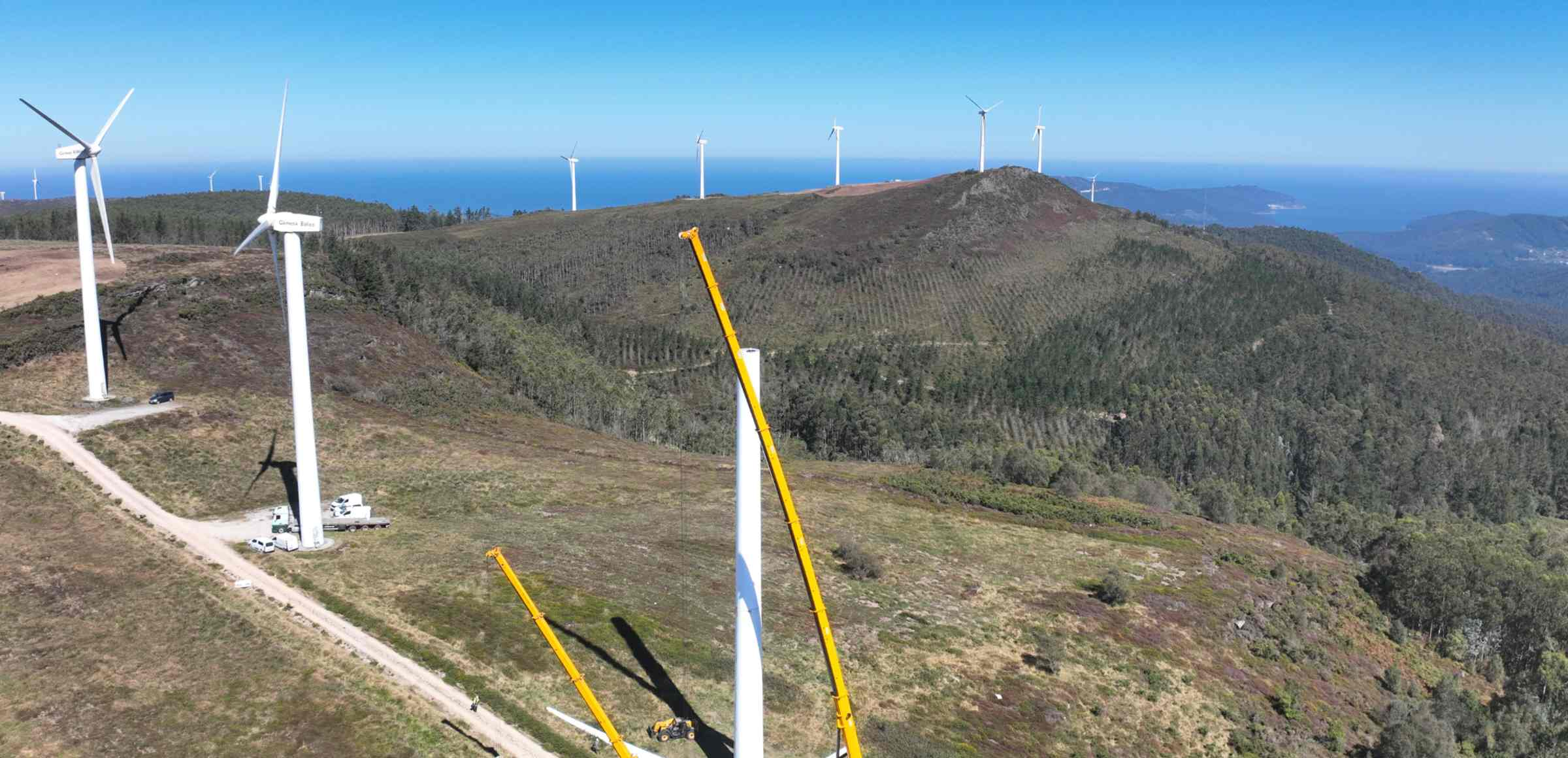
Endesa has started a €36.3 million repowering programme at the Coriscada wind farm in Galicia, replacing 40 turbines installed in 1998 with four 7MW machines while retaining the site’s existing 24MW maximum grid export.
The wind farm, in the municipalities of Mañón and Ortigueira, currently has 24MW of installed capacity spread across several turbine types and ratings. The replacement project will increase nominal generating capacity to 28MW, although the electrical connection will continue to limit exports to 24MW.
Endesa expects annual production to rise from 47GWh to 83.9GWh, an increase of 78.5%. That gain is much larger than the nominal capacity increase because four modern turbines should capture more energy across a wider range of wind conditions than the equipment they replace.
The fixed export limit shapes how the new plant will operate. Four turbines rated at 7MW can produce a combined 28MW under suitable conditions, so the plant controller will have to constrain output whenever total generation would otherwise push power above the permitted 24MW at the grid connection.
During lower and medium wind speeds, however, the larger modern rotors can produce more electricity without reaching that ceiling. Higher efficiency, improved controls, larger swept area, and current drivetrain technology allow more energy to be extracted across the year even though peak exports remain unchanged.
Electrical work will extend beyond the turbine replacement. Collection circuits, transformers, switchgear, protection, communications, plant controls, and reactive power capability must be compatible with the new machines and with current grid requirements. Existing infrastructure can be reused where suitable, but equipment designed around the original wind farm still has to be checked against the new operating characteristics.
The project also changes the civil and logistics requirements. Four turbines dramatically reduce the number of operating foundations and crane positions, but each new machine is far larger and heavier than the equipment installed in the 1990s. Roads, hardstandings, lifting plans, foundations, and component transport must accommodate contemporary 7MW technology.
The retained grid connection gives the project a development advantage because Coriscada does not have to secure another 28MW of export capacity before the new turbines can operate. Repowering can therefore raise annual generation through better energy capture even where additional network capacity is unavailable.
That approach is increasingly relevant across Europe’s older wind fleet. Many early projects occupy sites with established wind resources, land agreements, grid connections, and operating histories. Replacing ageing machines can use those advantages while reducing turbine count and increasing output, although planning and environmental requirements still have to be satisfied for the new equipment.
Endesa expects construction to continue through 2027, with testing due towards the end of that year and full operation planned for March 2028. The project is being delivered through Sistemas Energéticos Mañón Ortigueira SA, owned 96% by Endesa through Enel Green Power España and 4% by the Galician Energy Institute.
Up to €6.79 million of support has been awarded through Spain’s IDAE under the second call of the Repotenciación Circular programme. The scheme links renewable repowering with equipment reuse and material recovery rather than treating dismantled turbines solely as waste.
Endesa says components removed from Coriscada will follow several routes. Some equipment will be retained as spare parts for other operating wind farms, complete components may be sold for further use, and material that cannot be reused will be recovered through recycling routes.
That circular approach adds another engineering task to decommissioning. Turbine components have to be inspected, classified, removed without unnecessary damage where reuse is intended, and separated into appropriate material streams where recycling is the final route.
The company also intends to use local labour and Galician suppliers where possible, while training initiatives are being coordinated with the two municipalities. The main industrial programme will involve turbine supply, transport, cranes, civil works, electrical systems, commissioning, and removal of the existing machines.
Coriscada will ultimately operate with one tenth of its original turbine count. The reduction simplifies parts of long term maintenance and lowers the number of individual generators, gearboxes, towers, and foundations in operation, although each replacement machine carries substantially more generating capacity and larger individual components.
The scheduled testing phase in late 2027 will bring those systems together. Four modern turbines must operate through the upgraded collection network and plant controller while respecting the 24MW connection ceiling under varying wind and grid conditions.
If the forecast 83.9GWh annual production is achieved, Coriscada will demonstrate how repowering can increase energy output without increasing the site’s permitted peak export. The new capacity sits in the turbines; the additional value comes from producing more often below the same 24MW grid limit.