IN Brief:
- Wärtsilä and Tokyo Gas Engineering Solutions have signed an MoU covering Japanese data centre power.
- The companies will assess gas- and dual-fuel engine generation for selected projects under development.
- The work focuses on sites where grid constraints and lengthy electricity-procurement timelines complicate new capacity.
Wärtsilä and Tokyo Gas Engineering Solutions have signed a memorandum of understanding to evaluate dedicated power-generation systems for data centre developments in Japan, focusing on gas and dual-fuel engine plants where grid access or electricity procurement could delay new computing capacity.
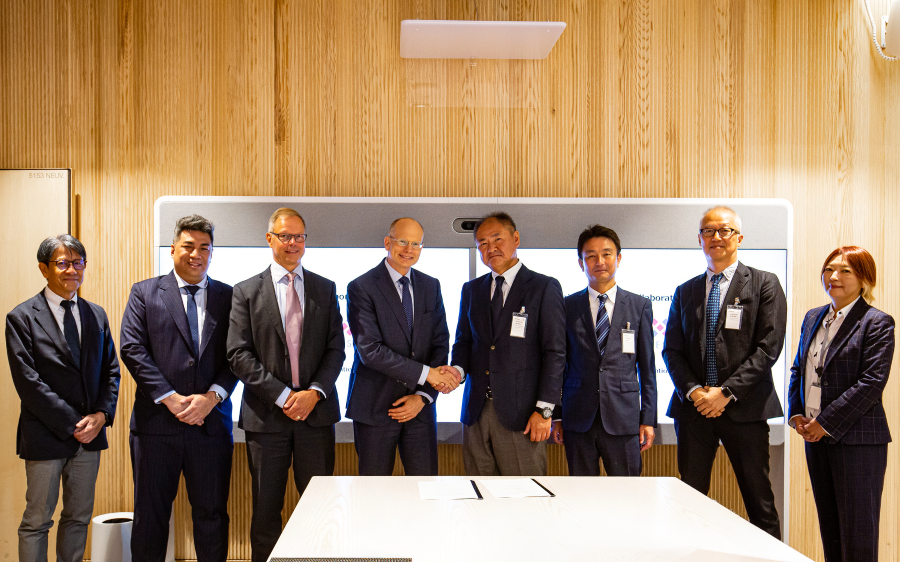
The agreement was signed in Helsinki during August and announced on 17 September. Under the MoU, Wärtsilä and TGES will develop initial technical concepts, establish performance parameters, and assess the feasibility of power solutions for selected Japanese data centre opportunities currently being developed by TGES.
No generating capacity, equipment order, project site, or final investment decision has been announced. The agreement is therefore an engineering and project-development framework rather than a confirmed power-plant contract, with the companies first assessing whether engine-based generation can meet the technical and commercial requirements of individual sites.
Japan’s data centre sector faces a problem that is increasingly affecting developments elsewhere: computing facilities can sometimes be planned more quickly than new grid capacity can be provided. AI-oriented campuses require large quantities of firm electricity, while transmission reinforcement, new substations, and high-voltage connections can involve long design, consenting, procurement, and construction programmes.
Grid availability is already reshaping data centre site selection in Europe, where developers are moving farther from established metropolitan hubs in search of faster connections and sufficient electrical capacity. The Wärtsilä-TGES study examines another response to the same constraint: supplying more of the demand directly at the site.
On-site generation can change the development timetable by moving part of the electricity requirement behind the customer’s grid connection. Modular engine plants can be installed in blocks and expanded as additional data halls are commissioned, potentially avoiding the need for the ultimate electrical capacity of a campus to be available before the first computing load goes live.
That does not automatically make a data centre independent of the electricity network. Developers still have to decide whether engines operate continuously, in parallel with the grid, only during periods of constraint, or within an islandable microgrid. Each arrangement creates different requirements around synchronisation, protection, fault levels, metering, controls, and transitions between local generation and network supply.
Availability requirements make those interfaces particularly important. Data centres generally rely on layered electrical architectures containing uninterruptible power supplies, batteries, standby generation, redundant distribution paths, automatic transfer systems, and duplicated cooling and control equipment. Introducing prime-power engines adds another generating layer that has to coordinate with those systems rather than simply replace an emergency generator.
If engines operate as a primary source of electricity, their duty cycle changes considerably from conventional standby plant. Emergency generators may accumulate relatively few operating hours outside testing, while prime-power units require fuel delivery, maintenance, cooling, emissions control, spare parts, and overhaul strategies suited to sustained operation.
Wärtsilä and TGES will examine gas and dual-fuel configurations. Wärtsilä says its modular engine architecture can ramp rapidly and scale as demand increases, characteristics that may suit campuses where computing capacity is commissioned in stages rather than as a single completed load.
The commercial case will depend on more than engine performance. Individual developments have to establish fuel availability, gas-network capacity, environmental requirements, emissions limits, planning acceptability, operating costs, land use, noise controls, and the security of the fuel supply itself.
A site selected partly because the electricity network cannot provide capacity quickly enough could still require substantial gas infrastructure. New pipelines, pressure-reduction equipment, compressors, metering, or storage can become another infrastructure programme running in parallel with data centre construction.
Dual-fuel capability may provide additional flexibility, although its practical value depends on which fuels are physically available and permitted at the site. Future compatibility with lower-carbon fuels also has to be separated from the fuel expected at commissioning, because theoretical capability does not guarantee commercial supply or emissions performance.
Battery storage can complement an engine plant by responding almost immediately to load changes, bridging the interval while generators start, smoothing engine loading, and supporting UPS or microgrid functions. Engines can then supply energy for much longer periods than would normally be economic for a battery designed mainly around short-duration resilience.
Coordinating batteries and engines can reduce the amount of generation that needs to remain running solely as reserve, but the controls must preserve sufficient stored energy for faults and transfers. Optimising fuel efficiency or electricity cost cannot be allowed to erode the site’s resilience requirement.
TGES contributes Japanese market and project-development knowledge, while Wärtsilä brings experience in engine-based power plants. That combination is relevant because even a technically credible generation package has to fit local grid rules, planning procedures, fuel arrangements, environmental requirements, land constraints, and the commissioning timetable of the wider data centre.
The MoU gives both companies a framework for testing those issues against actual developments rather than a generic data centre concept. Whether it produces equipment contracts will depend on the outcome of those project-level studies, but it shows electrical supply moving further upstream in data centre development: power availability is increasingly shaping where and when computing capacity can be built rather than being treated as a utility connection arranged after the site is selected.