IN Brief:
- Clever One customers gain access to more than 1,500 existing EDF public charging points across Denmark.
- The agreement includes 76 rapid chargers and strengthens customer access around Zealand, Copenhagen, several large cities, and motorway routes.
- The deal expands interoperability and utilisation of existing infrastructure rather than adding 1,500 newly installed chargers.
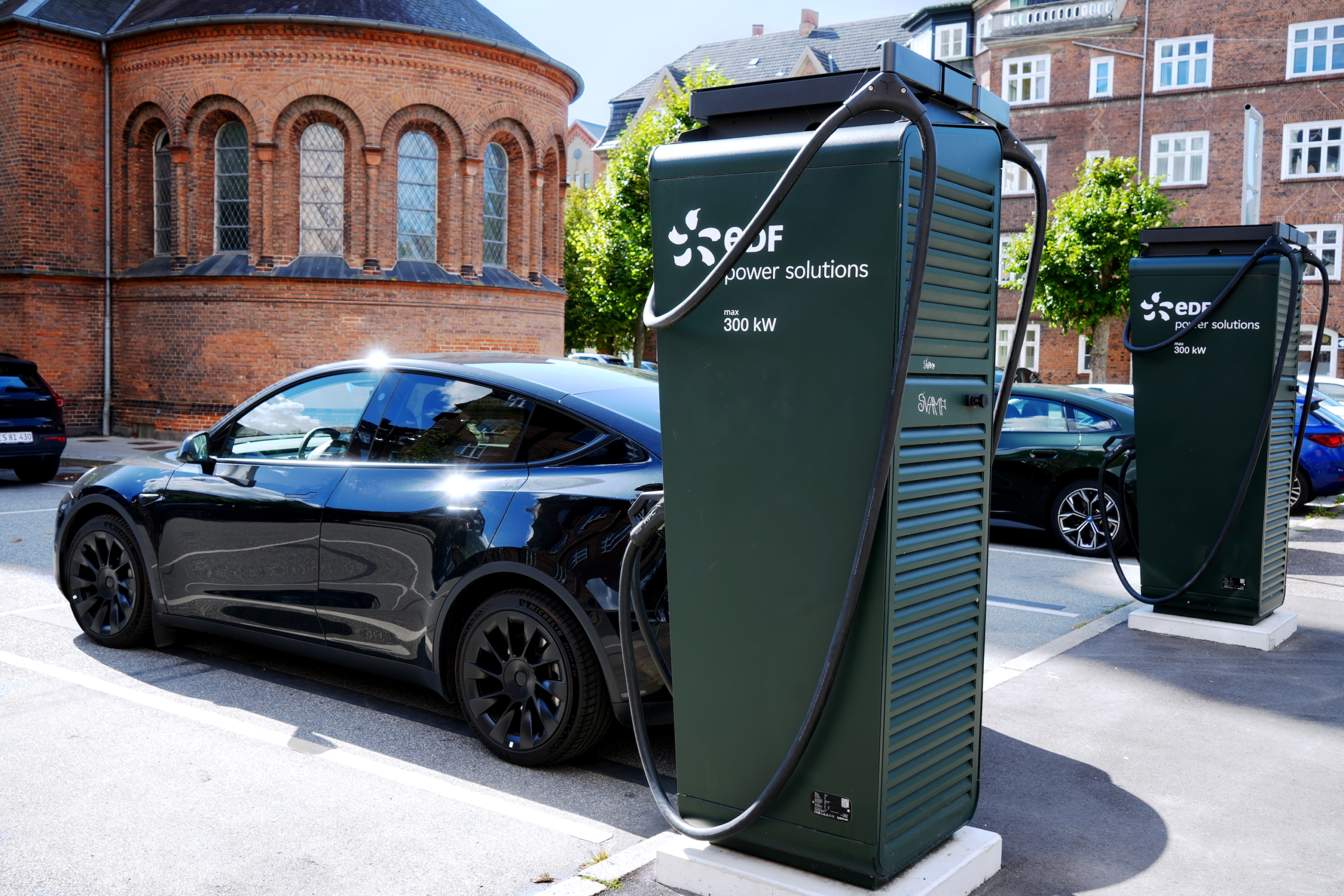
Clever has opened EDF power solutions’ Danish public charging network to its Clever One customers, adding access to more than 1,500 existing charging points across the country under a new roaming agreement that took effect on 9 September.
The network includes 76 rapid-charging points and has a particularly strong presence on Zealand and in Copenhagen, with additional coverage around Aarhus, Esbjerg, Funen, and motorway routes. Clever customers can use their existing service to charge on the EDF network rather than establishing a separate relationship with the underlying operator.
The agreement changes access rather than physical infrastructure. Denmark has not gained 1,500 new chargers through the deal: the EDF equipment was already installed and operating. What has expanded is the number of chargers available through Clever’s customer-facing network and the ease with which its subscribers can authenticate and use them.
That distinction is increasingly important as public charging companies describe network scale in different ways. An operator can construct and own equipment directly, acquire another charging business, or make third-party infrastructure available to its customers through roaming. Each increases customer reach, but only construction adds new physical charging capacity.
Clever One and Clever One Business customers can use the EDF network under the new agreement, while customers paying directly by kilowatt-hour can see the applicable price through Clever’s app before beginning a session. Backend systems handle the authentication and commercial settlement required for a driver to use another operator’s hardware.
EDF’s larger rapid-charging locations include 19 outlets at Korsør, 14 at Langeskov, eight at Kokkedal, and four at Frederiksberg. The Korsør installation is positioned near the E20, giving the network an en-route role alongside its urban coverage.
Rapid sites matter differently from the much larger number of lower-power public chargers. Drivers using them generally expect to recover a substantial amount of range during a shorter dwell, concentrating more electrical demand at individual sites and placing greater emphasis on available grid capacity, power-sharing controls, and reliable charger operation.
Roaming does not change the rating of that equipment, but it can affect utilisation. Making an existing site available to another large subscriber base can increase the number of drivers considering it during a journey, particularly where the alternative would have required another app, account, payment process, or tariff arrangement.
The technical work therefore sits largely in the digital and commercial layer. Charge-point status, authentication, session records, pricing information, and settlement have to pass between systems reliably enough that the driver experiences the site as part of the network they already use.
That interoperability has become a significant issue as Europe’s public charging estate has expanded through many separate operators. Physical build-out remains essential, but fragmented access can reduce the practical value of installed hardware if drivers face inconsistent payment methods or have difficulty identifying whether a charger is available to them.
Clever describes itself as Denmark’s largest charging operator and says its wider network comprises more than 65,000 charging points across urban sites, workplaces, supermarkets, rural areas, and motorway locations. The EDF agreement adds another operator’s estate to that customer proposition without transferring ownership of the underlying infrastructure.
The arrangement can be compared more closely with telecommunications roaming than with an infrastructure acquisition. EDF continues to operate its chargers, while Clever extends its customer service across them. The commercial terms between the two companies have not been disclosed.
For power networks, the immediate effect is consequently less dramatic than a new 1,500-point construction programme would be. There is no corresponding announcement of new transformers, connections, switchgear, or reinforcement associated solely with the agreement. Any electrical impact comes indirectly through changes in use of infrastructure that already exists.
Over time, higher utilisation can still influence planning. A rapid-charging location that becomes busier may encounter connection or site-capacity constraints sooner, encouraging additional chargers, local battery storage, load management, or network reinforcement. Operators also gain better utilisation data with which to decide where physical expansion should follow.
EDF says additional charging points are planned, but the 9 September agreement itself should be judged on interoperability rather than construction. It provides Clever customers with access to more than 1,500 existing EDF charging points, including 76 rapid units, while preserving EDF as the infrastructure operator.
That makes the development narrower than a large charging-hub build, but still relevant to how public infrastructure is used. Charger numbers alone do not determine network usefulness; drivers also need equipment they can locate, access, authenticate against, and pay for without unnecessary friction.
Denmark’s physical charging estate has not increased by 1,500 units overnight, but a larger customer base can now use those assets through an established service. As the market matures, making existing infrastructure interoperable will sit alongside the more capital-intensive work of building the next wave of sites.