IN Brief:
- DESNZ is seeking evidence on AI applications spanning forecasting, planning, optimisation, asset management, flexibility, and system operation.
- Six adoption challenges cover data, incentives, regulation, security and trust, technical integration, and organisational capability.
- Government is also testing a longer-term scenario involving increasingly autonomous coordination of generation, storage, networks, and demand.
The Department for Energy Security and Net Zero has opened a call for evidence on how artificial intelligence could be deployed across Britain’s energy system, testing both near-term applications and a longer-term model in which increasingly autonomous software helps coordinate generation, networks, storage, and demand.
The consultation was published on 8 September and runs until 6 November 2026. It will inform the UK’s first AI for Clean Energy Strategy and asks industry, regulators, system operators, researchers, innovators, and consumer groups where AI can add value, which barriers are slowing adoption, and where government action may be required.
DESNZ starts from an electricity system that is becoming more distributed, dynamic, and data-intensive. Renewable generation, electric vehicles, heat pumps, batteries, and smart appliances are increasing the number of assets that have to be forecast and coordinated, while low-carbon hydrogen and other new infrastructure add further operational complexity.
The scale of control-room activity already reflects that change. DESNZ says the number of instructions issued by the National Energy System Operator to balance the electricity system increased tenfold between December 2023 and June 2025 to more than 200,000, increasing the volume of decisions that have to be made against changing generation, demand, and network conditions.
AI is being considered as one part of that response rather than as a replacement for physical network investment. Near-term applications identified by government include improved forecasting, planning, optimisation, fault detection, asset management, and decision support, with the aim of using existing infrastructure more efficiently while helping operators manage a larger number of variable and distributed resources.
The consultation identifies six overlapping barriers to wider deployment: access to data; innovation, markets, and incentives; regulation and governance; risk, security, and trust; technical systems integration; and capability, people, and culture. That list moves the discussion away from whether individual algorithms work and towards whether utilities can use them safely inside regulated, long-lived operational environments.
Data quality is central because electricity organisations hold information across operational technology, enterprise systems, asset registers, market platforms, and customer-facing services built at different times and for different purposes. An AI model may be technically capable of useful analysis, but incomplete measurements, inconsistent standards, restricted access, or uncertain ownership can limit its value before the algorithm reaches an operator.
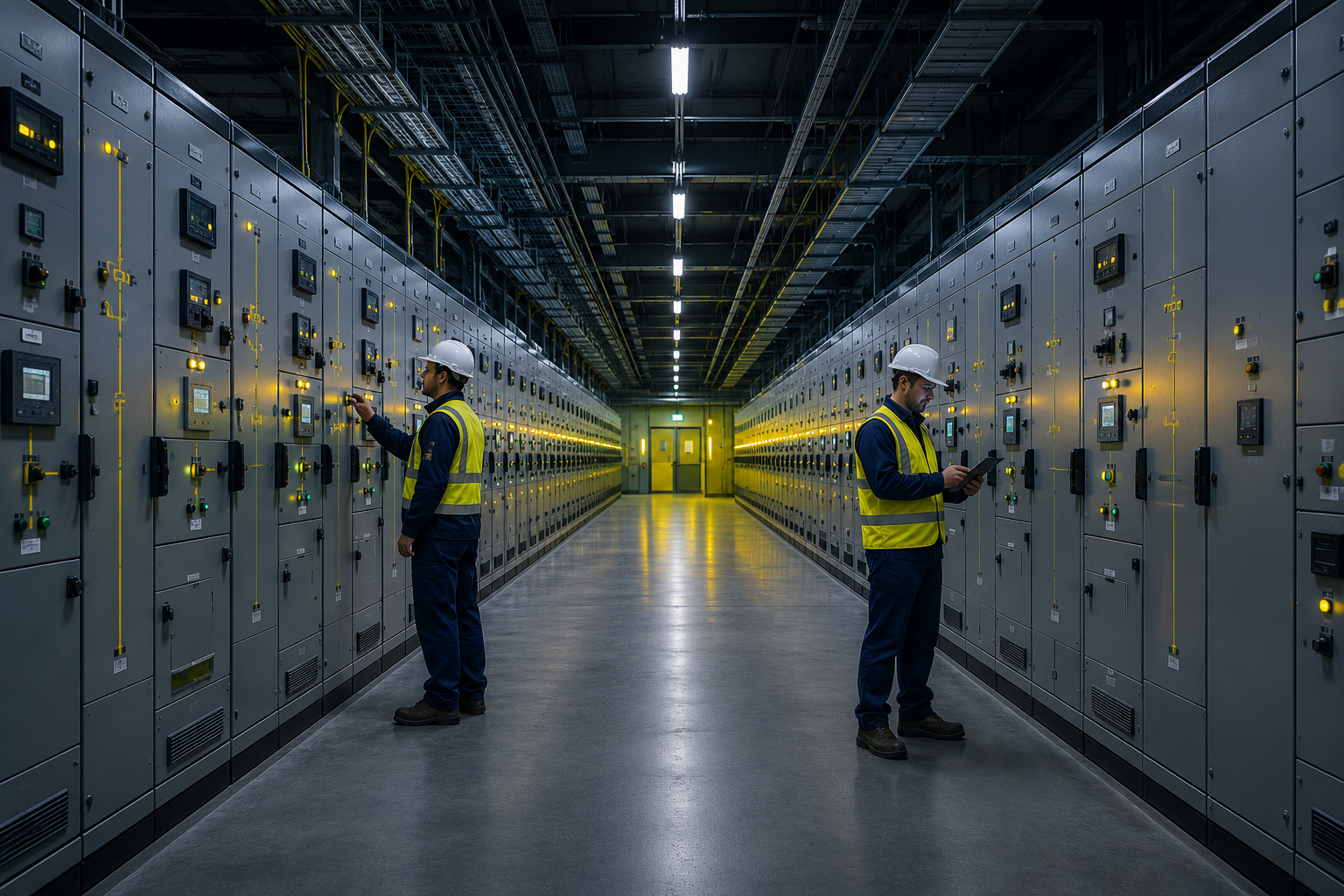
Integration presents a similar problem. Transmission and distribution control environments contain SCADA, energy management, protection, communications, and asset-management systems that were designed around deterministic operating practices. AI can sit outside those environments as advisory software relatively easily; allowing it to influence live operational decisions raises a much higher requirement for assurance, cyber security, accountability, fallback modes, and change control.
Existing grid-assistance projects already illustrate the more cautious model, with AI producing recommendations and system-state analysis while human operators retain authority over safety-critical actions. That approach gives utilities a route to test performance under operational conditions without immediately transferring control to autonomous software.
DESNZ deliberately examines what happens if that boundary moves. Its longer-term scenario considers AI agents coordinating activity at system level but acting locally within defined objectives and constraints. A battery could alter charging or discharging in response to grid frequency, prices, and local network limits while coordinating with nearby assets to avoid overloading a substation.
The document is explicit that this is a stretching scenario rather than a forecast or preferred pathway. Even so, it exposes engineering questions that become unavoidable as autonomy increases. Control objectives need defined limits, real-time data has to remain trustworthy, communications must survive disturbances, and operators need credible methods for overriding or isolating automated functions when behaviour departs from the expected operating envelope.
Security is one of the six named barriers rather than a separate afterthought. DESNZ highlights risks including model drift, data poisoning, opaque decisions, and supply-chain dependencies, while also recognising that AI can strengthen monitoring and threat detection. For critical infrastructure, the issue is whether assurance develops quickly enough to prevent either excessive caution or poorly controlled deployment.
The call for evidence sits alongside Lucy Yu’s independent review of AI deployment in electricity networks, whose final report was published on the same day. That review recommends movement towards AI-enabled, risk-based operation and planning, wider use of AI-driven flexibility, clear governance for increasing autonomy, and faster deployment of applications that have already demonstrated value.
Ofgem and NESO are also part of the emerging framework. The consultation points to Ofgem’s ethical AI guidance, regulatory laboratory, and technical sandbox, while NESO is already exploring forecasting, optimisation, and real-time decision support. The policy question is increasingly how those separate initiatives move into routine engineering practice rather than remaining a collection of pilots.
For network companies, that makes digital architecture part of physical-system design. Sensors, communications, data standards, cyber controls, control-room interfaces, and operational procedures determine whether an AI application can influence the grid safely, just as transformer ratings, breaker duties, and protection settings determine what a substation can carry.
The consultation does not prescribe which models utilities should buy or how quickly autonomy should advance. Its more useful contribution is to define the conditions that have to exist before deployment can scale: usable data, interoperable systems, economic incentives, clear accountability, trusted security controls, and people able to understand what the software is doing.
Responses are due by 6 November. The resulting strategy will therefore arrive after government has tested the gap between promising AI demonstrations and an electricity system where decisions have operational, regulatory, and security consequences. The difficult part is unlikely to be proving that algorithms can optimise something; it will be proving that utilities can depend on them when the lights have to stay on.