IN Brief:
- The half-brick MCOTS-F-28-T-HE operates across a continuous -40Vdc to +40Vdc input range and withstands transients up to 210Vdc.
- The filter delivers up to 600W or 40A continuously while adding surge, spike, reverse-polarity, and inrush protection.
- SynQor positions the module for power architectures designed to meet military and aerospace standards; final platform compliance remains a system-level requirement.
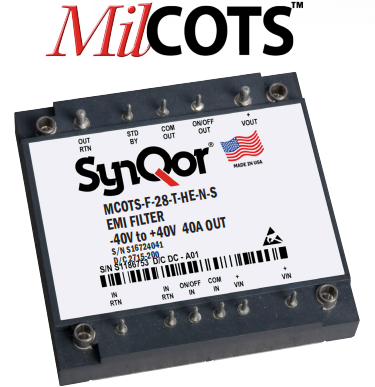
SynQor has expanded its Military Commercial-Off-The-Shelf power-conversion range with the MCOTS-F-28-T-HE, a 600W half-brick transient filter designed to protect 28Vdc defence and aerospace electrical systems from severe voltage disturbances before they reach downstream converters.
SynQor specifies a continuous input range from -40Vdc to +40Vdc, with the module capable of handling transient inputs up to 210Vdc. Continuous output is rated at up to 600W or 40A.
The wide transient range addresses the difference between the nominal voltage printed on a power-bus specification and the electrical conditions that equipment can encounter in service. Switching, inductive loads, generator behaviour, wiring impedance, faults, and other disturbances can push a nominal 28V supply well outside its steady-state range for short periods.
Those events matter because downstream DC-DC converters and electronic equipment may not be designed to absorb the full disturbance directly. Placing a transient filter ahead of the converter allows the front end to manage the abnormal input condition while presenting a controlled supply to the circuitry behind it.
The MCOTS-F-28-T-HE uses an input buck stage that keeps its output below 50Vdc when high-voltage spikes and surges occur. It also incorporates reverse-polarity protection, addressing another failure condition capable of damaging equipment connected directly to a DC bus.
Once the device has started, SynQor says it can continue delivering power as its input falls to 5.8Vdc. That ride-through behaviour allows the downstream system to remain supplied through severe temporary voltage sag rather than forcing an immediate reset whenever the bus drops sharply.
Startup is another controlled condition. The filter limits inrush current to approximately 4A, reducing the initial load placed on the upstream source as the module and downstream converter are energised. Standby current is specified at 12mA.
Inrush control becomes more important as the number of electronic loads on a platform increases. Input capacitors across multiple converters can otherwise draw large simultaneous charging currents, depressing the local bus or operating upstream protection even though the steady-state demand remains within design limits.
The filter also includes pass-through on/off control intended to allow downstream converters to be switched without degrading electromagnetic-interference performance. That supports load sequencing while retaining the input-conditioning arrangement around the converter.
SynQor lists the module for power systems designed around requirements including MIL-STD-461, MIL-STD-1275 B/D, MIL-STD-704, MIL-STD-810G, DO-160E, and DEF-STAN 61-5. The company describes the MCOTS filter and compatible DC-DC converters as building blocks for systems intended to meet those standards.
That wording is more precise than describing the component as universally pre-qualified. The applicable standard depends on the platform and installation, while compliance is demonstrated against the complete equipment configuration rather than inferred solely from the selection of one filter.
MIL-STD-1275 is associated with characteristics of military vehicle 28Vdc power systems, while MIL-STD-704 addresses aircraft electrical power. MIL-STD-461 covers electromagnetic interference and susceptibility requirements. An engineer therefore has to establish which tests and limits apply to the particular vehicle, aircraft, naval system, or other equipment being designed.
The surrounding architecture remains important even when the filter itself has been developed around those requirements. Cable impedance, grounding, input protection, fuse or breaker selection, thermal conditions, downstream converter behaviour, mounting, and electromagnetic layout can alter how the complete system responds to a test event.
That is the practical role of military COTS power modules. They provide designers with characterised building blocks intended for rugged applications without requiring every filter and conversion stage to be developed as a bespoke circuit, while leaving platform integration and final compliance testing with the system designer.
The MCOTS-F-28-T-HE’s 40A rating becomes relevant as more electrical equipment is added to established 28V architectures. Sensors, communications equipment, mission computers, actuators, electronic warfare systems, autonomous subsystems, and other loads increase both aggregate power demand and the number of converters attached to the bus.
More converters can also create more interaction between loads. A disturbance generated by one subsystem may propagate through common wiring and affect another unless filtering, grounding, source impedance, protection, and converter behaviour have been considered as a complete network.
Electromagnetic compatibility is part of the same problem. Switching converters generate differential- and common-mode noise, while the military platform may also expose electronics to disturbances generated elsewhere. The filter has to help control both the energy associated with large transient events and the higher-frequency conducted interference present during ordinary operation.
SynQor’s current MCOTS product material specifies more than 80dB of differential-mode attenuation and more than 36dB of common-mode attenuation at 250kHz for the MCOTS-F-28-T-HE, alongside 2,250V isolation to its common-mode connection. Those figures give designers additional information when modelling the filter within an EMI control scheme rather than treating transient protection as its only function.
The compact half-brick package is also relevant on ground, sea, and airborne platforms where power demand can increase without a corresponding increase in available equipment volume. Thermal design still determines how much power a module can deliver under a particular operating condition, but higher density gives integrators greater freedom in packaging the front-end power system.
Astute Group distributes SynQor products into the UK and European market and can support specification of the filter against an intended 28Vdc architecture. The datasheet remains the relevant starting point for that process, particularly where a programme has defined transient, EMI, environmental, and qualification requirements.
The MCOTS-F-28-T-HE is therefore a power-quality component rather than a simple voltage accessory. Its job begins precisely when the nominal 28V bus stops behaving like a 28V supply — a condition that becomes more consequential as military platforms carry more electronic loads behind the same electrical distribution architecture.