
IN Brief:
- Sumitomo Electric and Van Oord have secured an SSEN Transmission framework covering future HVDC subsea cable systems.
- Initial engineering will focus on the proposed 525kV Shetland 2 link, subject to approvals and a project call-off.
- Cable production is expected to begin at the new Port of Nigg factory during the second quarter of 2027.
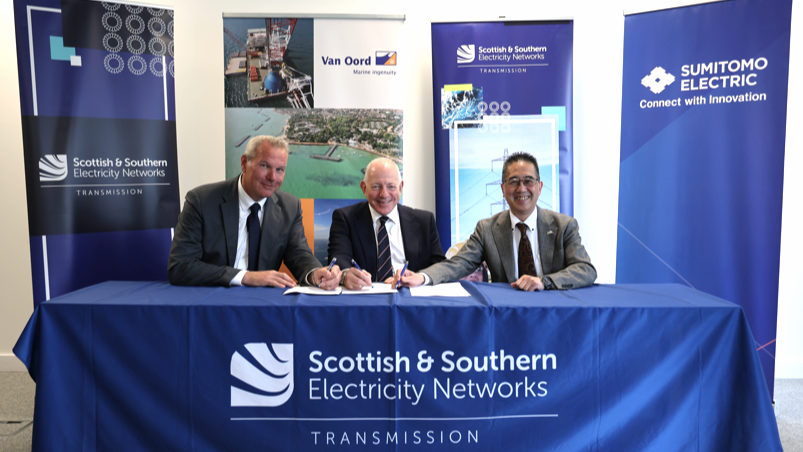
Sumitomo Electric and Van Oord have secured a long-term framework agreement with SSEN Transmission for the engineering, supply, transport, and installation of HVDC subsea cable systems in northern Scotland.
The first project expected to use the framework is Shetland 2, a proposed 525kV connection between the Shetland Islands and mainland Scotland. Initial design and engineering will begin under the agreement, while the main project call-off remains subject to regulatory, planning, and investment approvals.
SSEN Transmission expects the call-off for Shetland 2 during 2026. Sumitomo Electric will lead cable engineering, procurement, and manufacture, while Van Oord will undertake offshore transport and installation.
The framework can also be used for later links, giving the transmission owner a longer-term route to cable manufacturing and installation capacity. Such arrangements can standardise interfaces and commercial terms across a programme while retaining project-specific engineering for each route.
Manufacturing is scheduled to begin during the second quarter of 2027 at Sumitomo Electric’s new cable factory at the Port of Nigg. The £350 million facility is being developed to produce high-voltage subsea cables for offshore wind and interconnector projects.
More than 150 direct jobs and around 500 indirect roles are expected to be supported by the factory. Project execution and installation associated with the framework could support a further 670 positions, while SSEN Transmission’s wider northern Scotland investment programme has been linked to substantial employment across the region.
Shetland 2 would add another high-capacity route between the islands and the mainland transmission system. A first 600MW HVDC link entered service in 2024, connecting Shetland generation and demand to Great Britain.
Operating at 525kV allows more power to be transmitted for a given current than lower-voltage systems, reducing resistive losses and supporting greater capacity. The cable system must integrate subsea and land sections, joints, terminations, converter stations, controls, protection, and telecommunications.
Cable capacity has become a programme constraint
HVDC deployment is expanding across Europe as offshore wind moves farther from shore and transmission operators add long-distance subsea links. Cable factories require specialised extrusion lines, controlled manufacturing environments, high-voltage test equipment, storage carousels, deep-water quays, and access for cable-laying vessels.
Once project demand exceeds available factory capacity, new production cannot be added quickly. Early framework agreements therefore give transmission owners a route to secure manufacturing and vessel access before every project detail is finalised.
Initial engineering for Shetland 2 will cover route length, seabed conditions, burial depth, thermal properties, landfall design, conductor size, insulation, and installation method. Earlier supplier involvement can reduce late design changes that would otherwise disrupt factory slots or vessel schedules.
Each route will still require specific engineering because water depth, crossings, fishing activity, geology, environmental restrictions, and weather conditions vary substantially. Cable design and installation methods must be matched to those conditions rather than applied uniformly across the framework.
Subsea cable failures are relatively infrequent in relation to installed length, although repairs can be prolonged and expensive. Route surveys, armouring, burial, rock placement, crossing design, monitoring, and accurate installation records are therefore central to lifecycle performance.
Repair planning must also account for spare cable, jointing equipment, vessel availability, weather windows, and access to suitable ports. A transmission link may be technically repairable but remain unavailable for an extended period if specialist resources cannot be mobilised quickly.
Van Oord’s installation role brings vessel scheduling onto the same critical path as cable manufacture. A completed cable can occupy factory storage while awaiting a vessel, whereas an idle installation vessel creates significant cost when manufacturing or permitting slips.
Britain’s planned transmission expansion depends on securing cables, converters, transformers, switchgear, and vessels with limited global availability. The framework addresses one of those constraints before Shetland 2 reaches final investment approval.
Domestic production changes procurement exposure
The Port of Nigg factory will shorten the supply route for Scottish projects and increase UK participation in a market served by a limited number of global manufacturers. Local production will not remove dependence on imported raw materials, specialist machinery, or international expertise, but it can reduce logistics complexity and create a permanent technical workforce.
High-voltage cable manufacture requires strict control of conductor geometry, insulation cleanliness, extrusion, curing, screening, sheathing, and armouring. Defects introduced during production may remain hidden until factory testing, installation, or operation, making traceability and quality assurance essential throughout the process.
The framework also links industrial investment with regulated network approval. Factory utilisation depends on projects reaching final consent and maintaining their delivery schedules, while manufacturers require confidence in future orders before committing to equipment, recruitment, and training.
Shetland 2 remains conditional, and its capacity, route, converter configuration, and commissioning timetable may change as engineering advances. The initial phase will refine those elements and identify the surveys, permits, interfaces, and equipment decisions required before the main call-off.
Repeated project delivery would allow the factory, installation teams, and jointing workforce to retain skills between contracts, while standardisation could reduce mobilisation costs and technical variation. A single project would provide less industrial continuity than a sustained programme.
Britain’s transmission plans are frequently expressed in gigawatts and capital expenditure, yet delivery depends on physical assets with finite manufacturing slots. The framework reserves part of that capacity early, while project approvals and coordinated construction will determine whether it becomes operating infrastructure.

