IN Brief:
- CHINT has highlighted grid resilience, system flexibility, and modernised electrical architecture at Intersolar Europe 2026.
- The company’s technologies include SF6-free MV switchgear, prefabricated substations, cascading storage, and 10MW PCS systems.
- AI infrastructure, renewables growth, and electrification are increasing demand for grid-forming and high-efficiency power equipment.
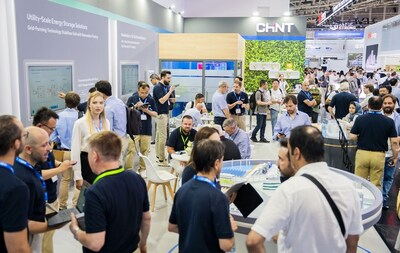
CHINT has presented a range of grid and power infrastructure technologies for European renewables, storage, and AI-related electricity demand at Intersolar Europe 2026.
The company’s European showcase focused on grid resilience, system flexibility, and electrical infrastructure modernisation. Its portfolio included solid-state transformer technology, solid-state circuit breakers, SF6-free medium-voltage switchgear, modular prefabricated substations, cascading storage architectures, centralised 10MW power conversion systems, and commercial and industrial PV distribution platforms.
For utility-scale PV and wind applications, CHINT presented a solid-state transformer designed around next-generation DC architectures, with native 800Vdc direct output and no intermediate conversion. The company also highlighted SF6-free 24kV medium-voltage switchgear aligned with EU F-gas regulation requirements, alongside modular prefabricated substations intended to reduce on-site installation work.
For utility-scale storage, the company presented a cascading two-hour and four-hour system designed for direct grid connection up to 35kV without a main transformer. The system includes independent per-phase control, grid-forming technology, and a stated efficiency above 90%. A centralised 10MW PCS was also presented for large-scale storage projects that can be scaled to hundreds of megawatts.
The commercial and industrial offer included an 800VAC PV distribution platform intended to reduce project-by-project engineering uncertainty in high-power solar applications. Residential and smaller-scale solutions covered AC and DC-side protection and control, backup power, and EV charging readiness.
European power infrastructure is being pulled by several forces at once: rising renewable generation, electrification of heat and transport, large digital infrastructure loads, and tighter environmental regulation on grid equipment. AI-related data centre growth is adding large, concentrated demands in locations where grid connection capacity, resilience, and power quality are already under strain.
These pressures are changing the role of electrical equipment suppliers. Switchgear, substations, transformers, power conversion systems, and control platforms are becoming central to whether projects can connect, operate reliably, comply with regulation, and support increasingly dynamic power flows. Equipment choice is now closely tied to project delivery risk.
The same shift has been visible across industrial power systems, where recent attention at Hannover Messe centred on low-voltage grid control, DC distribution, storage-backed capacity management, virtualised protection, and cyber-secure power systems. CHINT’s Intersolar portfolio sits in that wider move from passive electrical supply toward active, digitally managed infrastructure.
SF6-free switchgear is one of the clearer regulatory drivers. SF6 has strong insulating properties but a high global warming potential, making it a growing target of EU policy. Alternative technologies must still deliver reliability, compactness, safety, and lifecycle performance. As more medium-voltage assets are installed for renewables, storage, and industrial loads, SF6-free equipment is moving from specialist option to standard procurement consideration.
Grid-forming storage is another important part of the system transition. Many battery systems have historically operated as grid-following assets, responding to voltage and frequency conditions already present on the network. Grid-forming technology allows inverters to contribute more actively to voltage and frequency stability, which becomes more valuable as synchronous generation declines and inverter-based resources increase.
Data centre demand brings a further electrical layer. These sites require high connection capacity, high reliability, power-quality management, redundancy, and rapid deployment. Where grid capacity is constrained, integrated power architectures, storage, and high-efficiency conversion become tools for reducing connection risk and improving operational resilience.
CHINT’s emphasis on prefabricated substations also reflects practical delivery constraints. Network reinforcement and renewable connection projects are affected by skilled labour availability, site time, commissioning windows, and supply-chain bottlenecks. Modular equipment can reduce on-site complexity where design standardisation is strong and network operators accept the technical configuration.
High-voltage partnerships and equipment alliances across the wider grid sector have been expanding as utilities and industrial users seek faster delivery of AC infrastructure. The broadening of AC grid alliances between major technology suppliers shows the same underlying direction as CHINT’s announcement: Europe’s energy transition is moving from generation targets toward the electrical infrastructure needed to make those targets operable.
The next phase of grid modernisation will be judged by integration. A solid-state transformer, SF6-free switchgear, grid-forming storage block, or prefabricated substation delivers value only when it is designed into a system with suitable protection, control, communications, commissioning, and maintenance arrangements. Suppliers able to provide equipment with enough engineering depth to reduce project-level risk will be better positioned as grid investment accelerates.