
IN Brief:
- OSGE has applied for Polish state support for 14 BWRX-300 small modular reactor units.
- The first-phase sites are Włocławek, Stawy Monowskie, and Stalowa Wola.
- The application will feed into European Commission notification work on the support model.
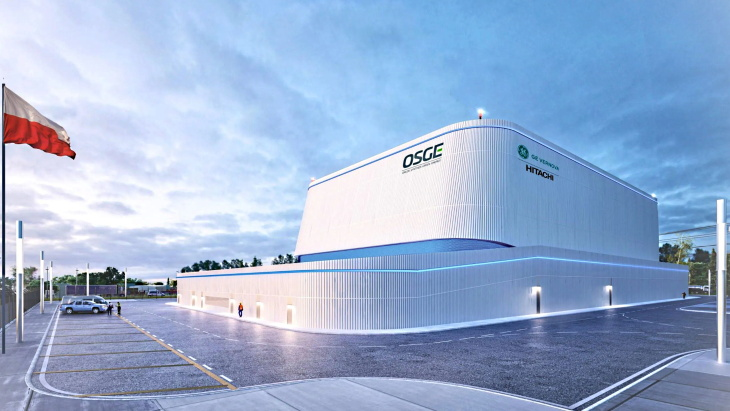
Orlen Synthos Green Energy has applied to Poland’s Minister of Energy for Contract for Difference support covering the construction of 14 GE Vernova Hitachi BWRX-300 small modular reactor units at three Polish sites.
The application covers Włocławek, Stawy Monowskie near Oświęcim, and Stalowa Wola. The units form the first phase of OSGE’s wider programme, which includes 26 BWRX-300 units under principal decisions already obtained from the Polish government. The company expects the first unit to be commissioned in 2032 at Włocławek.
A Contract for Difference would provide a price-stabilisation mechanism for the projects. Under this structure, the difference between a reference price and the market electricity price is settled between the generator and the supporting party. If market prices sit below the reference level, support is paid to the producer; if market prices rise above the reference level, the difference is returned.
The Polish government will prepare documentation for European Commission notification based on OSGE’s submission. The route follows the recent approval of state support for Poland’s first large-scale nuclear plant at Lubiatowo-Kopalino, where three Westinghouse AP1000 reactors are planned under a two-way Contract for Difference covering the 60-year lifetime of the plant.
OSGE has already obtained decisions in principle for all three locations in the application. Environmental impact assessment scoping decisions have been issued for Włocławek and Stawy Monowskie, while the application for Stalowa Wola has been submitted. The Stawy Monowskie project has also received grid connection conditions from Polskie Sieci Elektroenergetyczne.
The BWRX-300 is a 300MWe water-cooled, natural-circulation small modular reactor with passive safety systems. It draws on the design and licensing basis of GE Vernova Hitachi’s ESBWR boiling water reactor and uses existing GNF2 fuel design. The first BWRX-300 is under construction at Ontario Power Generation’s Darlington site in Canada, which is serving as a reference project for OSGE.
The application gives Poland’s SMR programme a clearer commercial structure. Site selection, environmental assessment, and grid connection conditions provide the foundations, but financing support will determine whether a fleet model can move into delivery. Standardisation is central to the programme, with repeated deployment of the same reactor design intended to reduce unit costs and support a domestic supply chain.
For Poland’s electricity system, the SMR programme sits alongside the country’s wider transition from coal-dominated generation toward a mix of nuclear, renewables, storage, and gas. SMRs are being developed as firm, low-carbon generation that can support industrial loads and grid stability where large, centralised nuclear projects may be slower to site, finance, and construct.
European nuclear development is also gathering pace outside Poland. In Sweden, the selection of Rolls-Royce SMR technology for a national nuclear programme has shown how modular reactors are entering formal energy planning in several markets, with recent Swedish SMR selection work adding further momentum to the technology’s European pipeline.
The grid connection element in Poland is especially relevant. SMR projects still require conventional high-voltage integration, substation capacity, system studies, protection design, and transmission planning. The Stawy Monowskie connection conditions show that at least one site is already being developed as a network asset, not only as a reactor deployment location.
Fleet deployment would also affect supply-chain planning. A 14-unit first phase would create demand for nuclear-grade components, civil works, electrical balance-of-plant equipment, control systems, turbine island integration, fuel logistics, and long-term operations capability. Standardised reactor modules do not remove the need for site-specific engineering; they alter the balance between factory repeatability and local grid, cooling, licensing, and construction requirements.
The financing process now becomes a central test. A CfD can provide revenue stability for capital-intensive generation, but the mechanism still needs European Commission approval and assessment of cost, competition, consumer impact, and state-aid compatibility. Poland’s recent large nuclear approval provides a precedent, though SMRs will require their own case around scale, delivery risk, and system value.
If approved, the application would move the Polish SMR programme closer to a fleet-based procurement and deployment model. That would place Poland among Europe’s most active markets for practical SMR delivery, with the early 2030s becoming the key window for modular nuclear to prove itself as grid-connected generation rather than a strategic option.

