IN Brief:
- EODev’s GEH2 hydrogen generator was deployed to power the base camp for Netflix Australia’s APEX production.
- The unit generated nearly 5 MWh of electricity over two months, avoiding 21.5 tonnes of CO₂ emissions and saving 5,200 litres of diesel.
- The project demonstrates how hydrogen fuel cell generators can support temporary power applications where noise, emissions, and reliability are operational constraints.
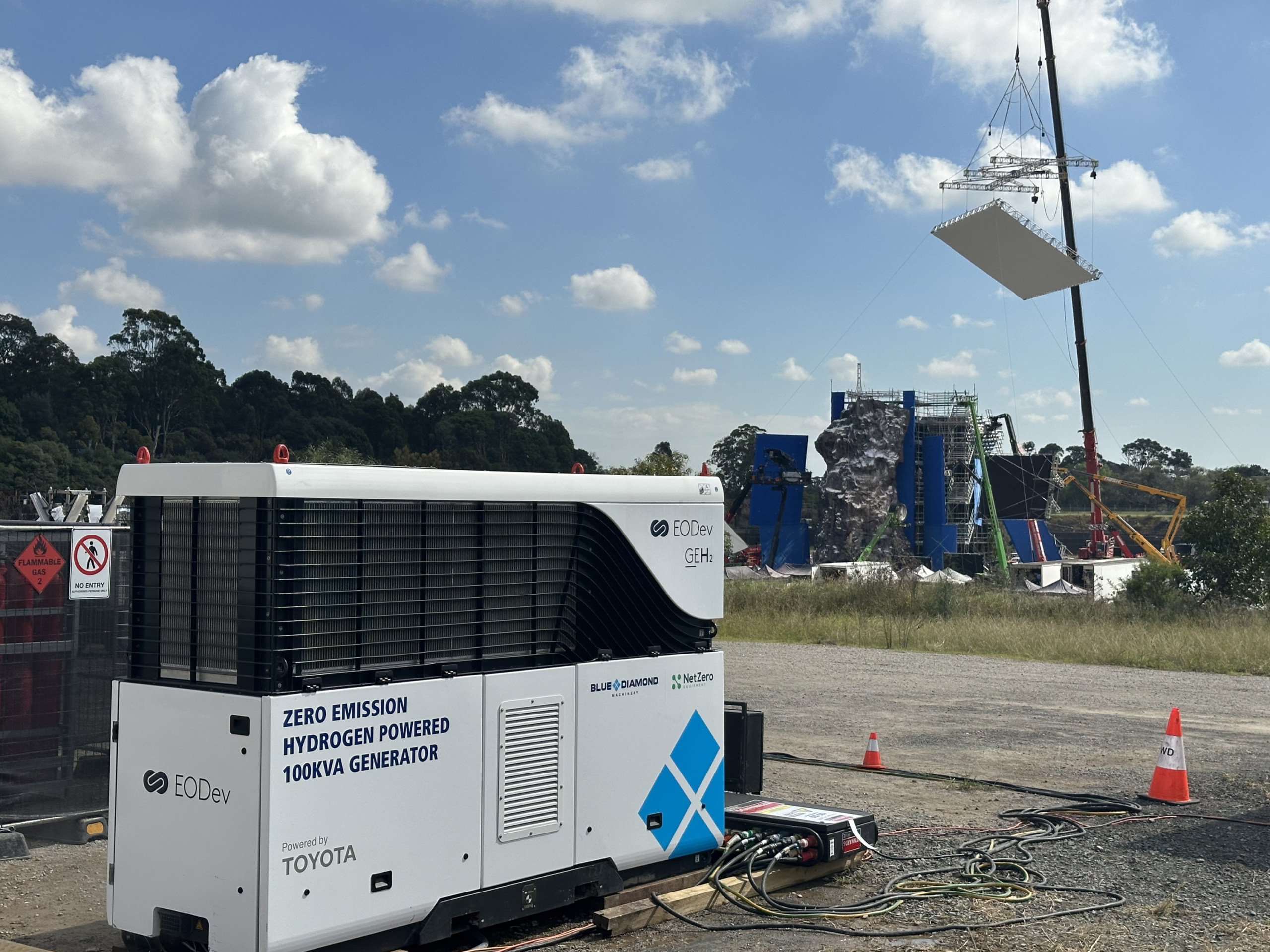
EODev has supplied its GEH2 hydrogen generator to power the base camp for Netflix Australia’s APEX production, replacing conventional diesel generation for temporary on-site power.
The GEH2 was deployed for two months to supply the production compound supporting the film crews. Loads included electrical equipment, trailers, kitchens, and other site facilities. Over the deployment period, the generator produced nearly 5 MWh of electricity, avoiding an estimated 21.5 tonnes of CO₂ emissions and saving 5,200 litres of diesel compared with an equivalent diesel generator.
The project was delivered in partnership with Blue Diamond Machinery in Australia. It follows an earlier EODev deployment during filming for the second season of Lupin and marks the use of hydrogen generation on a large audiovisual production in Australia.
The GEH2 is designed and manufactured in France and uses a Toyota fuel cell to convert hydrogen into electricity. At the point of use, the unit produces water and vapour rather than combustion emissions. EODev states that it operates at 65 dB at full load, making it suitable for noise-sensitive environments such as film sets, events, construction compounds, and temporary work sites.
The Australian model supplied through Blue Diamond Machinery is listed as a 100 kVA unit, with 80 kW prime power output, 110 kVA emergency standby power, lithium iron phosphate battery storage, remote support, 4G connectivity, and a dedicated safety system. The equipment is positioned as an alternative to diesel and gas generators across prime and standby applications.
The deployment addresses a practical challenge in decarbonisation: temporary power remains heavily dependent on diesel. Construction sites, film sets, events, emergency response operations, remote compounds, and infrastructure works often need mobile, dispatchable electricity before a permanent grid connection is available or where loads move between locations.
Battery systems can cover part of that demand, particularly where loads are intermittent or charging is available. Hydrogen fuel cell generators occupy a different role, providing longer-duration power where refuelling logistics can be arranged and where local emissions, noise, and fuel handling are priorities. Their commercial case depends on hydrogen availability, transport, storage, utilisation rates, and the cost difference against diesel alternatives.
Noise reduction gives fuel cell generators an additional advantage in temporary power applications. Diesel generators can create acoustic constraints that affect site layout, working hours, and operational comfort. Quieter generation can reduce mitigation requirements and make low-emission power more practical in locations where noise, particulate matter, and air quality all influence operating conditions.
The APEX deployment also shows how off-grid power technologies are moving into sectors beyond construction and utilities. Film production is a demanding test environment because loads can be varied, locations can be constrained, and reliability is essential. Production delays caused by power failure can carry high costs, placing operational performance under immediate scrutiny.
Hydrogen generators are unlikely to replace diesel across all temporary power applications in the near term. Fuel supply, cost, site safety processes, and equipment availability remain important constraints. The strongest early use cases are high-profile, noise-sensitive, emissions-conscious sites with defined deployment periods and manageable energy demand.
Decarbonising temporary electricity supply will require multiple technologies, including batteries, hybrid systems, grid connections, renewable generation, and hydrogen fuel cells. The GEH2 deployment on APEX adds another live reference point for fuel cell generators in mobile power applications where diesel has long been the default.