IN Brief:
- RWE has installed both offshore substations for the 660MW Nordseecluster A project.
- The platforms will collect turbine output, step it up to transmission voltage, and connect it onward to the mainland.
- The milestone shifts focus to cable work, turbine installation, and the wider 1.6GW buildout through 2029.
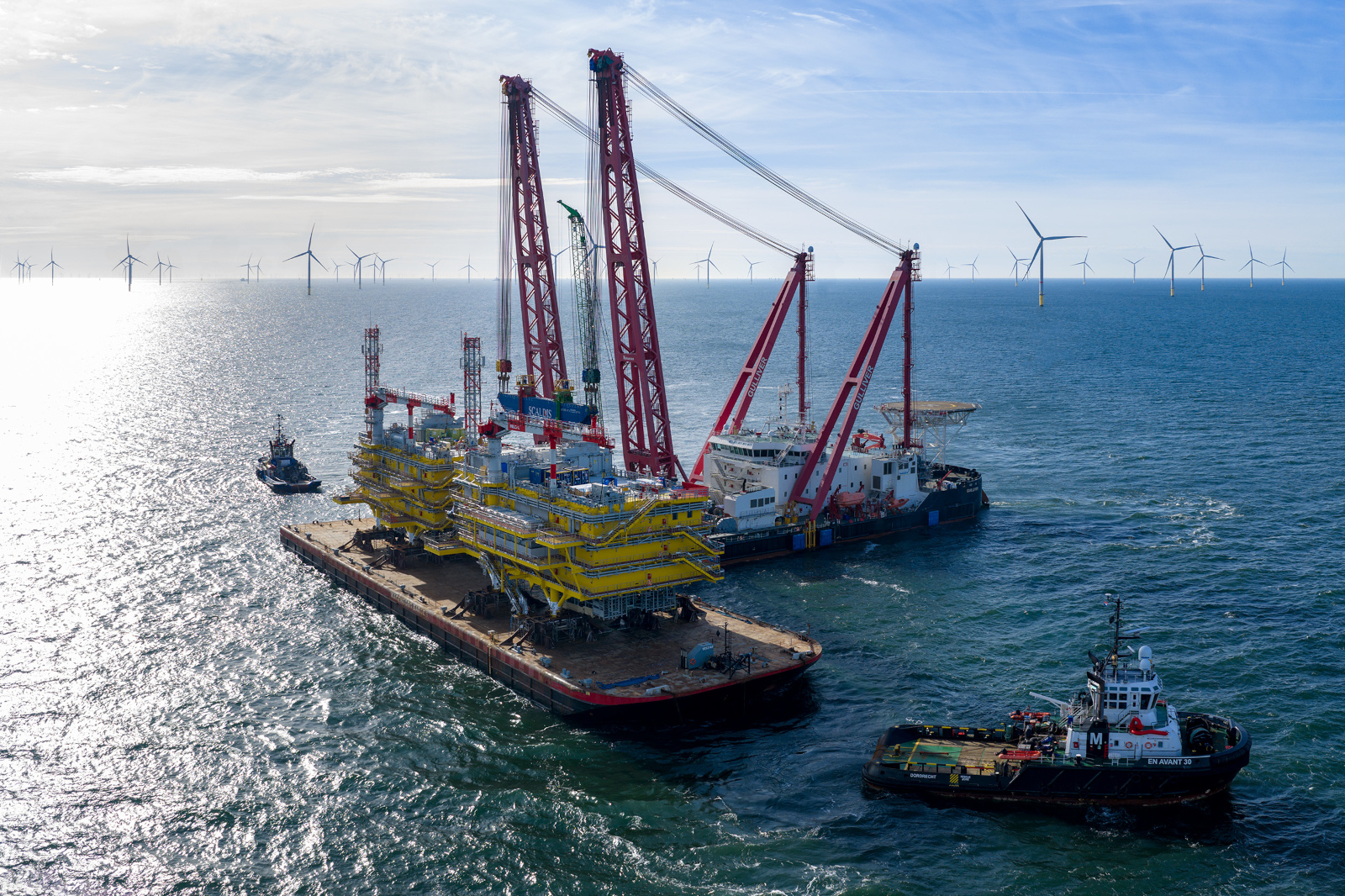
RWE has installed the two offshore substations for Nordseecluster A in the German North Sea, marking one of the most important construction milestones so far on the first phase of the wider 1.6GW Nordseecluster development. Located around 50 kilometres north of the island of Juist, the project is being developed jointly with Norges Bank Investment Management, with RWE holding 51% and NBIM 49%.
The two platforms are substantial pieces of offshore electrical infrastructure rather than secondary project hardware. Each is around 40 metres long and 22 metres high, with topsides weighing approximately 1,800 tonnes and 2,500 tonnes respectively. They were built by Chantiers de l’Atlantique in Saint-Nazaire, transported across the North Sea over roughly a week, and installed by SCALDIS using the floating heavy-lift crane Gulliver. Their foundations had already been installed at the end of 2025.
The reason the project needs two substations is equally significant. Nordseecluster A will connect through two separate grid connections, so the substations will gather power from the wind turbines, step it up to the required transmission voltage, and send it onward to the grid operator’s converter station before electricity is transported to the mainland. In offshore wind, that interface between the array and the wider transmission system is where project execution becomes unmistakably real. Turbines may dominate the visuals of the sector, but substations and export infrastructure are what turn a construction site at sea into a functioning generating asset.
Construction of Nordseecluster A is now progressing into its next phase. Foundation installation was completed at the end of last year, cable laying within the wind farm is under way, and installation of the project’s 44 turbines is due to begin in summer 2026. The 660MW first phase is scheduled to be fully operational from early 2027. Nordseecluster B, which will add a further 900MW through 60 turbines from 2029, moved a step closer at the end of March when Germany’s Federal Maritime and Hydrographic Agency granted planning permissions for that second stage.
That sequence matters beyond a single project. Germany’s offshore expansion targets remain steep, with the country aiming for at least 30GW by 2030, 40GW by 2035, and 70GW by 2045. Reaching those levels is not only a question of turbine manufacturing volume or auction capacity. It is also a question of marine logistics, fabrication slots, installation windows, cable availability, and the pace at which grid-interface assets can be built, shipped, and commissioned. Offshore substations sit at the centre of that picture, because they concentrate technical complexity, weight, schedule risk, and grid dependency into a handful of critical milestones.
Nordseecluster makes that especially clear. The first phase alone is large enough to justify two separate grid connections, while the full 1.6GW development is expected to generate enough electricity to supply the equivalent of around 1.6 million German households. RWE is also building major offshore projects elsewhere in Europe, including Sofia in the UK, Thor in Denmark, and OranjeWind in the Netherlands. That broader project slate underlines how quickly offshore execution risk has become a continental issue rather than a local one, with the same vessel capacity, electrical equipment, and specialist engineering expertise under pressure across multiple markets.
For now, the latest installation does what the strongest offshore milestones do: it narrows the gap between project schedule and physical delivery. With the substations in place, Nordseecluster A has moved from foundation and fabrication work into the much more visible turbine-installation stage. The electrical spine of the first phase is now in position, and that shifts attention toward commissioning, export, and how quickly Germany can keep turning offshore ambitions into operating plant.