IN Brief:
- National Gas expects sufficient supply to meet forecast summer demand under current conditions.
- UK Continental Shelf and Norwegian flows remain the main supply sources, supported by LNG and storage.
- Falling gas-for-power demand does not remove gas’s operational role in balancing a more renewable electricity system.
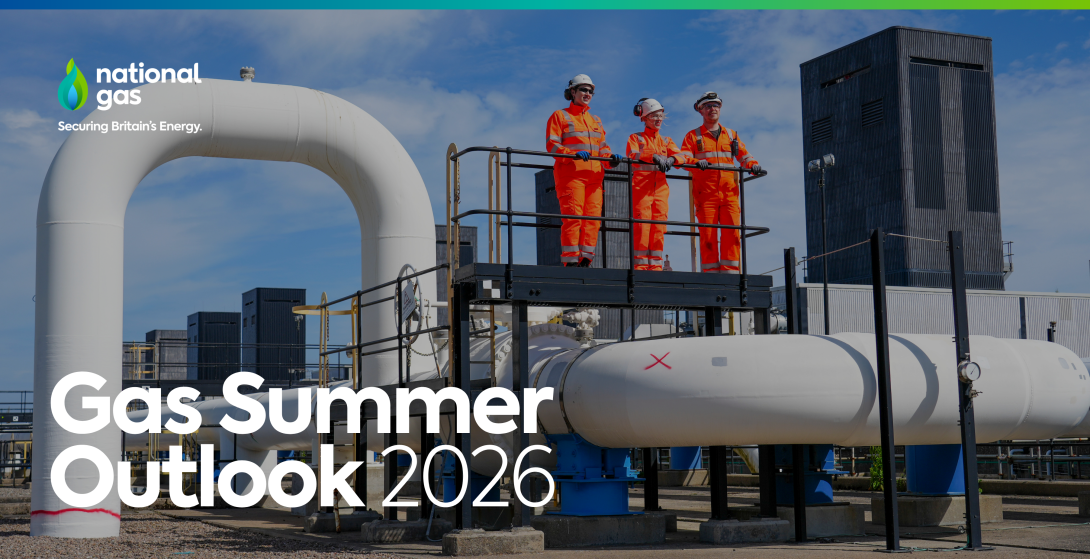
National Gas has published its 2026 Gas Summer Outlook with a relatively steady message for the market: Britain is expected to have sufficient gas supply to meet forecast demand over the summer months under current conditions. The operator’s assessment points to another season in which security of supply is not being driven by immediate scarcity, but by how effectively the system manages flows, maintenance, storage behaviour, exports, and the continuing interaction between gas and power.
The headline numbers are measured rather than dramatic. Total summer gas demand is expected to be broadly comparable with summer 2025, with gas demand for power generation forecast to fall by around 6%, partially offset by a 2% rise in domestic demand. National Gas expects supply to come primarily from the UK Continental Shelf and Norway, together accounting for around 86% of total supply, or 25.3 billion cubic metres. Forecast demand across Great Britain, together with exports to Ireland, is put at around 21.2 billion cubic metres. Flexible gas storage is expected to contribute about 1.5 billion cubic metres, or roughly 5% of supply, while LNG imports are forecast at around 2.7 billion cubic metres, or 9%. The full outlook is available here.
There is also a substantial engineering programme running in parallel. National Gas said summer maintenance will include the isolation of 460 miles of pipeline and outages across all compressor sites to prepare the network for winter 2026/27. That matters because summer is not just a lower-demand period; it is also the window in which critical maintenance and asset work has to be completed without compromising operational resilience. The company also expects Britain to export gas to continental Europe over the summer on broadly similar lines to last year, reflecting normal seasonal behaviour when domestic supply exceeds domestic demand.
Perhaps the most revealing line in the outlook, though, is not the supply forecast itself but the continued emphasis on power-sector balancing. National Gas notes that gas-fired generation remained critical during summer 2025, when gas stations were repeatedly called on to raise output quickly, at times by more than 6GW within a few hours, to make up for intermittent renewable generation. That is an important distinction in the current debate. The role of gas in the British system is changing, but it has not disappeared. It is increasingly less about running hard for long periods and more about being available when renewable output shifts, demand moves unexpectedly, or the system needs fast-response support.
That change is taking place against a power mix that is decarbonising, but not yet detached from gas. UK government energy statistics show renewable technologies supplied a record 152.5TWh of electricity in 2025, accounting for a record 52.5% share of generation, while wind generation also reached a record 87.1TWh. Those figures point in one direction: gas is no longer the central growth story in British power. But they also explain why the transmission network still matters so much. The more variable the electricity system becomes, the more valuable rapid-response flexibility becomes alongside it.
Storage behaviour illustrates the same point. Britain’s gas storage model remains fast-cycling and flexible, with inventories expected to rise and fall through the summer as gas is injected and withdrawn when needed. That differs from the more strategic seasonal refill pattern common in parts of continental Europe. It means Britain’s system is structured less as a large winter stockpile and more as an operational buffer within a dynamic regional market. In that sense, the summer outlook is as much about responsiveness as volume.
It also lands at a moment when the regulatory picture is reinforcing the dual-track nature of the transition. Ofgem has already approved substantial RIIO-3 investment for both gas and electricity networks, while National Gas is separately pushing forward with the first phase of its proposed hydrogen network on the East Coast. Taken together, those developments suggest that the gas network is being asked to do three things at once: maintain present-day security, support an increasingly renewable power system, and begin positioning parts of its infrastructure and expertise for a different low-carbon future. The 2026 Gas Summer Outlook does not change that equation. It simply shows how firmly it now defines the market.