IN Brief:
- ECS has commissioned a dynamic lighting control system at Teesside University’s Digital Life building in Middlesbrough.
- The installation uses Traxon e:cue controls and Pixel Ribbon GO RGBW HB lighting, with a master-slave arrangement for continuity if the primary controller fails.
- On-site training means the university can programme the system for events and operational changes without relying on external support.
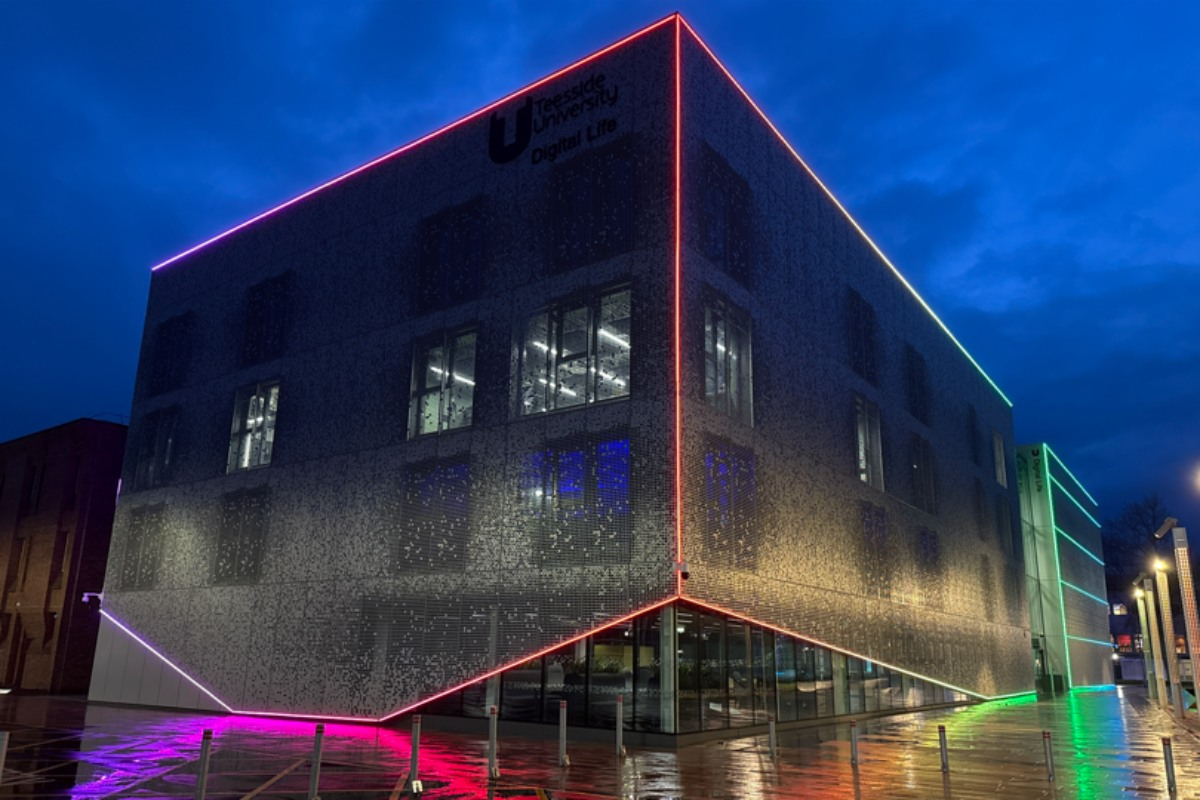
Teesside University has brought a new dynamic lighting control system into operation at its Digital Life building in Middlesbrough, with commissioning delivered by Elite Control Services as part of a wider installation led by Park Lighting Design, SES, and Traxon e:cue.
The scheme uses Traxon e:cue controls and Pixel Ribbon GO RGBW HB lighting to create programmable RGBW effects across the building installation. ECS’ role was focused on the controls layer: configuring the system, mapping and testing addresses, commissioning the network, and setting the building up so the lighting could be managed reliably by the university’s own team once handover was complete.
The technical detail that stands out is the control resilience. ECS implemented a master-slave arrangement using e:cue controllers, allowing the secondary controller to take over automatically if communication with the primary unit is lost. In building-services terms, that is a sensible piece of engineering. Dynamic architectural lighting is often treated as a finishing detail until a control fault leaves part of a scheme dark, out of sync, or dependent on a specialist call-out. A failover arrangement reduces that risk and makes the installation more suitable for a live campus environment with events, public-facing spaces, and changing operational demands.
That local operational flexibility appears to be part of the point. After commissioning, ECS provided on-site training so university staff could programme and adjust the system for different timings, events, and visual requirements. That moves the installation away from a fixed lighting scene and towards an actively managed building system, which is where most controllable lighting needs to end up if it is going to be used properly over time.
The setting gives the project wider relevance. Digital Life is Teesside University’s flagship centre for digital innovation, built to support areas including AI, immersive media, cloud technology, and cybersecurity. The wider building has been positioned as a low-carbon development, operating without gas and targeting BREEAM Outstanding. Within that context, control reliability and usability are not peripheral concerns. They sit alongside the broader question of how campuses run increasingly digital, flexible, and publicly visible estates without adding fragility to the infrastructure behind them.
There is also an educational angle. Project material for Digital Life says the building’s control system is used within teaching, with one course module covering how exterior lighting effects can be programmed and managed. That gives the installation a second function beyond appearance: it becomes part of the building’s operational toolkit and part of the environment students are working in.
For electrical controls specialists, the job is not especially glamorous, but it is the sort of detail that determines whether a smart building system remains useful after commissioning day. At Teesside, the emphasis has been on continuity, local control, and a lighting setup that can keep pace with the building around it.