IN Brief:
- GRIDSERVE’s national charging network generated £64m of revenue in 2025, up 45% year on year.
- The network delivered £26m EBITDA, while the group reached positive EBITDA for the first time.
- The company now operates more than 1,600 ultra-rapid charging bays across over 200 locations, with further expansion planned during 2026.
GRIDSERVE has reported £64m of revenue from its national charging network for the year ending 31 December 2025, representing 45% year-on-year growth.
The network delivered EBITDA of £26m and a margin of 40%, while group EBITDA reached £3m, taking the wider business into positive territory for the first time. Revenues have grown at a compound annual growth rate of 55% since 2023, reflecting higher utilisation across the company’s public charging estate.
During 2025, GRIDSERVE completed more than three million charging sessions and reported 99% availability across 200 operational sites. Its charging network now spans more than 1,600 ultra-rapid charging bays across more than 200 locations on the UK strategic road network. More than 500 additional ultra-rapid charge points are planned during 2026, with further sites under development across Moto, Roadchef, and Extra motorway service area networks.
The results mark a shift in the economics of public charging infrastructure. The sector has often been characterised by high capital expenditure, uncertain utilisation, grid-connection constraints, and long payback periods. Positive EBITDA at group level, combined with stronger charging-network profitability, gives a clearer view of how high-power charging can develop as utilisation increases.
Utilisation remains central to the investment case. Ultra-rapid charging assets require significant electrical capacity, grid connection work, civil engineering, charger hardware, payment systems, maintenance, and land agreements. Underused sites can become capital-heavy liabilities, while busy sites can create strong revenue density if reliability and customer throughput are maintained.
Reliability is also becoming a regulatory and commercial differentiator. The UK Public Charge Point Regulations place reliability requirements on applicable charge points, and charging operators are increasingly judged on availability, payment ease, repair speed, and user experience. A 99% availability figure across a large operational estate influences network trust, repeat usage, fleet suitability, and investor confidence in charging infrastructure as a dependable asset class.
The company has also been investing in infrastructure for emerging heavy goods vehicle demand. In 2025 it launched the Electric Freightway programme with Department for Transport backing, opening public eHGV charging hubs at Extra Baldock and Moto Exeter. Further sites are due to open during 2026. Heavy vehicle charging will add a different load profile to the network, with higher energy demand, larger parking and access requirements, and stronger dependence on site-level power capacity.
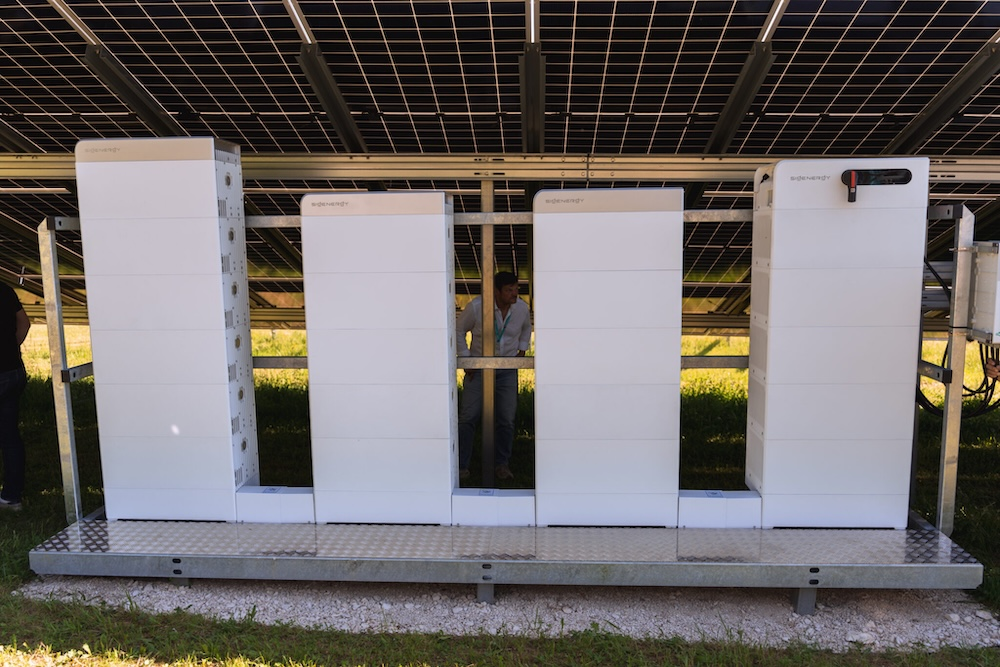
Grid constraints remain a practical barrier for high-power rollout. GRIDSERVE has been piloting battery storage solutions with Ameresco, National Highways, and Roadchef to maintain consistent high-power charging at constrained locations. Battery-backed charging can reduce the immediate grid-capacity requirement, smooth peak demand, and support ultra-rapid charging where network reinforcement would otherwise delay deployment.
That combination of charging and storage is appearing across several parts of the market. Temporary and constrained sites are increasingly being served by battery-backed rapid charging systems designed to reduce dependence on immediate grid capacity. For motorway service areas and freight corridors, the same principle applies at larger scale: site energy must be managed as actively as the charging hardware itself.
The charging market is now dividing into more specialised segments. En-route ultra-rapid charging, destination charging, workplace charging, fleet depots, eHGV corridors, and residential charging all have different electrical and commercial requirements. GRIDSERVE’s focus on motorway and strategic road-network infrastructure places it in the high-utilisation, high-power segment, where reliability and location quality are decisive.
Autocharge, launched by GRIDSERVE in 2025, adds another operational layer. Plug-and-go charging reduces friction at the charger, especially where fast turnaround is part of the service value. Payment reliability, charger identification, remote monitoring, and session data are becoming part of the operational architecture of charging networks alongside power electronics and grid connection design.
Long-term investors TPG Rise Climate and Infracapital continue to back the company’s expansion. Charging infrastructure development still depends on patient capital, particularly where grid works and site development precede revenue generation. The investment case strengthens as utilisation rises, but deployment remains front-loaded and dependent on connection capacity, site access, maintenance capability, and policy stability.
GRIDSERVE’s 2025 results show that a large UK ultra-rapid charging network can move into positive earnings while still expanding. The next stage will be shaped by power availability, eHGV demand, battery-backed sites, and the ability to maintain high availability as the network grows.