IN Brief:
- A critical blower failure took an FCC unit off line at Lavera, France.
- A temporary, oil-free air system combined thermal and electric compression at scale.
- Stage V power generation supported the deployment, with commissioning completed within weeks.
A critical equipment failure at Petroineos’ Lavera refinery in France triggered a rapid mobilisation of temporary air production and power equipment to stabilise operations and limit downtime risk on a key process unit.
The failure hit the air blower serving the site’s fluid catalytic cracking (FCC) unit. With the blower out of action, the unit was taken off line, creating an immediate threat to production continuity given the FCC’s central role in converting heavier fractions into higher-value products.
Petroineos and Aggreko developed and deployed a temporary solution under a two-month window, spanning initial consultation, engineering clarification, delivery, installation, and commissioning. The installation was sized to cover two operating modes on the FCC, with flow rates set to meet different operating scenarios.
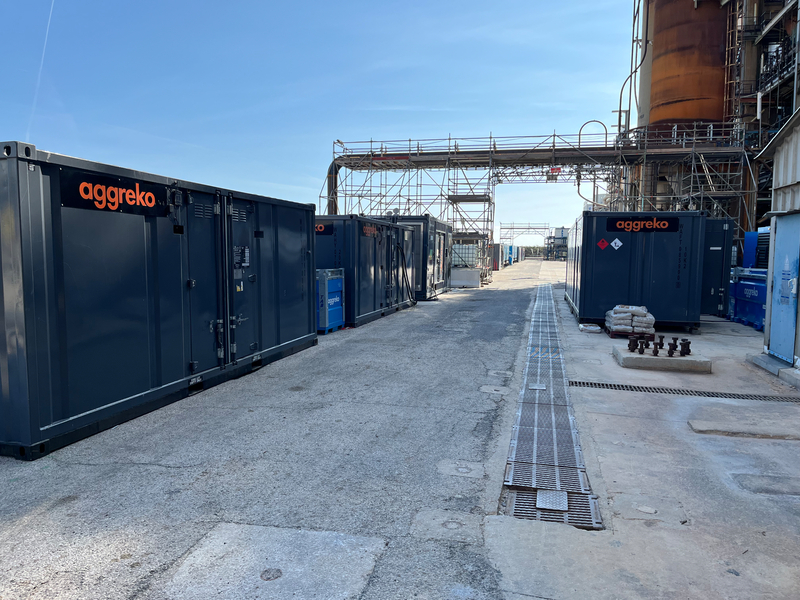
The deployed package combined 32 Stage V-compliant thermal and electric compressors, supplying 2,000 tonnes of oil-free air aligned with Class 0 ISO 8573-1 requirements. On the power side, the installation included two PowerMX2 Stage V generators plus four 600 kVA generators, intended to limit carbon monoxide, nitrogen oxide, and particulate matter emissions while optimising fuel consumption under varying load conditions.
A final week was dedicated to testing and commissioning to verify operational readiness and performance before full deployment. The result was continued FCC operation for 45 days, allowing the refinery to maintain production continuity while remedial work progressed.
A Petroineos spokesperson said: “We have worked with Aggreko since 2017 – they know how we work, and this was vital to avoiding an unplanned plant shutdown when the FCC unit failed. The compressors they were able to provide, all within record time, meant we were able to avoid further unscheduled downtime and limit the financial impact of the unit’s unexpected failure.”
They added: “Situations like these are very fraught, so we appreciated the responsiveness of the Aggreko team and the round-the-clock support they were able to offer. It’s not an exaggeration to say this could’ve been a crisis if not for their swift intervention.”
Gilles Revial, Petrochemical and Refining Sector Manager, South of Europe, at Aggreko, said: “Considering the extremely tight timescales on this project and the consequences of any delays or failures, these insights were crucial in helping us develop and deploy this bespoke compressed air solution.”
Temporary compressed air and power packages are becoming a more common resilience tool for refineries managing ageing equipment, tight turnaround windows, and constrained spare capacity, particularly where a single failure can cascade into multi-unit disruption.