IN Brief:
- AMPECO has launched CoOperator, an AI operations agent embedded in its EV charging management platform.
- The tool is designed to analyse failed sessions, rejected authorisations, offline chargers, and other operational faults, then recommend or execute actions.
- The launch points to a wider shift in charging software from dashboard-based monitoring towards conversational, workflow-driven operations.
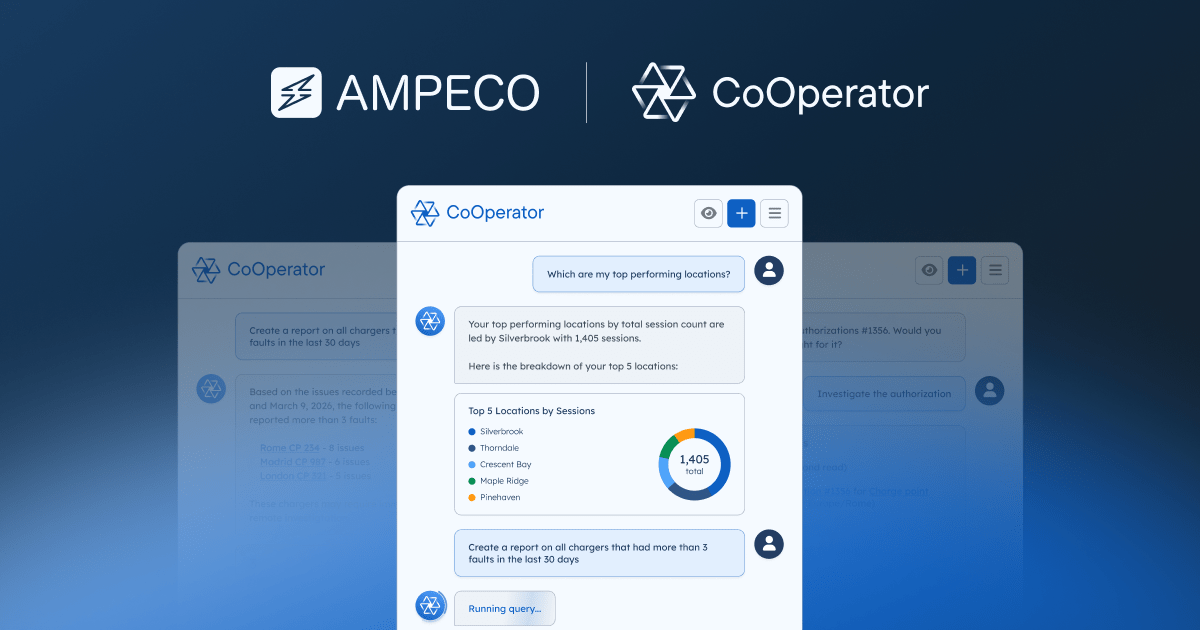
AMPECO has launched CoOperator, a new AI-powered operations agent for EV charging networks that is designed to reduce the manual work involved in fault tracing, network monitoring, and routine back-office changes.
The product sits inside the company’s charging management platform and is structured around three layers: information, analysis, and actions. In practical terms, that means operators can query the platform in natural language, investigate why a charger is offline or a session has failed, and then move from diagnosis to operational changes without leaving the workflow.
AMPECO is positioning the diagnostic layer as the main operational gain. CoOperator is built to identify the root cause behind failed authorisations, including expired tokens, payment issues, network failures, and business-rule conflicts. It can also analyse hardware faults and connectivity losses, assess whether a problem is isolated or affecting a wider part of the fleet, and generate a recommended repair path.
That matters because charging networks are becoming harder to run at scale. Operators are now dealing with mixed hardware estates, multiple payment and roaming relationships, changing regulatory requirements, and rising uptime expectations from site hosts and drivers. Under those conditions, time spent navigating logs, release notes, configurations, and device-level data quickly becomes a commercial issue as much as a technical one.
AMPECO says CoOperator draws on live charging data, technical documentation, the platform codebase, and operator-specific system configuration. The company is also leaning heavily on the security architecture around that data. It says each instance is deployed to the operator’s own infrastructure, access remains scoped to the user’s permissions, and AI providers process data only to generate a response rather than retain it. Consequential actions are previewed before execution, with audit trails preserved by default.
The launch also introduces a roadmap beyond diagnostics. AMPECO has already set out plans for a “CoOperator Workforce” in Q2 2026, intended to handle configured routine tasks in the background rather than only respond to prompts. That would move the platform further from a support tool towards something closer to an operational layer in its own right.
Whether that shift holds up will depend on how consistently AI can interpret the fragmented realities of field hardware, comms failures, and charger-specific error behaviour. Even so, the direction is becoming harder to ignore. As charging estates grow, network operations software is moving beyond visibility and towards automated interpretation, with vendors competing on how quickly they can turn raw fault data into usable action.
Operators already on the platform can activate the tool through the marketplace, while prospective users can book a demo.