IN Brief:
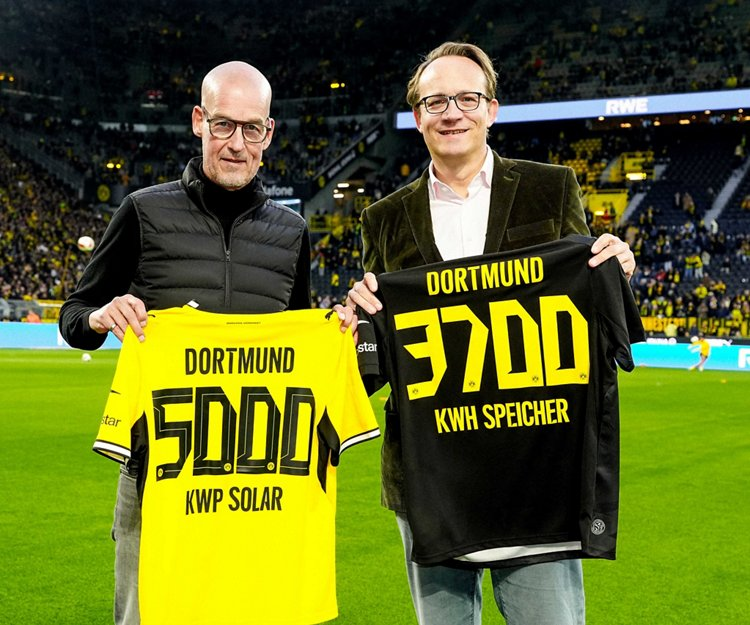
- RWE and Borussia Dortmund have commissioned a 3.7 MW battery at Signal Iduna Park.
- The battery is coupled to a rooftop solar installation exceeding 5 MWp.
- The developers say the solar array can meet up to 45% of stadium electricity demand.
RWE and Borussia Dortmund have commissioned a 3.7 MW battery storage system at Signal Iduna Park, bringing together electricity storage and a stadium-scale photovoltaic installation in the German city. The companies formally marked commissioning on 26 October, following the start of operation of the solar system in December 2025. The battery can deliver its rated 3.7 MW power output for slightly more than one hour, according to RWE. Its connection to the solar installation allows some electricity produced in daylight to be stored and used later, rather than requiring generation and consumption to coincide.
The existing photovoltaic array contains 11,132 solar modules and has installed capacity exceeding 5 MWp. RWE and the football club say the solar installation could meet up to 45 per cent of the stadium’s electricity requirements. That figure is expressed as potential contribution, not a statement of measured annual self-consumption after battery installation. The relationship between the solar peak rating and the battery power rating is also important: MWp describes the photovoltaic system’s rated peak output under reference conditions, while MW specifies the battery’s delivery capability at a particular moment.
The combined system is intended to deal with the difference between the hours when solar electricity is generated and the pattern of demand at a major venue. A stadium uses electricity for lighting, services, equipment and other activities, and events can concentrate requirements into periods outside strong daylight. Charging a battery during available generation creates an option to use that electricity later. It does not increase the total electricity harvested from the sun, and losses occur during charging, storage and discharge. The benefit is greater control over the timing of consumption and the use of the on-site installation.
RWE stated that the new storage system delivers its maximum power for just over one hour. That statement should not be translated into a precise published megawatt-hour capacity without the manufacturer’s underlying technical specification. Power and energy are not interchangeable measures: a battery can be designed for high discharge power and relatively short duration, or for a lower power output over many hours. For this project, the reported duration suggests an operating role that can bridge near-term changes in stadium consumption, rather than providing many hours of full-load power at rated output.
The venue’s solar and storage projects form part of a broader partnership between the energy company and the club. The partners previously installed photovoltaics on the BVB FanWelt building before completing the larger stadium roof system. The battery is the most recent part of that combined programme. RWE says work will continue on optimising the stadium’s energy management under a six-year relationship. RWE has not specified an additional generating facility or a grid-export contract for the newly commissioned battery.
For designers of large commercial electricity systems, this type of installation highlights several engineering decisions. Energy management controls must coordinate production forecasts, battery state of charge and expected site demand. Conversion equipment must maintain electrical quality and operate within the constraints of the local connection. Protection and metering are required to distinguish electricity being produced, stored, consumed and, where permitted, delivered to the network. The organisations have not released the electrical single-line diagram or full supervisory control configuration, so particular operating modes should not be asserted as already implemented.
Borussia Dortmund chair Carsten Cramer described the project as part of the club’s wider decarbonisation programme. RWE chief executive Markus Krebber said the combined assets were now operational and would allow more flexible use of stadium solar power. Their statements focus on how the system can work together, rather than on an independently audited emissions reduction after commissioning. The practical environmental benefit will depend on how much solar electricity is actually consumed at the venue, the operating strategy for the battery and the electricity displaced from elsewhere.
Although modest relative to utility-scale batteries, the 3.7 MW installation provides a concrete example of coupling local generation with storage at a large electricity customer. The project is already commissioned, unlike announcements that describe planned capacity or regulatory consent alone. The next measurable outcomes would be actual energy flows, site consumption and operating performance over events and seasons. The partners have not published those results. For now, Signal Iduna Park has a working photovoltaic and battery system whose stated purpose is to improve the timing and utilisation of local renewable electricity.