IN Brief:
- Enviromena has purchased the 27.5MWp Parkgate solar development near Braintree from Innova.
- The consented solar site has an Allocation Round 6 Contract for Difference and targets summer 2028 energisation.
- The proposed wider partnership covers 233MWp of solar, including the initial Parkgate acquisition, and 75MW of associated battery projects.
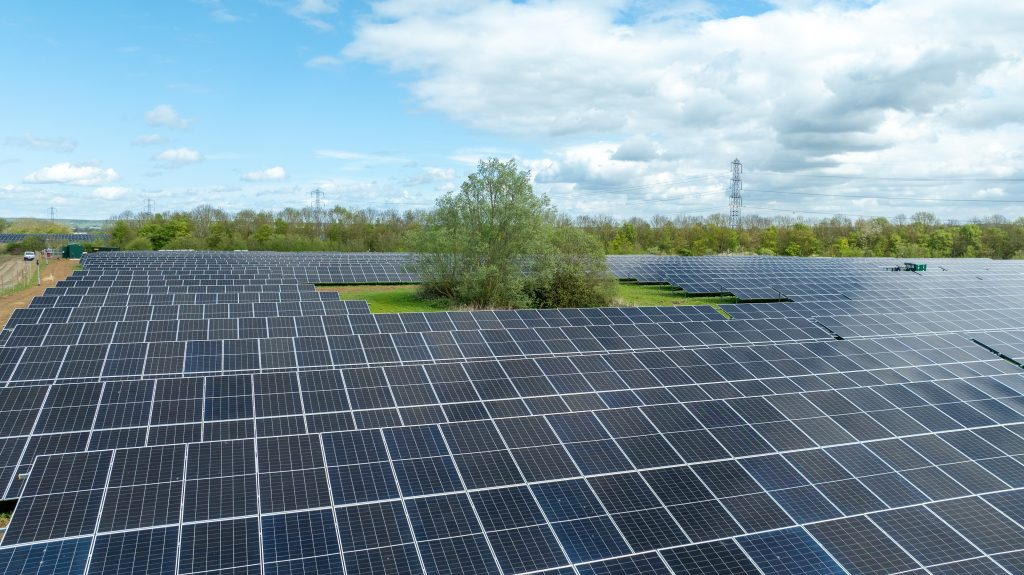
Enviromena has acquired the consented 27.5MWp Parkgate Farm solar development near Braintree, Essex, from Innova Renewables, completing the first transaction under a proposed wider UK solar and storage partnership. The site has a Contract for Difference awarded through Allocation Round 6, but its electricity output is forecast rather than operational: energisation is targeted for summer 2028.
The companies disclosed the transaction on 22 October. Enviromena estimates that Parkgate will produce more than 28,000MWh of electricity annually once operating, equivalent to the annual consumption of more than 10,000 homes under the company’s comparison. Both figures are projections and depend on the installation being constructed, connected and brought into service; they do not describe energy already delivered from the site.
Enviromena expects the partnership to cover 233MWp of solar and 75MW of associated battery projects, with further acquisitions sought before the end of 2026. The 233MWp describes the intended wider relationship, with the 27.5MWp Parkgate purchase its first completed transaction. The statement does not give a separate finalised list or value for each prospective transaction, and no purchase price for Parkgate has been disclosed.
Parkgate’s stated 27.5MWp rating describes the peak direct current output of its photovoltaic modules under defined test conditions. Actual generation changes with irradiance, temperature, panel orientation and electrical losses. Power from the modules must pass through inverters before being exported as alternating current, and a project’s peak module rating is not necessarily the same as the permitted capacity at its grid connection.
Delivering a 27.5MWp photovoltaic project requires a design that accommodates modules, mounting structures and direct current collection circuits, as well as inverter and transformer equipment capable of exporting power under the agreed connection conditions. The earthing, protection, metering and monitoring systems must be coordinated with the installation’s electrical layout. Enviromena has not disclosed a final equipment specification or identified a construction contractor for Parkgate, so those components describe normal engineering requirements rather than confirmed purchase orders.
The site’s Contract for Difference provides a defined commercial framework for eligible electricity production when the project starts generating. Under the UK scheme, the agreed strike price is compared with a market reference price; differences can result in payments to the generator or payments back when the reference price is higher. Awarding a contract supports revenue planning, but does not mean that the farm has completed construction or met all requirements for commercial operation.
Parkgate secured support in Allocation Round 6 and Enviromena describes the site as fully consented. Neither development resolves all remaining delivery tasks. The company still needs to complete detailed engineering, procurement, construction, connection testing and commissioning to meet its summer 2028 target. The 22 October statement does not confirm that physical construction has begun or establish a firm energisation date.
Grid connection work establishes how the plant will exchange electrical power with the local network while remaining within its operating limits. Inverters need appropriate controls for voltage and frequency conditions, while protection systems must detect faults and isolate unsafe equipment. The completed installation also needs metering and communication arrangements for its generation and market obligations. The extent of those works at Parkgate has not been itemised publicly.
The 75MW battery figure relates to projects in the proposed broader partnership. It measures power capacity, not the stored energy available for discharge: no MWh rating or discharge duration is provided. Storage can absorb and subsequently export electricity within the limits of its controls, charge level and grid connection, but the announcement does not establish that Parkgate itself will include a battery installation.
Further sales may transfer additional Innova developments to Enviromena in the coming weeks. The proposed portfolio has not yet been acquired in full, and the announced solar and battery totals should not be presented as generating assets already under Enviromena’s ownership. Its eventual make-up will depend on the projects that are actually transferred and the completion of each site’s engineering and delivery programme.
Enviromena has an existing operating presence in Essex through the 71MWp Medebridge Solar Farm near South Ockendon, which it says has been operational since September 2025. Parkgate would be the company’s second large solar installation in the county if brought into service as planned. The two projects differ in development stage, with the former generating electricity and the latter awaiting construction and energisation.
Parkgate’s projected annual output will depend on module orientation, solar irradiance, inverter availability, electrical losses, maintenance and any export restrictions. At 28,000MWh annually, the published estimate provides an indication of expected energy production but cannot establish output in a particular hour or during a winter peak. The capacity and generation figures answer different questions: MWp measures rated photovoltaic module power, whereas MWh measures energy over time.
The immediate project milestone is the intended energisation in summer 2028. Until the installation is built and tested, Enviromena’s completed acquisition is a transfer of a consented development rather than the addition of operational solar capacity. Any subsequent Innova portfolio disposals will require separate confirmation as their transactions complete.