IN Brief:
- GE Vernova’s Electrification business has signed a contract for the planned Windyhill 400 kV GIS package.
- SP Energy Networks confirms SF₆-free switchgear but does not establish the project-specific insulating gas formulation.
- Installation, testing and energisation remain future milestones within the broader transmission reinforcement programme.
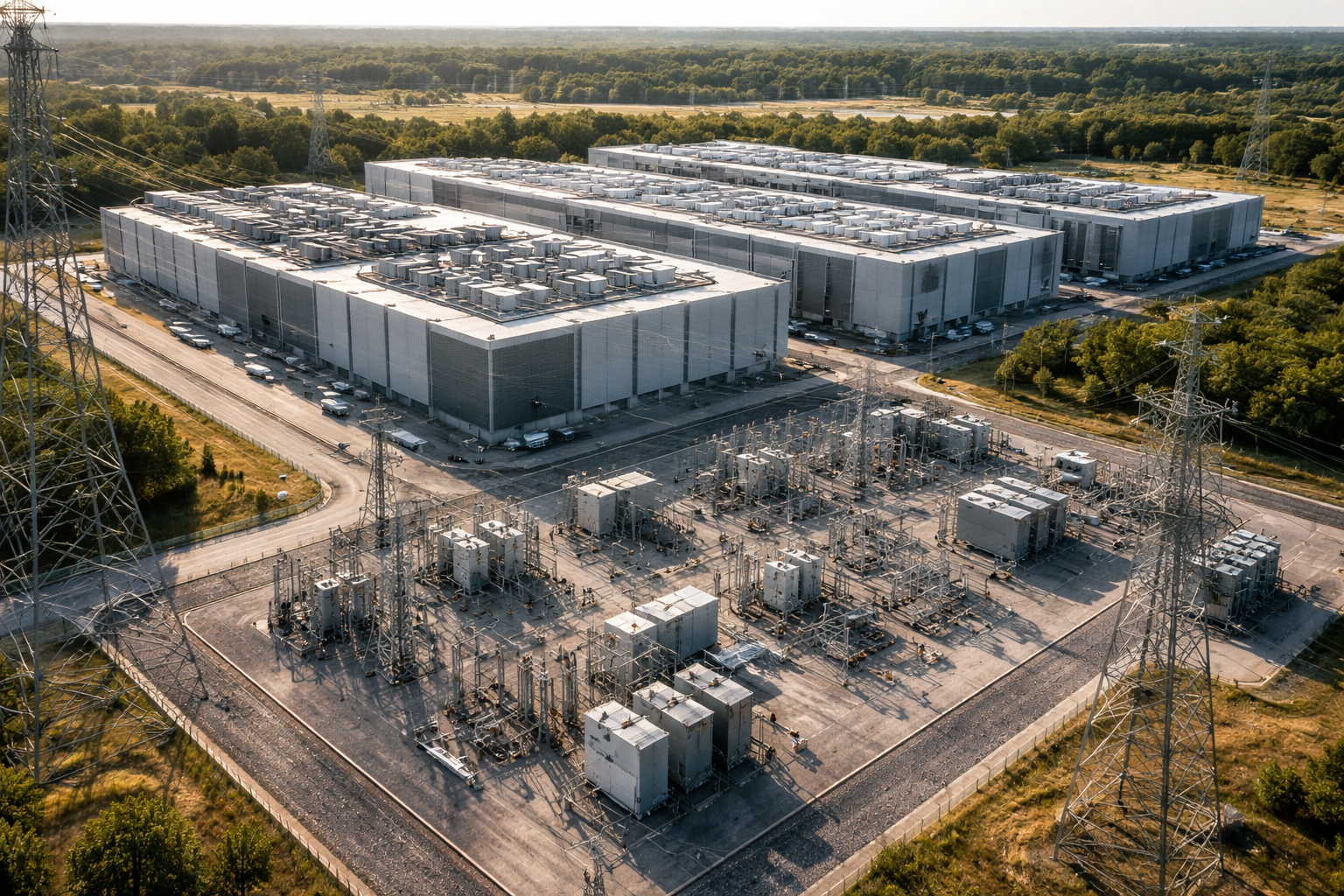
SP Energy Networks has signed a contract with GE Vernova’s Electrification business for gas-insulated switchgear (GIS) at the planned Windyhill 400 kV substation near Glasgow. The award forms part of the Windyhill–Lambhill–Denny North reinforcement programme, known as DLUP, and provides for switchgear technology that does not use sulphur hexafluoride (SF₆). The announcement confirms a signed supplier agreement, not that equipment has reached site, been installed or entered service.
The proposed 400 kV station is part of a wider upgrade to the west-of-Scotland transmission system, intended to accommodate electricity transfers as renewable generation and network flows increase. Existing elements of the Denny North–Lambhill–Windyhill corridor operate at 275 kV, and the programme involves additional works beyond this GIS package. Commissioned grid capability will depend on the full set of network changes, not simply the procurement of one group of high-voltage switchgear.
The 15 October agreement represents the equipment procurement stage. SP Energy Networks has not confirmed in that announcement the contract price, delivery milestones or a Windyhill-specific commissioning date. Factory production, site construction, installation, integration with protection and control systems, testing and energisation remain separate steps. Until these are completed, the future substation cannot be treated as an operational 400 kV network asset.
Gas-insulated switchgear contains high-voltage conductors and switching equipment within sealed enclosures, with insulating gas separating live components from grounded metalwork. The design allows a compact arrangement compared with many outdoor air-insulated substations, while still requiring control of electric-field clearances, enclosure integrity, switching transients and safe access for maintenance.
Traditional GIS commonly uses SF₆ for insulation and switching duties because its electrical properties enable compact high-voltage equipment. SF₆ is also a powerful greenhouse gas, so equipment design and maintenance have long required measures to control leakage, handling and recovery. SP Energy Networks states that its new Windyhill GIS will avoid SF₆, addressing reliance on that insulating medium while preserving the need for specified dielectric strength, interruption performance and long-term maintainability.
The operator identifies SF₆-free GIS as a feature of the Windyhill project but does not provide a project-specific specification establishing the exact alternative insulating medium, mixture or gas concentration to be installed. It would therefore be premature to assign a particular chemical formulation to Windyhill’s switchgear. Technical acceptance will depend on the contracted equipment meeting the relevant electrical, environmental and operational requirements rather than on a description of the supplier’s broader product portfolio.
At 400 kV, insulation design must account for high electric fields during normal operation and withstand temporary overvoltages during switching and faults. The switchgear must be integrated with protection relays, isolating arrangements, instrument transformers, control systems and a substation layout suitable for the relevant network configuration. Those engineering requirements remain regardless of the selected insulating medium.
The Windyhill development is broader than the equipment award. Earlier project documents describe establishing a new 400 kV substation, uprating an existing 275 kV circuit and improving the capability of the established overhead line route. The grid operator’s plans aim to increase transfers within the west-of-Scotland transmission system as more renewable electricity becomes available from the north.
The relationship between network voltage and transfer capability is important but not automatic. A higher operating voltage can move a given amount of three-phase power with lower current, all else equal, which can reduce resistive losses and improve the utilisation of a transmission corridor. The real capacity gain also depends on conductors, thermal ratings, transformers, switchgear, stability limits and operating constraints elsewhere on the network.
The new GIS must interrupt faults and maintain insulation across normal voltage conditions and transient stresses. Its circuit breakers, disconnectors, earthing switches, instrument transformers and relays will need coordinated ratings and protection settings to interface with the upgraded transmission system. The choice of SF₆-free insulation does not remove those engineering duties, and the announcement provides no project-specific factory acceptance or site test results to report.
Detailed equipment schedules and interfaces will determine how many GIS bays are supplied and how the new assets are commissioned alongside existing circuits. The signed contract does not itself confirm acceptance of a final installed switchgear layout. Electrical design reviews, factory testing, safe installation and functional checks will be needed before the operator can energise the completed equipment and use it to carry transmission power.
SP Energy Networks positions the contract within its RIIO-T3 investment programme and its objective of strengthening transmission capacity with lower-impact equipment. The Windyhill agreement advances a defined procurement package, while associated civil, electrical and network integration works still control when the wider reinforcement can be put into service. No completed Windyhill switchgear installation, confirmed operating date or measured lifetime emissions saving is established by the contract announcement.