IN Brief:
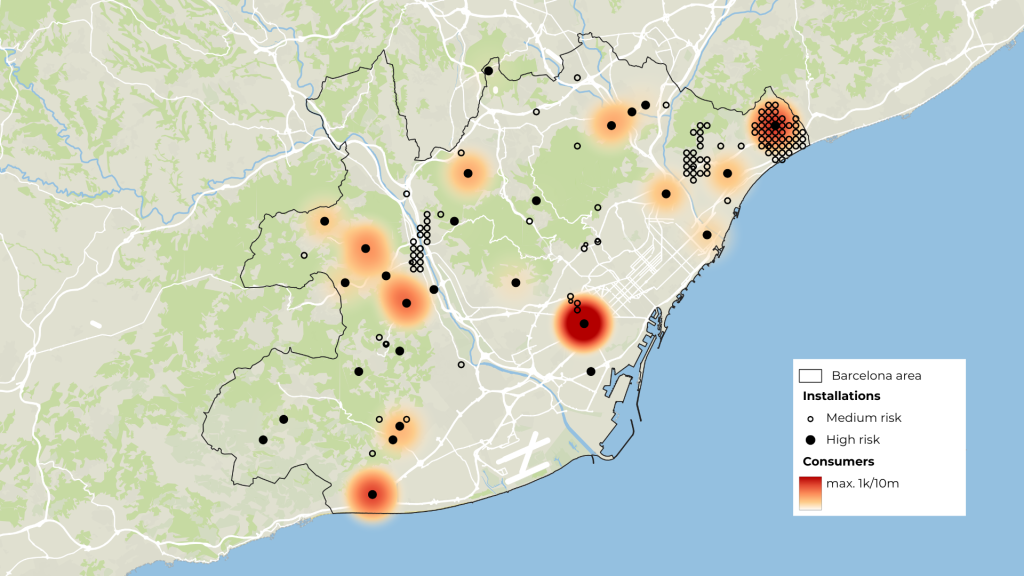
- IREC has mapped flood risks to substations, distribution assets, electricity users, and connected infrastructure across metropolitan Barcelona.
- Expected annual damage is estimated at €3–4 million, split approximately equally between direct infrastructure damage and wider impacts.
- The ICARIA methodology is intended to support adaptation planning and has been tested alongside case studies in Austria and Greece.
IREC has developed a planning tool to map and quantify flood risk across the electricity network of metropolitan Barcelona, combining the physical exposure of substations and distribution infrastructure with the financial consequences for customers and other critical systems when power assets fail.
The work forms part of the European ICARIA project and is intended to give public authorities a stronger basis for climate-adaptation investment. Rather than treating flooding as a broad regional hazard, the methodology links flood models with the location and function of electrical assets and then estimates the consequences of their loss.
IREC puts expected annual damage to the metropolitan electricity system at between €3 million and €4 million. Approximately half of that figure is attributed directly to damage to infrastructure, while the other half reflects impacts on electricity users and cascading effects on other infrastructure dependent on power availability.
The project has also modelled more severe but less frequent events. IREC estimates that an extreme episode comparable with a DANA weather system or Storm Gloria could produce approximately €5 million of electricity-system damage at the ten-year return period used in the analysis. That figure should therefore not be confused with the separate €3–4 million estimate for expected annual damage.
The distinction matters because the consequences of flooding extend beyond equipment physically touched by water. A distribution centre or substation can fail and disconnect customers outside the immediate flood zone, while electricity interruption can affect communications, transport, water, buildings, and other services whose own physical infrastructure may remain intact.
IREC’s methodology separates those direct and indirect effects. Substations and distribution centres form part of the exposed asset base, while the analysis also models consequences for consumers and cascading infrastructure. The resulting maps can identify locations where protecting a relatively small number of electrical assets may reduce a much wider service risk.
The underlying flood work has been developed during more than three years of the ICARIA project, led by Veolia and the Universitat Politècnica de Catalunya. Researchers have modelled compound events in which hazards such as intense rainfall, maritime storms, and wave action coincide rather than being treated as unrelated episodes.
For metropolitan Barcelona, the wider project estimates that areas vulnerable to serious rainfall-induced flooding could increase by as much as 25% over the next 75 years under the scenarios studied. That creates an awkward mismatch with electricity infrastructure whose replacement and reinforcement cycles can extend over decades.
A distribution asset selected for refurbishment today may still be operating as the hazard around it changes. Conventional investment planning based only on historical exposure can therefore understate future risk where rainfall intensity, coastal conditions, urban development, or drainage performance shift during the asset’s remaining life.
Distribution networks are particularly exposed to this planning problem because their assets are geographically dispersed. Large power stations and transmission substations attract obvious resilience work, but smaller substations, switching points, and feeders can sit close to drainage channels, roads, rivers, coastal areas, and dense development while serving substantial numbers of customers.
Quantifying the risk does not automatically identify the correct engineering intervention. Depending on the asset, adaptation might involve flood barriers, improved drainage, relocating equipment, raising sensitive electrical components, changing network configuration, providing redundancy, or accepting a known level of exposure where the cost of intervention cannot be justified.
The benefit of the mapping approach is that those measures can be prioritised against probability and consequence rather than applied uniformly. Protecting every electrical asset to the same standard would be expensive and could waste capital at sites with limited exposure or little wider system importance.
Ranking assets according to direct damage, customers affected, and cascading consequences gives planners a route to compare resilience expenditure with other network demands, including capacity reinforcement, reliability improvement, ageing-equipment replacement, and maintenance.
ICARIA is not limited to Barcelona. The project has also carried out case studies in Salzburg in Austria and the South Aegean Islands in Greece, covering hazards including flooding, heatwaves, maritime storms, extreme winds, and wildfires. The differing locations are intended to test approaches that can be transferred into adaptation planning elsewhere in Europe.
The method can be replicated more readily than the underlying numbers. Another city would still need its own flood, network, asset, and customer data because local topography, distribution topology, equipment design, redundancy, and underground or overhead construction can materially change the consequences of the same weather event.
For network operators, the useful step is the connection between environmental modelling and electrical-system impact. Knowing where water is likely to go is only part of a resilience plan; understanding which assets at those locations turn a local flood into a broader interruption provides the basis for targeted engineering investment.
Barcelona’s €3–4 million expected annual damage estimate gives the analysis a financial scale, but the more useful output is the ability to identify where that exposure sits. Resilience investment becomes easier to justify when planners can show which substations and distribution assets convert a weather event into a wider electricity-system failure.