IN Brief:
- Turntide has received its first production order for batteries used in Hitachi Rail intercity trains.
- The LFP packs will support diesel, overhead electric, and battery operation within a tri-mode fleet.
- Arriva Grand Central’s new trains are expected to enter passenger service during 2028.
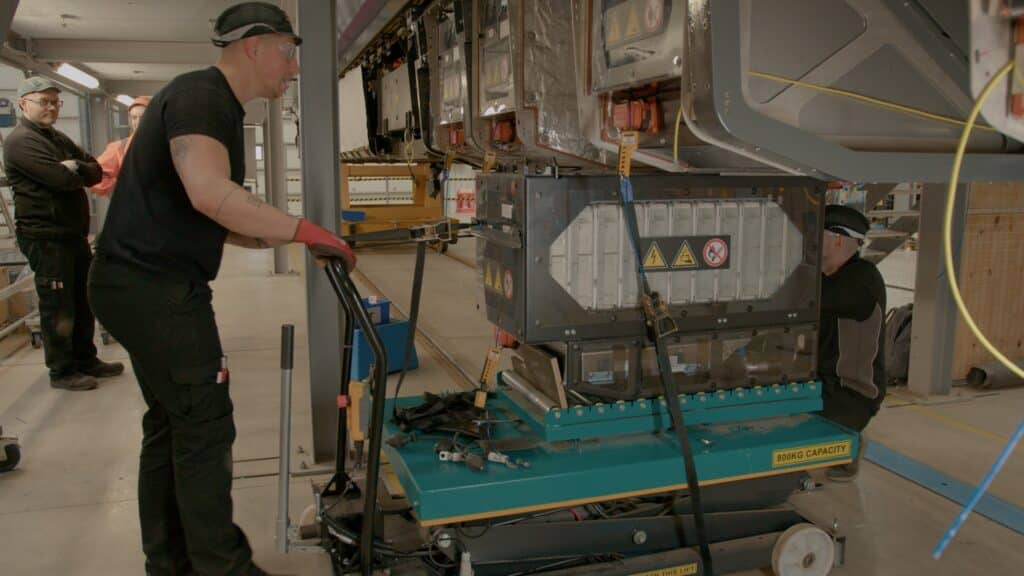
Turntide Technologies has moved into production of lithium iron phosphate traction batteries for Hitachi Rail after securing an initial order for Arriva Grand Central’s new tri-mode intercity fleet.
The order follows a research and development partnership announced in July 2025, with engineering work now progressing from design and validation into manufacture at Turntide’s Gateshead operation.
Once integrated into the trains, the batteries will operate alongside overhead electrical supplies and diesel engines. This tri-mode arrangement allows the fleet to use electrified infrastructure where available, run on battery power across suitable non-electrified sections, and retain diesel capability where route conditions require it.
Grand Central’s new trains will be assembled at Hitachi Rail’s Newton Aycliffe facility and are scheduled to enter passenger service during 2028. The wider fleet programme carries an estimated value of approximately £300 million.
Turntide’s second-generation lithium iron phosphate system has been designed to occupy broadly the same installation space as an existing diesel power module. Maintaining that packaging envelope supports integration into the new fleet and could provide a route for future retrofit work across compatible Hitachi trains.
Hitachi has identified more than 600 engines within its UK fleet platforms that could eventually be considered for replacement or partial substitution. Any retrofit programme would depend on route characteristics, structural integration, duty cycle, vehicle configuration, finance, remaining asset life, and the availability of charging opportunities.
Lithium iron phosphate chemistry is widely used where cycle life, thermal stability, and durability carry greater weight than maximum energy density. Rail applications nevertheless impose demanding requirements covering vibration, shock, fire behaviour, electromagnetic compatibility, environmental exposure, crashworthiness, and long-term maintainability.
The battery pack must operate as part of a wider traction system. Power electronics manage charge and discharge, while thermal control, battery management, isolation monitoring, fire detection, train communications, and protection keep the equipment within its approved operating limits.
Batteries bridge gaps in railway electrification
Continuous overhead electrification provides efficient high-capacity traction, but it requires substantial investment in masts, conductors, substations, clearances, bridges, signalling interfaces, protection, and route possessions. Battery operation can cover discontinuous sections without requiring every kilometre of a route to be wired immediately.
The approach is most effective where trains can recharge under overhead lines or at terminal facilities and where the non-electrified distance remains within practical range. Gradients, speed, stopping patterns, passenger load, heating, cooling, timetable recovery, and adverse weather all influence the energy required for a journey.
Regenerative braking can return energy to the battery when the surrounding electrical system cannot absorb it, reducing mechanical brake wear and improving overall efficiency. The pack must retain enough state-of-charge and thermal headroom to accept repeated high-power charging events during operation.
A 2024 Hitachi trial indicated potential fuel-cost reductions of between 30% and 50% in mixed operation, with zero-emission battery running possible across suitable sections. Route-specific modelling remains essential because results depend heavily on topography, service pattern, dwell times, electrification coverage, and seasonal auxiliary loads.
Battery mass also affects performance. Additional stored energy increases vehicle weight, which can reduce efficiency and alter axle loading. The engineering objective is therefore to install enough capacity to complete the duty reliably, with appropriate operational reserve, without carrying unnecessary weight.
Manufacture in the North East links battery-pack engineering with Hitachi’s established UK train-assembly base. Local capability can support design changes, validation, maintenance preparation, and through-life technical support, although the origin and long-term supply of cells remain relevant to industrial resilience.
Traction batteries will require planned replacement and recycling. Capacity will decline with age and use, and a pack may cease to meet rail requirements before it becomes unsuitable for less demanding stationary applications. Warranty and maintenance strategies must account for charging rate, temperature, route intensity, cycle depth, and actual energy throughput.
Battery trains do not remove the case for overhead electrification on intensively used routes. Where frequent high-power services operate throughout the day, fixed electrical infrastructure can provide greater energy efficiency and avoid carrying large onboard batteries. Battery systems can instead complement electrification where gaps, bridges, tunnels, or programme delays make continuous wiring difficult.
The production order moves the technology beyond a standalone demonstrator and into a passenger-fleet programme with a defined entry date. Manufacturing, route testing, approvals, depot preparation, maintenance systems, and staff training will now determine whether the fleet enters service as planned in 2028.