IN Brief:
- A €450 million EIB loan will finance most of a €600 million Austrian green hydrogen project.
- The 140MW electrolyser is designed to produce up to 23,000 tonnes of renewable hydrogen annually.
- A dedicated 22km pipeline will connect the plant to OMV’s Schwechat refinery.
OMV has secured a €450 million European Investment Bank loan for a 140MW renewable hydrogen plant under construction at Bruck an der Leitha in Lower Austria.
Covering nearly three-quarters of the project’s expected €600 million investment cost, the financing represents the EIB’s largest commitment to Austria’s energy sector. Commercial operation is scheduled to begin by the end of 2027.
Renewable electricity will power a large-scale electrolyser capable of producing up to 23,000 tonnes of hydrogen annually. Once commissioned, the facility is expected to become Austria’s largest renewable hydrogen plant and one of the five largest operating installations of its type in Europe.
A new 22km pipeline will carry hydrogen from Bruck an der Leitha to OMV’s Schwechat refinery, where it will progressively replace material produced from fossil feedstocks. Annual direct carbon dioxide emissions from the refinery could fall by as much as 150,000 tonnes, equivalent to around 10% of its present direct emissions.
The hydrogen will initially serve established refining processes, while the production platform could later support sustainable aviation fuel and other lower-carbon refinery products. Using an existing industrial consumer avoids the need to create an entirely new end market before the electrolyser begins operating.
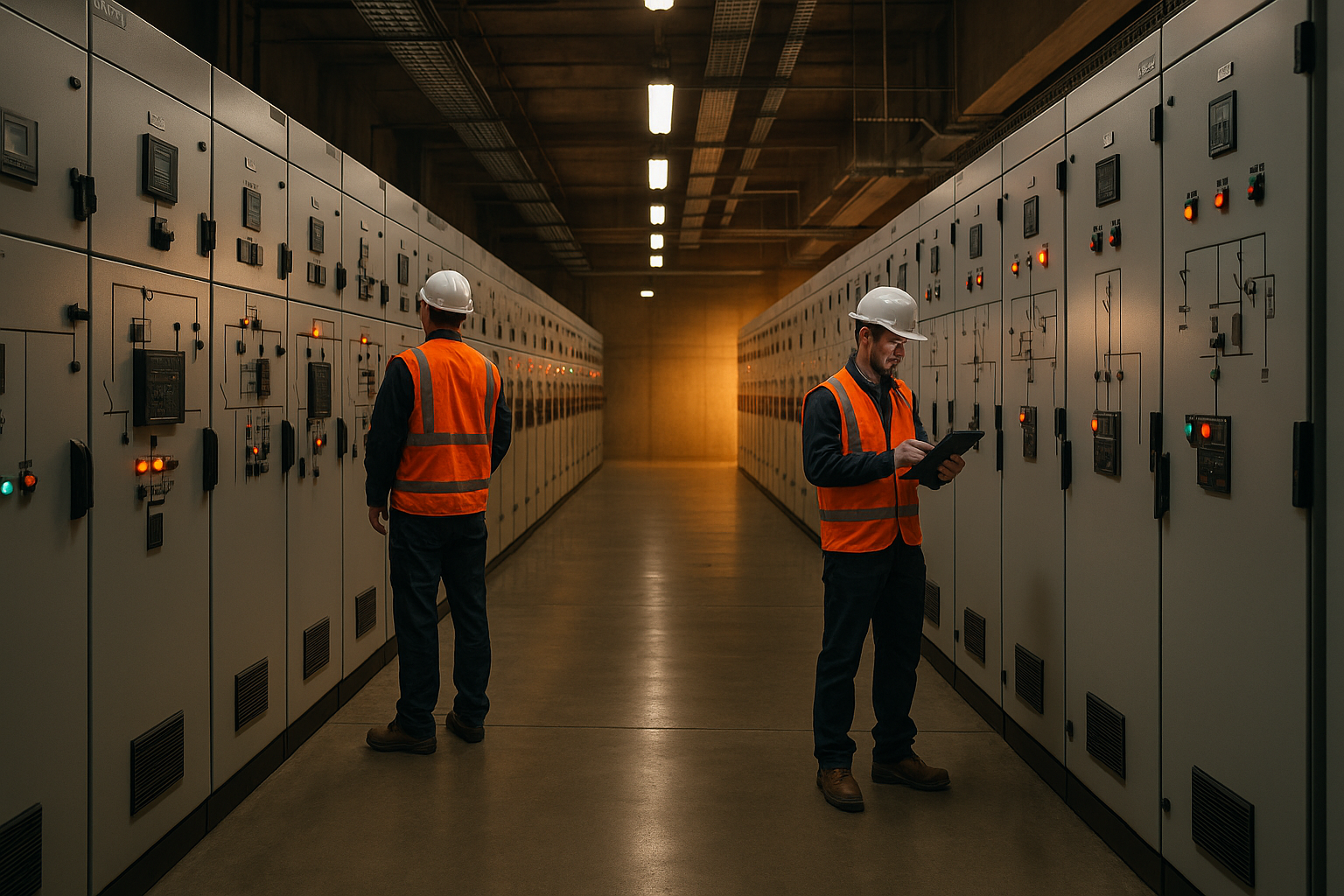
Beyond the electrolyser stacks, the electrical installation will require a substantial grid connection, high-voltage transformation, rectification, power-quality control, cooling, water treatment, compression, gas handling, auxiliary supplies, process control, and protection. Plant operation will be governed by both the refinery’s hydrogen demand and the availability and cost of renewable electricity.
Industrial electrolysis becomes a power-system load
At 140MW, the installation will operate on the scale of a large manufacturing facility rather than a demonstration project. Connection studies must account for fault levels, reactive power, harmonic performance, voltage stability, and rapid load changes created by power-electronic conversion equipment.
Although electrolysers can vary their consumption, the degree of flexibility available to the power system depends on downstream process requirements. A refinery needs a dependable hydrogen supply, which limits the extent to which production can simply stop during periods of high electricity demand or low renewable output.
Hydrogen storage, pipeline capacity, and process buffering can provide some separation between electricity consumption and refinery demand. The practical operating range will nevertheless depend on storage volume, compressor capacity, electrolyser turndown, maintenance requirements, and the contractual conditions governing supply to Schwechat.
Renewable sourcing introduces another layer of complexity. Annual procurement equivalent to the plant’s electricity use does not necessarily align hydrogen production with renewable generation at each hour. Direct power-purchase agreements, more granular matching, and controllable operation can produce a closer relationship between electricity consumption and available low-carbon output.
Replacing fossil-derived hydrogen also transfers part of the refinery’s energy requirement onto the electricity system. The emissions reduction therefore relies on sufficient renewable generation, network capacity, and operating arrangements that avoid increasing dependence on high-emission marginal generation.
Integrated projects combining wind, solar, batteries, and electrolysis are beginning to address those constraints. One European development combining renewable generation, storage, and hydrogen production uses batteries to manage power availability and improve the utilisation of shared electrical infrastructure.
The EIB loan reduces the capital barrier surrounding the Austrian project, although equipment cost forms only one part of its economics. Electricity procurement, grid charges, operating hours, compression, water treatment, pipeline maintenance, electrolyser degradation, and the value of displaced fossil hydrogen will determine its long-term cost.
Large electrolysers will also compete with other industrial and digital loads for connection capacity. Transformers, rectifiers, switchgear, control systems, and specialist engineering resources are required across several expanding sectors, leaving project schedules exposed to the same supply-chain pressures affecting conventional grid reinforcement.
Construction through 2027 will test the availability of large electrolyser packages and the ability to integrate high-power electrical equipment with refinery processes. The dedicated pipeline and its associated safety, metering, and control systems must be commissioned alongside the hydrogen plant and the receiving infrastructure at Schwechat.
Annual hydrogen production, electrical efficiency, equipment availability, renewable matching, and the quantity of fossil hydrogen displaced will provide the most useful measures of performance. Those operating results will help establish whether large refinery-based electrolysis can be reproduced economically across Europe’s industrial energy system.