
IN Brief:
- ADS-TEC Energy is presenting integrated charging, storage, and energy management systems at Power2Drive Europe.
- The company’s portfolio includes battery-buffered ultra-fast charging, stationary BESS, and intelligent control systems.
- The approach addresses high-power charging requirements in locations where grid capacity is limited or expensive.
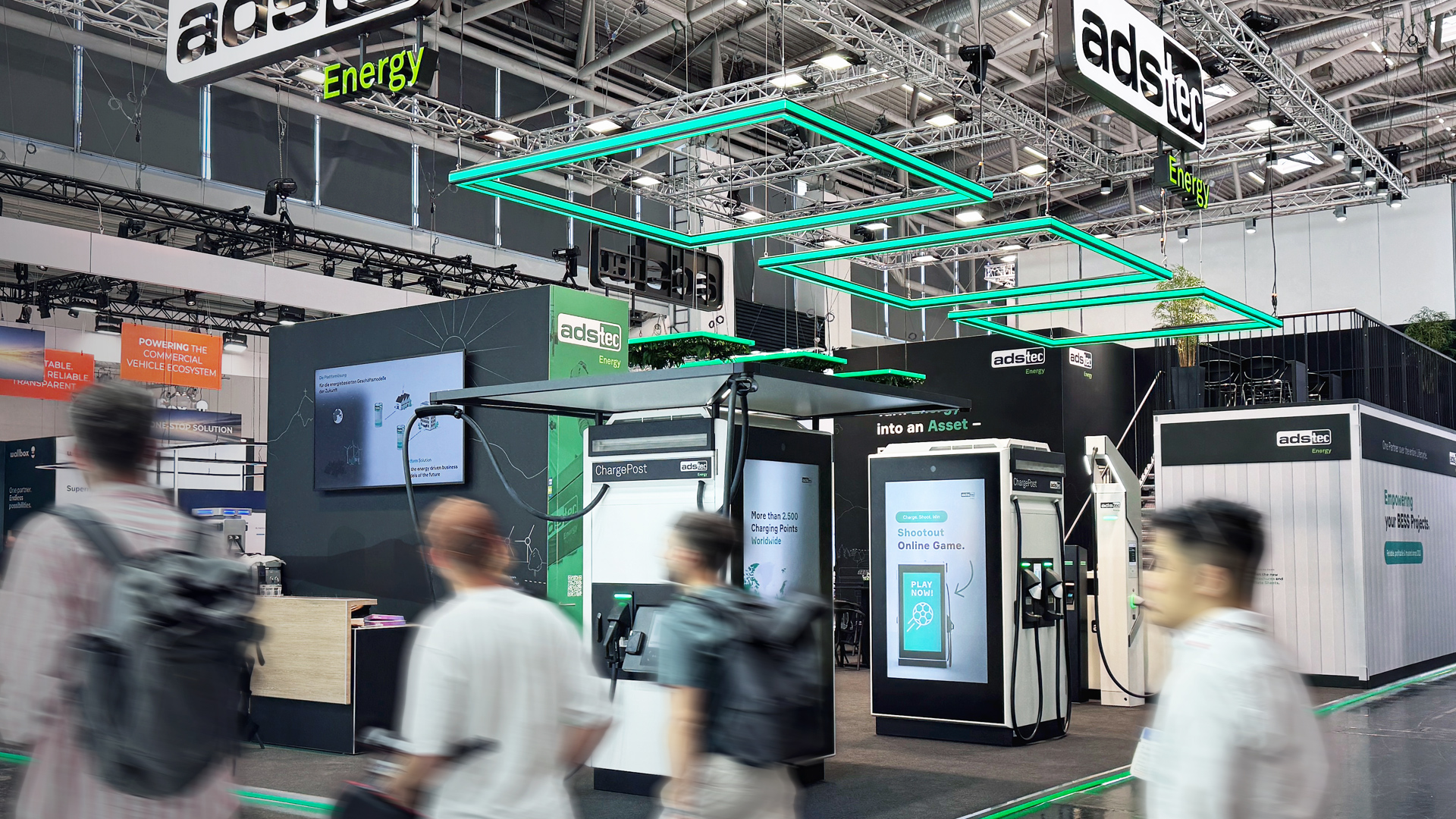
ADS-TEC Energy is presenting an integrated portfolio of battery-buffered ultra-fast charging, stationary battery storage, and intelligent energy management systems at Power2Drive Europe in Munich.
The company’s exhibition programme centres on systems designed to deliver high charging power from limited grid connections. The ChargeBox platform uses an integrated battery buffer between the grid supply and the charging load, enabling ultra-fast charging without requiring the same immediate reinforcement as a conventional high-power charger.
ChargeBox can deliver up to 320kW of charging power and is designed around a compact footprint for sites where connection capacity, space, and reinforcement cost are limiting factors. ADS-TEC is also highlighting ChargePost, an integrated charging system with bidirectional battery storage, energy trading capability, and optional advertising features.
The stationary storage range includes the BESS760, a 760kWh system for commercial and industrial sites, and the BESS5000, a 5MWh system intended for larger-scale energy arbitrage, flexibility markets, and grid services. Together, the portfolio presents charging, storage, and energy management as a single electrical infrastructure package.
High-power charging is increasingly constrained by the electrical conditions behind the charge point. Many suitable locations for fleet depots, public charging hubs, retail charging, and service-area infrastructure do not have sufficient grid capacity available at the required speed or cost. Battery-buffered charging gives site operators a way to deliver high output to vehicles while drawing power from the grid at a lower or more manageable rate.
The approach changes the design problem. Instead of sizing the connection solely around the maximum charging event, the system can charge an intermediate battery over time and discharge into vehicles when demand arrives. That can reduce peak import, ease reinforcement pressure, and make higher-power charging viable on constrained sites, although the battery must be sized carefully around utilisation, dwell time, recharge windows, and expected charging sessions.
Fleet electrification is making these constraints more visible. Logistics depots, construction fleets, municipal fleets, and heavy transport charging locations often need predictable charging within defined operational windows. A low-utilisation public charger and a fleet depot with clustered overnight charging create very different electrical profiles, even if both use similar charger ratings. Storage-backed systems need to be designed around those duty cycles rather than headline charging power alone.
Recent charging infrastructure projects, including heavy-duty truck charging work in Valencia and public hub development in Manchester, show how EV charging is increasingly functioning as power infrastructure. Connection capacity, storage, metering, load management, and site controls now sit alongside charger specification, payment systems, and user access.
Energy management is the technical layer that makes the model workable. A site with chargers, stationary storage, solar generation, building demand, and grid import limits needs controls that can prioritise charge sessions, preserve battery state of charge, prevent overloads, and respond to tariff or market signals. Without that coordination, battery-buffered charging can shift a constraint from the grid connection to the site electrical system.
The commercial balance also depends on whether the battery serves one function or several. A charging buffer may need to retain capacity for customer demand, while an asset used for energy trading may seek to cycle when market prices are favourable. A battery used for resilience needs reserved energy. Combining those roles can improve economics, but only where controls and operating rules prevent conflicts between them.
ADS-TEC’s portfolio is aimed at the part of the market where grid reinforcement is either too slow, too costly, or too large for the charging requirement immediately in front of the site owner. Battery-buffered charging will not remove the need for network upgrades as transport electrification scales, but it can change the sequence of deployment and allow more sites to operate before full reinforcement is available.

